


Nagaland Education Association holds a state-level workshop on Artificial Intelligence and SWAYAM in Kohima.
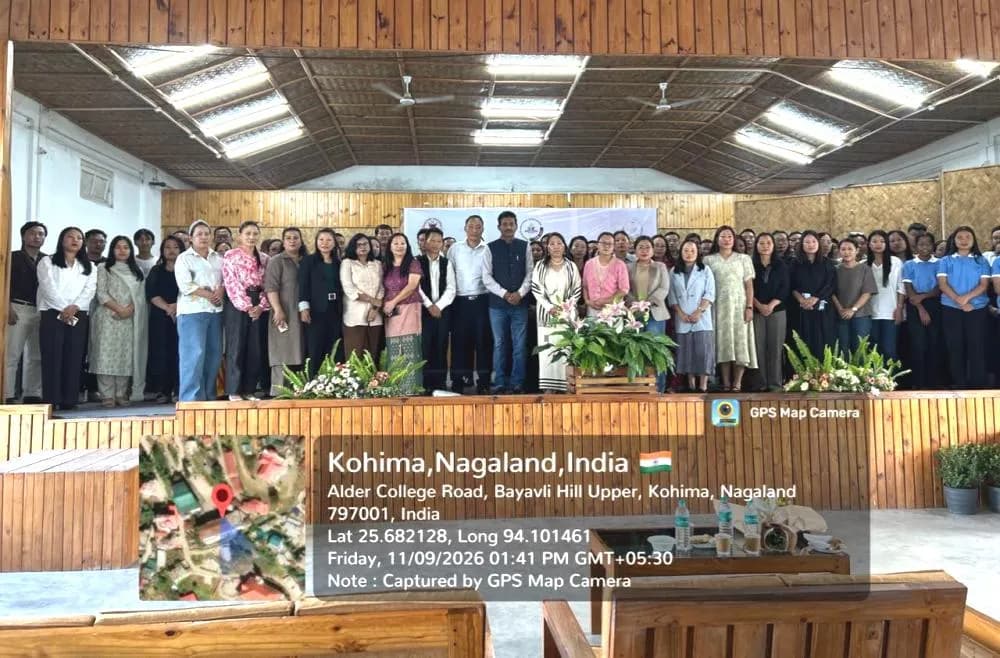
DIMAPUR — The Nagaland Education Association (NEA), in collaboration with the Department of Education, Nagaland University, and the Department of Education, Alder College, Kohima, organised a state-level one-day workshop on artificial intelligence (AI) and SWAYAM for teaching faculty at Alder College in Kohima on September 11.
In her address, Dr. Bweyhunle Khing, President of the Nagaland Education Association, highlighted the growing significance of AI in education and stressed the need to equip teachers, students, and educational administrators with the knowledge and skills required to engage effectively with emerging technologies.
Dr. Khing described education as the foundation of all professions, remarking that without teachers there would be no government officers and society could not function. She stressed that in the digital era, teachers must be active, responsible, dedicated, and well-informed about emerging technologies.
She added that investing in teacher training and professional development is an investment in the nation's future, and strengthening educational institutions is essential to building a peaceful society capable of competing globally.
The first technical session on ‘AI in education’ was conducted by Moasunep Kichu, Technical Officer in the Department of IT at NIELIT, Kohima. He introduced participants to the fundamentals of AI from an educator's perspective and outlined practical principles for its responsible use in teaching and learning.
He pointed out that AI will not replace teachers; rather, teachers who harness it effectively can reduce administrative burdens and create more time for meaningful interaction with students. He explained that AI can assist educators with repetitive tasks while teachers retain responsibility for pedagogical judgement, cultural understanding, creativity, and student care.
Kichu demonstrated a four-stage teacher-AI workflow and discussed prompt engineering and the application of AI in lesson planning, teaching preparation, research, and other academic activities. He encouraged teachers to treat AI as a "co-pilot, not an autopilot", stressing the importance of human oversight in all AI-assisted educational processes.
He also outlined the "4 Vs" of responsible AI use, namely verify, validate, value privacy, and vigilance, urging educators to apply these principles. He cautioned that excessive dependence on AI for academic tasks could weaken students' independent thinking and problem-solving abilities.
The second technical session on SWAYAM was conducted by Dr. B Venkata Rao, Associate Professor in the Department of Education at Nagaland University. He outlined the opportunities offered by SWAYAM and encouraged educational institutions to appoint dedicated SWAYAM coordinators to promote effective use of the platform.
Dr. Rao explained the importance of the Academic Bank of Credits (ABC) ID in relation to SWAYAM and the role of Massive Open Online Courses (MOOCs) in expanding access to flexible education. He noted that SWAYAM offers opportunities for students from disadvantaged and remote areas, in-service teachers, working professionals, and lifelong learners, enabling them to access courses at their own pace without tuition fees.