


Nagaland districts hold coordination meetings to implement Phase-I of the Reform Utsav campaign.
DIMAPUR — Multiple districts across Nagaland conducted coordination and sensitisation meetings on Tuesday to oversee the implementation of identified reform initiatives under Phase I of the Reform Utsav campaign.
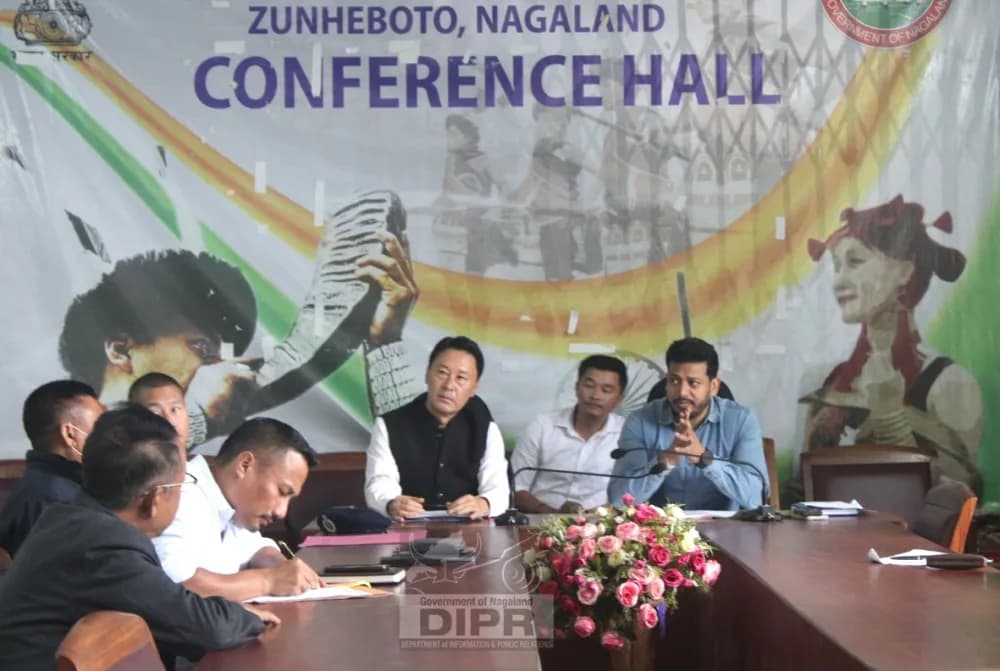
Zunheboto: A high-level district meeting was held at the deputy commissioner’s (DC) conference hall in Zunheboto, chaired by Secretary to the Government of Nagaland and State Nodal Officer for Zunheboto, Zarenthung Ezung.
According to a DIPR report, the discussions centred on prioritising campaign initiatives, citizen action groups, public suggestions through traditional and online platforms, policy feedback, and ease of governance.
The meeting also discussed constituting a District Coordination Committee with public participation, forming sub-divisional coordination committees particularly for the Akuhaito block, conducting visits by district officials to various blocks, preparing a District Action Plan, and engaging the district public relations officer to disseminate information. The Sub-Divisional Officer of PHED Olemlong Longkumer delivered a presentation on the implementation process.
Peren: In Peren, a district-level meeting was held at the DC conference hall, led by Commissioner and Secretary for Information Technology and Communication Arenla Jamir, who was accompanied by Director Sabou Yashu and other officials.
Jamir explained that the campaign, scheduled from October 2 to December, is a Government of India initiative aimed at engaging citizens directly to identify difficulties in accessing government services and seek suggestions to simplify processes.
She informed that the state government has constituted a State Level Coordination Committee, with her assigned as the State Nodal Officer for Peren and Chümoukedima districts.
The Reform Utsav portal will be launched on October 2, enabling citizens to submit suggestions. Jamir noted that the campaign involves identifying problems, deliberating on solutions, and implementing feasible reforms through three components: Jan Manthan, Vimarsh, and Jan Samadhan.
She identified healthcare, education, roads, power, and water as priority sectors in Peren, calling for focus on areas such as Tening, Ahthibung, and Nsong.
DC Peren Hiazu Meru delivered closing remarks, stating that instructions would be issued to sub-divisional officers to conduct awareness programmes.
Tseminyu: DC Tseminyu Japheth Woch informed that Reform Utsav is a nationwide, time-bound reform campaign launched by the prime minister to source and implement systematic reform suggestions towards Viksit Bharat 2047.
The campaign is structured around three pillars: Jan Manthan (Discover) from October 2 to October 30, Vimarsh (Deliberate) from October 10 to November 30, and Jan Samadhan (Delivered) from October 10 to December 20, centrally tracked through the portal.
These will be followed by Sankalp Siddhi from December 25 to the 27th to mark the culmination. Woch encouraged all citizens of Tseminyu district to actively participate by submitting suggestions once the portal becomes active.
Chümoukedima: The Chümoukedima district administration and district-level officers attended a state-level video conference review meeting on Sustainable Development Goals (SDGs) and the Reform Utsav 2026 campaign at the DC conference hall.
Principal Secretary and Development Commissioner Y Kikheto Sema gave a presentation on SDG performance across districts, noting that the goals consist of 16 targets and 84 indicators. He called for timely reporting and urged deputy commissioners to identify infrastructure gaps, while highlighting the three aspirational blocks in Nagaland: Akuhaito, Khongsa, and Thonoknyu.
Secretary for Industries and Commerce Kumar Ramnikant delivered a presentation on Reform Utsav. Addressing the gathering, DC Chümoukedima Polan John stressed that SDG implementation requires collective effort and urged departments to ensure proper data reporting and focus on lagging parameters.