


The Nagaland BJP defended the Viksit Bharat–G RAM G Bill, citing gaps and accountability issues in MGNREGA implementation.
Share


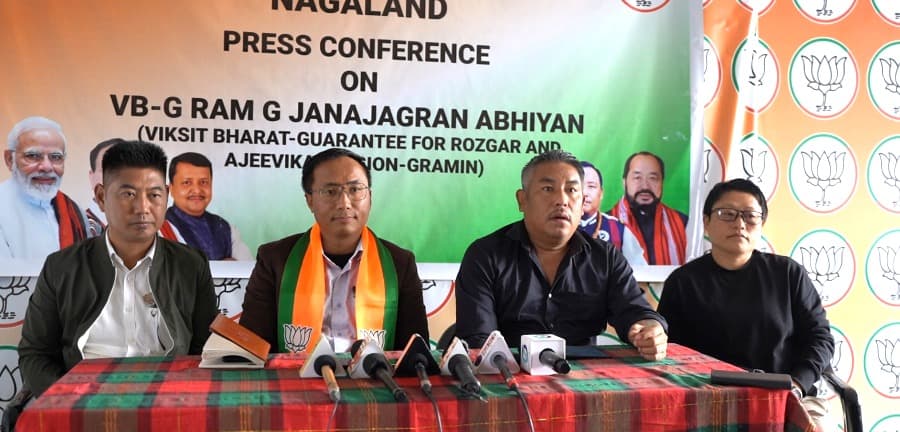
DIMAPUR — The Nagaland unit of the Bharatiya Janata Party (BJP) on Wednesday defended the proposed Viksit Bharat–Guarantee for Rozgar and Ajeevika Mission (Gramin) Bill, 2025, saying it seeks to address structural shortcomings in the implementation of the Mahatma Gandhi National Rural Employment Guarantee Act (MGNREGA).
Addressing a press conference in Dimapur, the party said that despite MGNREGA’s provision of 100 days of guaranteed employment per rural household, only 7.6% of households nationwide were able to avail the full entitlement in the 2024–25 financial year, based on figures cited by the party. The BJP said this left more than 93% of households without access to the scheme’s full benefits.
State BJP general secretary Sunep C Jamir said the proposed Bill was designed to respond to such gaps by restructuring the rural employment framework in line with the long-term Viksit Bharat 2047 vision.
The party also cited alleged misappropriation of around INR 193 crore during the same period, saying this highlighted weaknesses in monitoring and accountability under the existing system.
Jamir said the Viksit Bharat–G RAM G Bill proposes increasing guaranteed employment from 100 to 125 days and introducing technology-based monitoring tools such as artificial intelligence-driven oversight and geospatial tracking to reduce delays and leakages. He added that the revised framework includes provisions aimed at greater inclusivity, including support for persons with disabilities.
Also read: Congress to launch nationwide 'MGNREGA Bachao Sangram' from January 10 against G RAM G Act
The press conference was part of the BJP’s nationwide grassroots outreach to generate public awareness about the proposed Bill. BJP Dimapur district president V Shekishe Achumi, state general secretary Manai Konyak and BJP Media Cell convenor Nini Cheng were also present.
Jamir said the new bill takes into account changes in rural India since MGNREGA was enacted in 2005, including improved digital penetration, expansion of direct benefit transfers and infrastructure development. He referred to Census 2011 data showing that nearly 69% of India’s population lives in rural areas.
According to Jamir, the new framework shifts from a purely demand-driven approach to a structured model focusing on four priority areas: water security, rural infrastructure such as roads and solid waste management, livelihood infrastructure including storage facilities and self-help group support, and climate resilience.
On accountability, Jamir said the proposed Bill places responsibility on state governments under a normative budgeting system. Any delays in fund release or implementation, he said, would be borne by the state concerned, unlike the existing demand-based mechanism.
State BJP general secretary Manai Konyak said the proposed Bill is aimed at benefiting underprivileged rural communities and urged those who are not eligible to refrain from accessing benefits meant for the needy.