


NPF Central Farmers’ Wing will tour Nagaland from May 11 to the 25th to engage farmers and assess challenges.
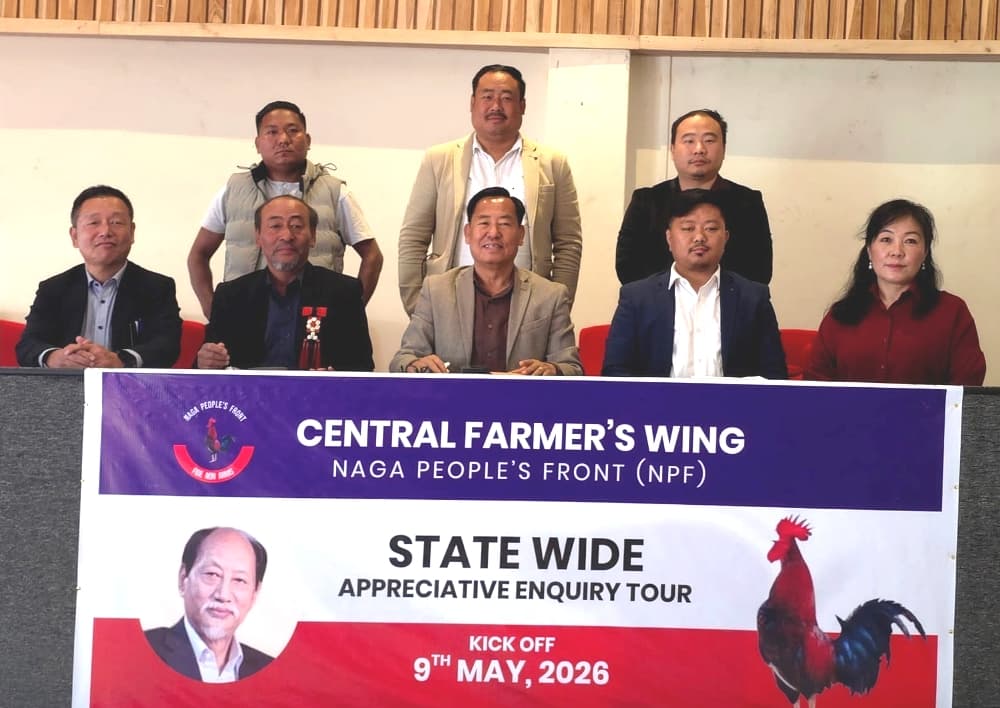
KOHIMA — The Naga People's Front (NPF) Central Farmers’ Wing on Saturday announced that it will undertake a "State-wide appreciative inquiry tour" from May 11 to the 25th.
The announcement was made during a press conference held at the NPF Central Headquarters in Kohima to mark the kick-off of the tour.
Addressing the media, Y Vikheho Swu, president of the NPF Central Farmers’ Wing, said the tour aims to directly engage with agricultural communities across Nagaland and understand the ground realities faced by farmers.
Swu said many farmers and entrepreneurs in the state have demonstrated exceptional initiative with or without government support.
He noted that several villages are celebrating their agricultural heritage through festivals featuring local products, creating sustainable livelihoods and economic benefits for families and communities.
Also read: NPF appoints Nangshikokba Longkumer as Central Youth Wing president
He also acknowledged the government’s contribution towards promoting agricultural activities through the distribution of seeds and saplings, provision of farming tools and machinery, and the identification of crop clusters to make farming more profitable and efficient.
He informed that the tour seeks to identify and acknowledge Naga farmers who are performing exceptionally well, recognise their efforts, and celebrate their achievements.
The farmers’ wing also plans to visit Krishi Vigyan Kendras (KVKs) and Agri & Allied departments to interact with officers and field officers to better understand their roles and contributions.
"The state has also seen visible increase in livestock production. We appreciate the role of the department, various financial houses and banks, the KVK and specially ICAR," Swu said.
Highlighting the challenges faced by the farming community, he said the farming sector in Nagaland is increasingly being sustained by the older generation as many youths are shifting towards white-collar jobs.
He also pointed to climate resilience as another major challenge, stating that unpredictable climate conditions have complicated traditional farming practices. He stressed the need for adopting climate-resilient crops and farming methods that can withstand environmental challenges.
On the shift from jhum cultivation to modern farming practices, Swu said the transition requires collective effort and decisions involving not only the government but also farming communities and villages.
He said while the state is gradually moving towards modern farming practices such as avocado, coffee, rubber and kiwi cultivation, jhum cultivation remains deeply connected to Naga culture, traditions and way of life.
"Jhum cultivation cannot be dropped. But how do we move from here to the modern farming? I think that’s something the policy making should take a decision involving the farming communities and the villages," he said.
Swu clarified that the farmers’ wing is not a developmental agency but acts as a mediating body between the government and farmers by recommending deserving cases to appropriate departments.
He informed that the tour has been divided into three groups.
Group A will cover Tuensang, Noklak, Shamator, Kiphire, Meluri and Phek; Group B will cover Mon, Longleng, Mokokchung and Wokha; while Group C will cover Tseminyu, Zunheboto, Pughoboto, Niuland, Chümoukedima, Peren, Dimapur and Kohima.
Meanwhile, Chikrokhoyo Kezo, general secretary of NPF Central Farmers’ Wing, said the tour is expected to benefit farmers through awareness and dissemination of information collected from various government departments related to agriculture and allied sectors.
He said the wing would also coordinate with departments to facilitate access to crops, seeds and other assistance for farmers.
Nguto Assumi, secretary and administrator of the NPF Central Farmers’ Wing, said nearly 70% of Nagaland’s population is engaged in farming activities.
He said the tour aims to understand how farmers in Nagaland are faring and how they can avail various schemes and benefits provided by the central and state governments.