


Supongmeren Jamir calls for consumer awareness on smart meters at DEC meeting under RDSS in Kohima district.
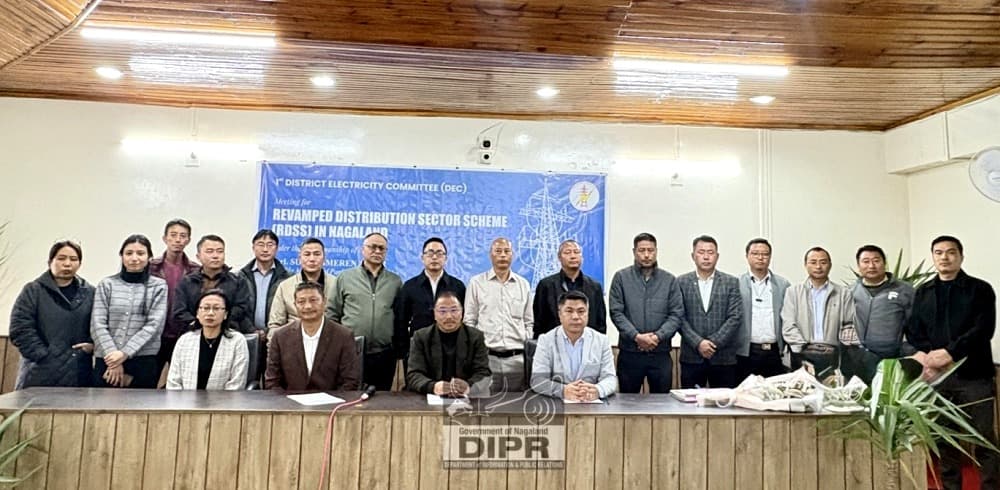
DIMAPUR — Member of Parliament, Lok Sabha, Supongmeren Jamir on Tuesday stressed the importance of creating awareness among consumers about the accuracy and benefits of smart meters.
Jamir, who is also the chairperson of the District Electricity Committee, urged the department to highlight the advantages of upgrading from conventional meters to smart meters so that consumers can better understand the system.
The MP was addressing the first meeting of the District Electricity Committee (DEC) under the Revamped Distribution Sector Scheme (RDSS) at the DC’s conference hall, Kohima, a DIPR report stated.
The MP thanked the officials for updating the members on the implementation of RDSS in the state.
Jamir sought updates on the electrification status in different districts and enquired about the reasons behind unelectrified and partially electrified habitations in Kohima district, where 27 habitations remain unelectrified and 14 partially electrified.
Also read: From health cover to highways: Governor Bhalla maps Nagaland’s growth story
It was also noted that the rapid mushrooming of new habitations in the district has contributed to the challenge.
He observed that if such numbers exist in Kohima district, similar situations may also be present in other districts and suggested that the department conduct detailed assessments and consumer reviews.
The Deputy Commissioner, Kohima, B Henok Buchem, who chaired the meeting, raised and discussed the implementation of smart metering and rooftop solar, asking the department to highlight their potential benefits for consumers and the importance of improving efficiency in the power distribution system.
He also stressed the need for coordinated efforts among departments and stakeholders for the effective implementation of the scheme in the district.
Presenting an overview of the RDSS, Additional Chief Engineer, Power department, Lobosang Jamir stated that the difference between power supplied and revenue realised from consumers should ideally be zero, but achieving this remains a major challenge in the state.
However, with the implementation of smart metering under RDSS, efforts are being made to address the issue.
He informed that the Ministry of Power, Government of India, launched the reforms-based and result-linked RDSS in July 2021 to improve the operational efficiency and financial sustainability of the power distribution sector.
Under the scheme, financial assistance is provided to strengthen distribution infrastructure subject to meeting reform targets.
Jamir stated that to expedite power sector reforms in the state, the State Level Distribution Reforms Committee (DRC) was constituted on January 31, 2022 under the chairmanship of the Chief Secretary.
At the district level, District Electricity Committees were constituted on July 14, 2022 as directed by the Government of India to monitor the implementation of RDSS and other power sector schemes.
He informed that under RDSS, projects have been sanctioned for the state, including the implementation of smart metering, loss reduction works, electrification of left-out households and engagement of a Project Management Agency.
The Additional Chief Engineer highlighted that the scheme aims to improve the quality and reliability of power supply, ensure a financially and operationally efficient distribution sector, reduce Aggregate Technical and Commercial (AT&C) losses to 12–15 percent and minimise the gap between the average cost of supply and average revenue realised.
He also stated that the state’s AT&C losses currently stand at around 43.93 percent for FY 2024–25, which poses a major financial challenge. To address this, smart metering is being implemented across the state.
Out of the total target of 3,23,878 meters, a total of 37,081 smart meters have been installed so far, including 36,249 consumer meters, 667 distribution transformer meters and 165 feeder meters.
The additional chief engineer further highlighted that the department has been facing challenges in the implementation of smart meters due to public resistance. He stressed the need for greater awareness and sensitisation among consumers regarding the objectives and benefits of smart metering.
He added that public cooperation would be important for the effective implementation of the scheme and for improving the overall efficiency of the power distribution system.
The meeting concluded with emphasis on strengthening awareness and sensitisation among the public on smart metering.
Members also highlighted the need to continue awareness campaigns, address public concerns, and ensure the proper functioning and transparency of the smart metering system.