


Salhoutuonuo Kruse urges educated youth to take up farming, highlighting agriculture as a sustainable livelihood and entrepreneurship opportunity at the 4th Jhum Fair in Chiechama.
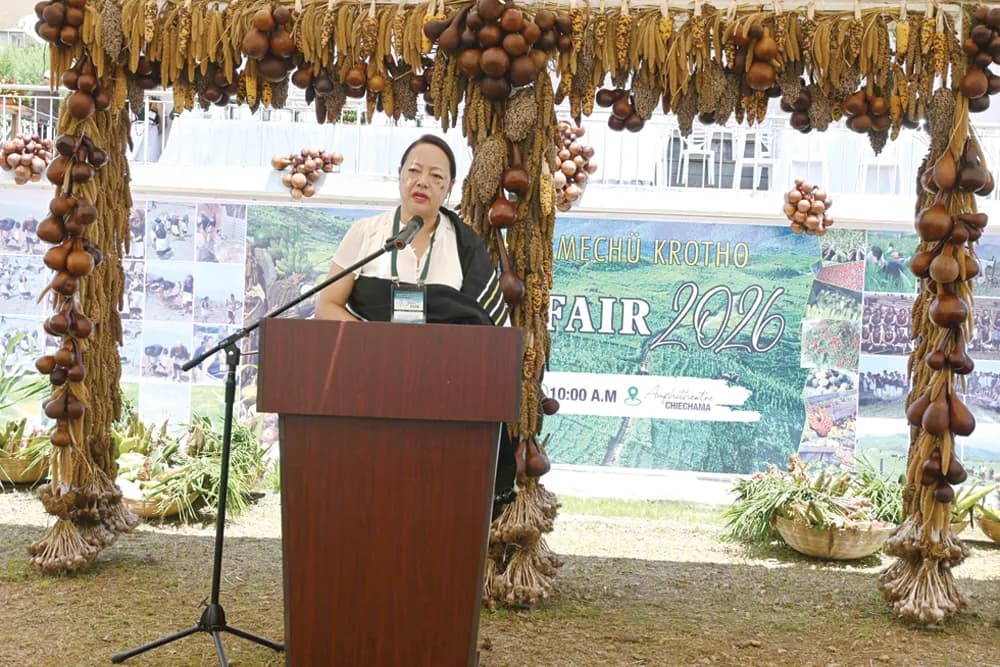
KOHIMA — Minister for Women Resources Development and Horticulture Salhoutuonuo Kruse on Saturday urged educated youth in Nagaland to take up farming, saying government employment opportunities had reached a saturation point and agriculture could provide sustainable livelihoods and avenues for entrepreneurship.
Kruse was speaking at the 4th annual Jhum Fair organised by the Chiechamiapfü Mechü Krotho (CMK) at the Amphitheatre, Chiechama, in Kohima district.
She said the fair was not merely a celebration of agriculture but also a reflection of Nagaland’s rich heritage, traditional knowledge, community spirit and the hard work of farmers.
Highlighting agriculture as the traditional foundation of Naga society, Kruse said farming had historically sustained communities not only by providing food but also by supporting their social, economic and cultural life.
She observed that agricultural practices in Nagaland were gradually changing due to population growth, commercialisation, government development programmes and the adoption of settled farming and modern agricultural techniques.
The minister highlighted various government schemes available to farmers, including the Rashtriya Krishi Vikas Yojana (RKVY), National Food Security Mission (NFSM), Pradhan Mantri Krishi Sinchayee Yojana (PMKSY), Mission for Integrated Development of Horticulture (MIDH) and Mission Organic Value Chain Development for North Eastern Region (MOVCD-NER).
Also read: Nagaland invites proposals for food irradiation units
According to Kruse, these schemes aim to improve farm productivity, irrigation, mechanisation, organic farming, horticulture, post-harvest management, value addition and farmers’ incomes.
She urged farmers in the area to make maximum use of the offices of the Sub-Divisional Agriculture Officer (SDAO) and Sub-Divisional Horticulture Officer (SDHO) to access government schemes and benefits.
Encouraging educated youth to enter the agricultural sector, Kruse said their involvement could help Nagaland transition from traditional subsistence agriculture to modern, sustainable, market-oriented and technology-based farming.
She stressed that adequate support through training, start-up assistance, infrastructure, market linkages and government schemes would be essential to make farming more attractive to the younger generation.
Kruse also highlighted the potential of organic farming in Nagaland, citing the State’s traditional farming practices, rich biodiversity, favourable climate and relatively low use of chemical inputs in many farming areas.
She called for agricultural practices that improve productivity while protecting soil and forests, conserving traditional crop varieties and strengthening farmers’ livelihoods.
The minister further called for special attention to women farmers, young people and small producers through improved technology, training, storage and processing facilities, credit and access to wider markets.
She urged farmers, self-help groups, cooperatives, scientists, government officials and entrepreneurs to work together to make agriculture more profitable, sustainable and resilient.
Kruse said the Jhum Fair should become a platform where “tradition meets innovation, agriculture meets enterprise and community meets opportunity.”
She congratulated the organisers, farmers and participants for making the event possible and expressed hope that the fair would strengthen commitment towards farmers and inspire the younger generation to respect and carry forward Nagaland’s agricultural heritage.
The programme was led by Avonuo Theunuo.