


Oken Jeet Sandham’s new book The Naga Talks explores deadlocks and complexities in the Naga peace process.
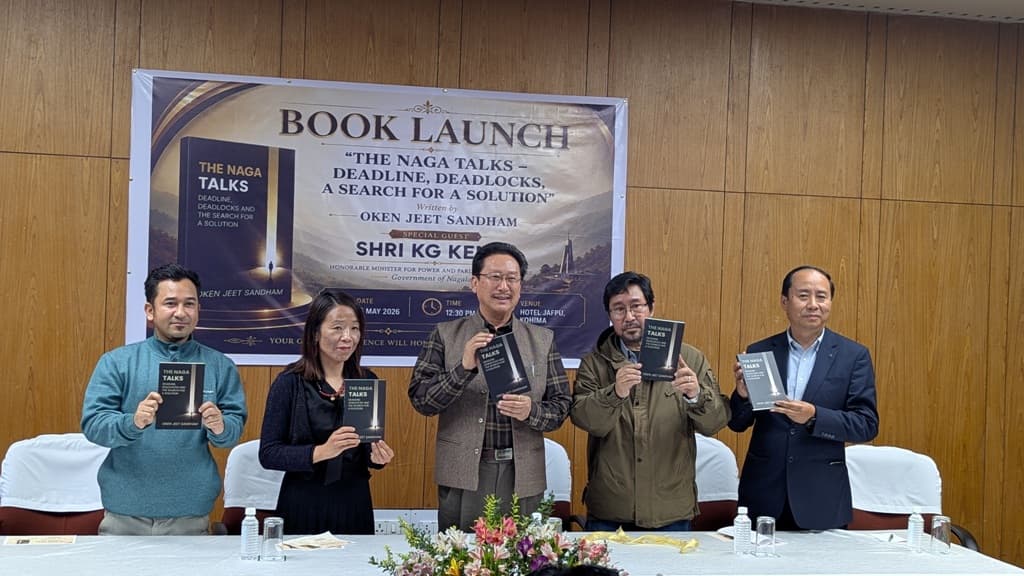
KOHIMA — A book titled “The Naga Talks: Deadline, Deadlocks and the Search for a Solution” by senior journalist and NEPS News editor Oken Jeet Sandham was released by Minister for Power and Parliamentary Affairs KG Kenye at Hotel Japfü, Kohima, on Friday.
The book release marks the sixth book authored by Sandham, senior journalist and editor of NEPS News.
Speaking at the launch, the author said he had not initially planned to write on the Naga political issue, but his interest developed after a meeting between Prime Minister Narendra Modi and members of the Parliamentary Working Committee of the Nagaland Legislators’ Forum in New Delhi on July 16, 2015.
Sandham said the Prime Minister’s remark during the meeting — “If peace comes, it must come in toto. Every single Naga person is important in bringing the solution” — left a deep impression on him and prompted him to reflect on the Government of India’s approach toward resolving the Naga issue.
He said another major development came on August 3, 2015, when the Government of India signed the Framework Agreement with the NSCN (IM). The agreement raised several questions regarding its contents, secrecy, and direction of the peace process, he added.
Also read: EduConnect 2026: Abu Metha stresses technology’s role in education
The author also noted that the then interlocutor for the Naga peace talks, RN Ravi, repeatedly maintained that there would be no piecemeal solution and that all stakeholders and Naga political groups would be taken on board.
“These developments pushed me to study the peace process more deeply,” Sandham said, adding that it eventually led to the publication of his first book on titled “Narendra Modi and Naga Peace Accord” in 2015.
He said continued uncertainty surrounding the Framework Agreement later inspired his second book, “Modi Walking on Elusive Naga Peace,” published in 2017.
The latest book, he added, was written because of the unanswered questions, political complexities, and prolonged negotiations surrounding the peace process.
According to the author, the book is not only about negotiations and agreements but also about expectations, missed opportunities, and the continuing search for an honourable, inclusive, and lasting solution.
He expressed hope that the publication would contribute to greater understanding and reflection on one of the most significant political issues in Naga history.
Speaking at the programme, Minister Kenye said the Naga political issue has remained a part of “our life” and that the people are still struggling to reach a destination.
Referring to the historical background of the movement, he said the first written document related to the issue was the memorandum submitted to the Simon Commission in 1929.
“From then till today, Nagas have travelled nearly 100 years, but the question remains whether there is still enough hope for a solution,” he said.
Kenye observed that many important events in the early years of the movement were not properly documented due to limited literacy and awareness at the time.
He said that had such events been recorded by journalists and writers, many misunderstandings, accusations, and violent incidents could possibly have been avoided.
He stressed the importance of preserving authentic records today and called on the present generation to retrospect on the past and make difficult decisions for the future. He also encouraged writers and journalists to address various issues confronting society.
President of the Kohima Press Club, Vishü Rita Krocha, said Sandham’s writings have consistently helped the public understand the complexities of the Naga political issue by translating high-level negotiations into accessible narratives.
She said the title of the book itself reflected the urgency, frustrations, and prolonged stalemates that have characterised the peace talks over the years. In an age of rapid and often surface-level reporting, she added, comprehensive books like this are important both as historical records and as guides for policymakers, scholars, and the younger generation.
Senior journalist Kopelo Krome delivered the concluding remarks at the programme, which was also attended by Neisatuo Mero.