


Rio says merged NPF will safeguard Naga identity, customary laws and regional politics after formal ECI recognition.
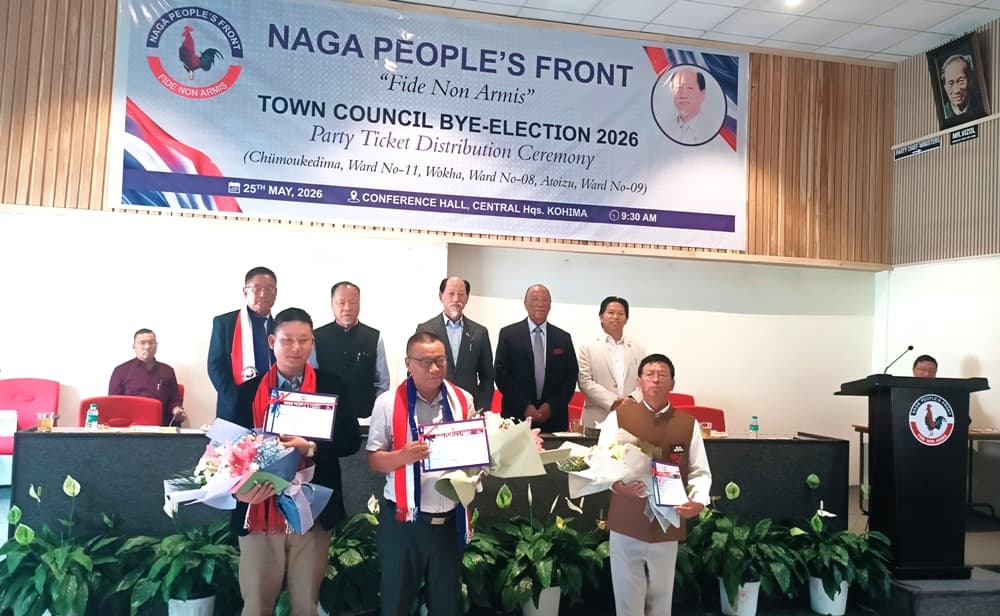
KOHIMA — Chief Minister and president of Naga People’s Front (NPF), Neiphiu Rio, on Monday described the merged party as “a custodian of Naga identity” and said it must continue to protect Naga history, culture and customary laws following its formal recognition by the Election Commission of India (ECI).
Addressing the NPF party ticket distribution ceremony for town council by-election 2026 at the party’s central headquarters in Kohima, Rio said the merger of the former Nationalist Democratic Progressive Party (NDPP) with the NPF had fulfilled a long-standing aspiration of party members and supporters.
Congratulating the candidates who received party tickets, he expressed confidence that they would strengthen the party and emerge victorious, even expressing hope for uncontested wins where possible.
Also read: ULB bypolls announced in Nagaland; voting on June 16
Referring to the merger, Rio said the party leadership had personally apprised the ECI of the development and was informed that recognition would take time because of ongoing elections.
According to him, the Commission eventually granted formal approval on May 4, 2026.
“Today, formally in the register of the ECI and the State Election Commission, we have become one party and certified,” Rio said.
Thanking both former NDPP members and the NPF leadership, Rio said the development represented an important phase in his political journey and expressed hope that the present period would become a “golden period” for the party.
Recalling his own political beginnings, Rio said he felt “comfortable” returning to his “original party”, where he had started his political career.
Describing the NPF, popularly known as the “Cock Party” after its election symbol, as Nagaland’s first regional party and among the oldest surviving regional parties in the country, Rio said the organisation had historically stood for the rights and identity of the Nagas.
“The illiterate people also call it the Naga party,” he said.
Urging younger party workers to understand the history of the party and the contributions of earlier leaders, Rio emphasised the need for discipline and reminded party members and elected representatives to adhere to party guidelines, constitutional provisions and anti-defection laws.
Referring to recent political developments in urban local bodies, he said issues in Kohima and Dimapur had been resolved after councillors understood the party constitution and anti-defection provisions.
Rio cautioned party leaders against placing individual interests above public welfare.
“As public leaders, you have to protect the interest of the people first,” he said.
The Chief Minister also spoke about governance and municipal reforms, informing party workers that the state government had engaged consultants to develop a revenue model for municipalities.
According to him, the consultants arrived in Dimapur on Monday and would study taxation and revenue collection systems followed in cities such as Kolkata and Guwahati.
He said the model would be introduced not only in Dimapur and Kohima but could later be extended to other towns including Mokokchung. The proposed system, he added, would focus on expanding the taxation base and introducing digital mechanisms for revenue collection and management.
Rio further urged party workers to educate people about government welfare schemes, skilling initiatives and entrepreneurship opportunities and encouraged them to assist youths, women, farmers and entrepreneurs in accessing training, financial support and bank loans.
He also called on party workers not to remain silent in the face of misinformation, saying silence often strengthens false narratives.
Speaking on the role of regional politics, Rio said he now felt “more relaxed” in the NPF because responsibilities were shared collectively among senior leaders, unlike perceptions surrounding the NDPP which many viewed as centred on an individual.
He maintained that regional parties continued to make sacrifices to protect Naga identity, history, culture and customary laws.
Referring to historical developments, Rio said the British had recognised the uniqueness of the Nagas following prolonged resistance and subsequently enacted the Bengal Eastern Frontier Regulation Act, 1873, which later evolved into the Inner Line Permit system.
He also highlighted Article 371(A) of the Constitution of India as a constitutional safeguard for Nagaland and stressed the need for emotional and socio-cultural integration among Nagas across states.
“If Nagaism survives, everybody will survive. If Nagaism fails, all of us will fail,” he said.
Meanwhile, MLA and NPF Secretary General Achumbemo Kikon said the programme marked the first election-related event of the party following the ECI’s recognition of the merger.
Reading portions of the Commission’s order, Kikon said the ECI approved the merger after verifying that it had the support of the required two-thirds majority and that no contrary claim had been received.
According to him, the order stated that the NDPP had ceased to exist as a separate political party and that its election symbol, “Globe”, would remain frozen until further orders.
Kikon said the upcoming town council by-elections in Chümoukedima, Wokha and Atoizu would serve as the first electoral test for the merged party.
Party tickets were issued to Neitsüu Kuotsu for Chümoukedima Ward No. 11 (Chaara), Along Lotha for Wokha Ward No. 8 (Tsumang B) and Shimavi Kiba for Atoizu Ward No. 9 (Samba Ghoki). NPF Working President Pusazo Luruo administered the pledge to the candidates, while Rev. Izeiteilung Teriang, State Chaplain, offered the dedicatory prayer.
Nominations for the by-elections will continue till May 29, while polling is scheduled for June 16.