


The Department of Art and Culture held the Living Morung Initiative programme in Kohima to promote traditional knowledge.
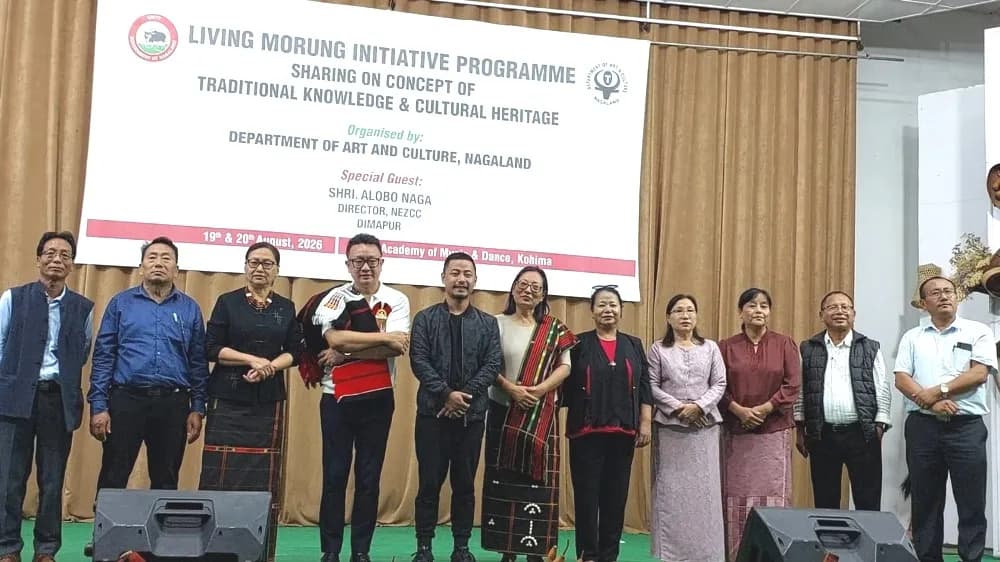
KOHIMA — The Department of Art and Culture organised a ‘Living Morung Initiative’ programme on Wednesday themed “Sharing on the concept of traditional knowledge and vultural heritage” at the State Academy of Music and Dance in Kohima.
Speaking as the special guest, Director of the North East Zone Cultural Centre (NEZCC) Alobo Naga said the theme was deeply relevant to the present times, stressing that culture should not merely be preserved but kept alive.
As a musician, educator, and cultural practitioner, Alobo stated that he views culture not only as heritage but also as an opportunity for learning, empowerment, and connection.
Traditional songs, dances, crafts, weaving, dialects, languages, stories, and indigenous knowledge systems form an integral part of Naga identity, he said.
Warning that traditional knowledge survives only when shared, he stated that if elders stop passing on their knowledge and young people stop learning, centuries of heritage could be lost within a single generation.
Also read: Nagaland moves to lock in heritage with GI push
Alobo said that while living in a rapidly changing modern world, there is a risk of traditional culture disappearing if conscious efforts are not made to safeguard it. In this regard, he stated that the responsibility is not only to preserve heritage but also to document, share, and teach it, making it relevant to younger generations. He maintained that tradition and modernity do not need to compete, saying that technology and contemporary creativity can be embraced while remaining firmly rooted in cultural heritage.
To make traditional expressions relevant to younger generations, including Gen Z, he stated that technology can play an important role in documenting and transmitting indigenous knowledge.
He also shared that the NEZCC is exploring the use of artificial intelligence and other software to transcribe folk songs from existing audio and video documentation to make them available for teaching in schools and colleges, ensuring that future generations can learn Naga and other Northeast folk traditions.
Earlier, Director of Art and Culture Adela Moa, in her welcome address, said the morung in the past served as an indigenous learning institution where lived experiences, discipline, defence skills, social responsibilities, moral values, folk songs, arts, and crafts were passed down. However, she noted that rapid modernisation has led to the decline of the indigenous institution, resulting in the loss of traditional knowledge and cultural identity.
Recognising the need to address this decline, she said the state government introduced the Living Morung Initiative to promote cultural revitalisation through intergenerational learning, skill training, and heritage conservation. The Department of Art and Culture has already conducted the programme in villages across all districts of Nagaland, she added.
The event featured traditional horn blowing by Lhüvepra Venyu; a folk song by Tobu Area Shekho Ukhong, Kohima; sharing of traditional knowledge on bamboo and bamboo crafts by Petekolie Khawakhrie; folk song with tati by Rüsokhrie Krotho, Kohima; sharing of traditional knowledge on loin loom weaving by Neivozonuo Kire; a special performance by Moko Koza, recipient of the Governor's Award for Music 2025; and a folk dance by the Soyim Students' Union, Kohima.
Other cultural presentations included an indigenous game by Benreu Students' Union, Kohima; war cry and yodelling by Tavesüh Tetseo; an action song by Tamlu Cultural Troupe, Kohima; insect sounds mimicry by Kükuveyi Venyo; traditional drum beating by Mejungsungkum Longkumer; a folk dance by the Lotha Yachummaro Cultural Club; a traditional flute performance by Wekhazü Kreo; a folk song by the Tikhir Union, Kohima; tati by Kuwe-ü and Weshe-ü Kreo; a folk song by the Keyake Chakhesang Youth Cultural Group; and traditional trumpet blowing by Nyutsü Nyusou.
The programme will continue on Thursday from 11:30 am onwards.