


Angelina Tajen stresses need for inclusive livestock insurance to protect farmers and rural livelihoods in Nagaland.
KOHIMA — Emphasising that livestock insurance is crucial for protecting rural livelihoods and ensuring financial security for farmers, Secretary, Department of Animal Husbandry & Veterinary Services (AH&VS) and Tribal Affairs, Angelina Tajen, on Monday called for stronger implementation, inclusivity and ground-level adaptability of insurance mechanisms in the state.
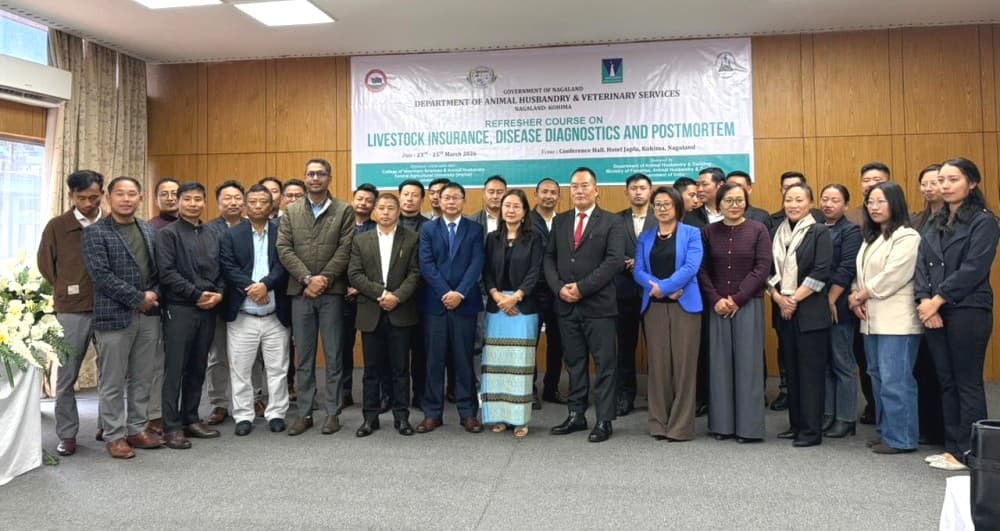
Tajen was addressing the inaugural programme of a three-day refresher course on livestock insurance, disease diagnostics and post-mortem held at Hotel Japfu conference hall, Kohima.
The programme was organised in collaboration with the College of Veterinary Science & Animal Husbandry, Jalukie, and sponsored by the Department of Animal Husbandry & Dairying, Government of India.
Highlighting the importance of livestock insurance, she narrated the story of a small farmer in a remote village who lost one of his two pigs to disease after rearing them for 11 months, leaving his family financially vulnerable due to the absence of insurance coverage.
Also read: Nagaland faces 55.44% shortfall in animal husbandry products
“In Nagaland, livestock is not merely an economic activity—it is a way of life,” she said, noting that around 70% of households rear livestock, with pigs and poultry forming a major part of the sector.
She cited production figures for 2024–25, stating that the state recorded 24.42 metric tonnes of meat, 52.79 metric tonnes of milk, and 443.38 lakh eggs. Despite this, a gap between demand and production persists, highlighting the sector’s untapped potential.
In this regard, he secretary underscored the role of the National Livestock Mission (NLM) as a transformative initiative aimed at promoting entrepreneurship, enhancing productivity, strengthening value chains, and reducing risks through insurance.
Emphasising the need for livestock insurance, Tajen pointed out that risks from diseases remain significant. In 2023–24, 45,196 poultry birds were affected, with 17,873 fatalities, while 24,061 pigs were affected, resulting in 12,039 deaths.
She pointed out that for a small farmer, the loss of even one animal can mean loss of income, food security and financial stability, adding that insurance serves as a critical safety net.
She highlighted several ground-level challenges in Nagaland, including difficulties in conducting post-mortem examinations in remote areas, poor connectivity, and limited accessibility to veterinary personnel, often resulting in delays and complications in claim settlements.
She also pointed out the mismatch in poultry insurance norms, where insurance companies require a minimum flock size of 1,000 birds, whereas most farmers in the state rear only 50–200 birds.
“When insurance begins at 1,000 birds, but our farmers rear 100 or 200, we must ask—are we protecting livelihoods or unintentionally excluding those who need protection the most?” she remarked.
Towards this, Tajen called for flexible claim verification through geo-tagged photos and videos, certification by field veterinary staff, and cluster-based verification systems.
She also advocated for inclusion of small poultry farmers through group insurance models, relaxation of minimum flock size norms, and improved last-mile veterinary services.
She emphasised that livestock insurance requires collective responsibility, involving government support, administrative efficiency, insurance sector participation, and farmer awareness.
“Livestock insurance is more than a scheme. It is a commitment to our farmers. When a farmer loses an animal, it is not just a loss of livestock, but a loss of hope, security and dignity,” she said.
Earlier, delivering the welcome address, Dr. Imomanen Tzudir, Director of AH&VS, highlighted that a majority of Nagaland’s rural population depends on farming, including agro-forestry, horticulture, livestock and poultry, which are interdependent systems.
He informed that as per the 21st Livestock Census (2024–25), Nagaland has around 80,000 bovines, 2.7 lakh pigs, and about 20 lakh poultry, describing them as “golden assets” for marginal farmers.
He also noted growing uncertainties due to climate change, natural disasters and emerging diseases, which pose risks to livestock and can result in significant economic losses. He urged the need to educate and encourage farmers to insure their livestock.
A speech was also delivered by entrepreneur Penyusielie Suokhrie on livestock insurance from an entrepreneurial perspective.
The programme was led by Dr. Kuokehebi Gwirie, Additional Director, Directorate of AH&VS.
Officials from 17 districts of Nagaland are attending the three-day course.