


KVK Phek hosts training programme on ‘Empowering rural livelihood through scientific backyard poultry management.’
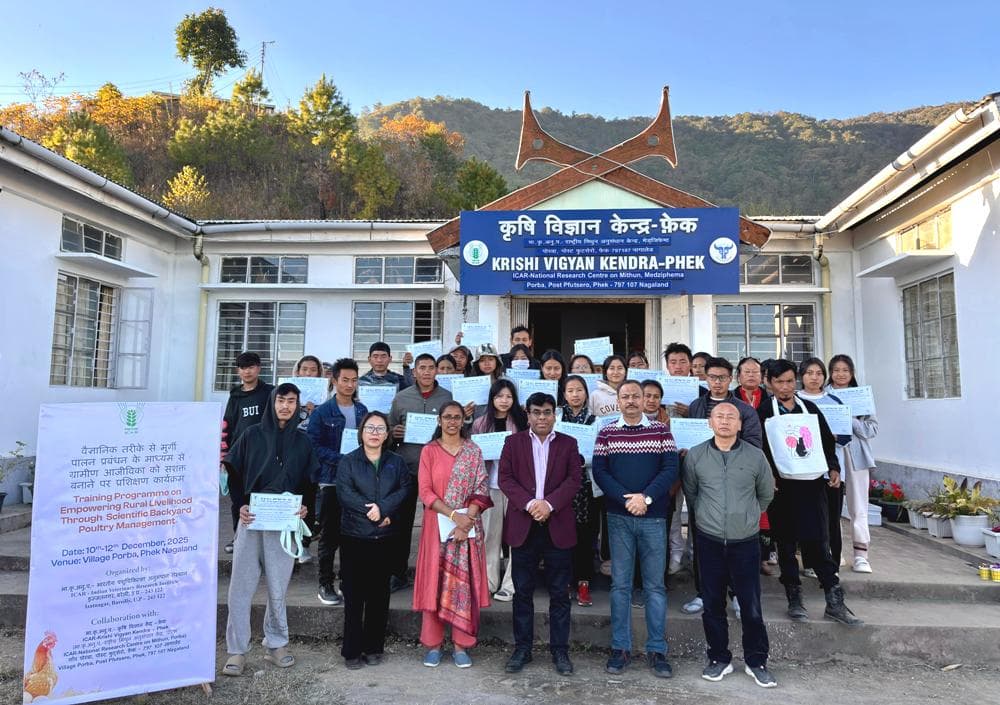
DIMAPUR — A three-day training programme on ‘Empowering rural livelihood through scientific backyard poultry management’ was organised by ICAR–IVRI, Bareilly (UP), from December 10 to the 12th for the farmers of Porba village at KVK Phek.
The training programme was held in collaboration with ICAR–Krishi Vigyan Kendra (KVK), Phek (ICAR–NRC on Mithun, Medziphema, Porba) under ICAR–ATARI, Zone VII, Umiam, an update stated.
The programme began with a welcome address by Dr. Sanjeev Kumar Singh, Senior Scientist & Head, KVK Phek, who highlighted the relevance of the training in strengthening rural livelihoods through scientific poultry management.
In his inaugural remarks of Dr. MH Khan, Principal Scientist & Head, ICAR–IVRI, emphasised the significance of the training programme in enhancing the technical skills of farmers and promoting sustainable poultry practices in the region.
He appreciated the initiative taken by ICAR–IVRI, Bareilly, under the NEH component, to support farmers of remote and tribal areas by providing them with scientific knowledge, quality inputs, and capacity-building opportunities.
Dr. Khan encouraged the participants to make full use of the training to improve their income and strengthen backyard poultry production in their villages.
In the first technical session, Dr. Narendra VN, Scientist, ICAR–NRC on Mithun, spoke on entrepreneurship opportunities in poultry, while Dr. Yallappa MS, Scientist, ICAR–NRC on Mithun, highlighted the importance of climate-resilient poultry farming.
The second and third technical sessions featured a series of detailed lectures and presentations by experts from various disciplines. Dr. Hannah K Asangla, CTO, Agronomy, discussed income generation activities in agriculture and allied sectors, encouraging farmers to explore diversified livelihood options. Dr. T Esther Longkumer, CTO, Soil Science, presented on the integration of poultry with natural farming, explaining how poultry units can contribute to soil health and reduce external input costs.
Dr. Harini KR, SMS, Animal Science, delivered a comprehensive session on feeding and housing management of chicks and layers, providing practical guidelines on balanced nutrition, housing design, and flock management.
Dr. Ragulraj S, STO, ICAR–NRC on Mithun, Porba, elaborated on hatchery management, disease management, value addition, and marketing of poultry, offering farmers technical insights into improving productivity and enhancing market opportunities.
Additionally, Manjunath KS, SMS, Horticulture, discussed protected cultivation in horticulture and its role in supporting integrated farming systems.
As part of the three-day training programme, farmers also visited the Poultry Unit of KVK Phek.
“During this exposure visit, participants observed practical demonstrations and interacted with the experts to understand various aspects of scientific poultry farming, including brooding practices, housing systems, chick care, health management, and daily operational procedures.
“The visit provided hands-on learning experiences, enabling farmers to relate the classroom teachings to real-world farm management,” the update stated.
The lectures were followed by an interactive session, providing participants with a platform to discuss challenges faced in the poultry sector and explore practical solutions.
Participants also shared their experiences and feedback during the valedictory session. As part of the programme, poultry chicks along with starter feed were distributed to all the participating farmers to support the establishment and development of backyard poultry units in their village.
The initiative aims to provide farmers with the necessary inputs to begin scientific poultry rearing and to encourage them to adopt improved management practices learned during the training.
Certificates of participation were also distributed to all the trainees in recognition of their active involvement throughout the three-day programme.
The event concluded with a formal vote of thanks delivered by Dr. Hannah K Asangla, who expressed gratitude to the resource persons, organising team, and participants for their cooperation and enthusiastic participation.