


KVK Dimapur organised the Bhumi Suposhan Programme in Chümoukedima village to promote sustainable and climate-resilient farming practices.
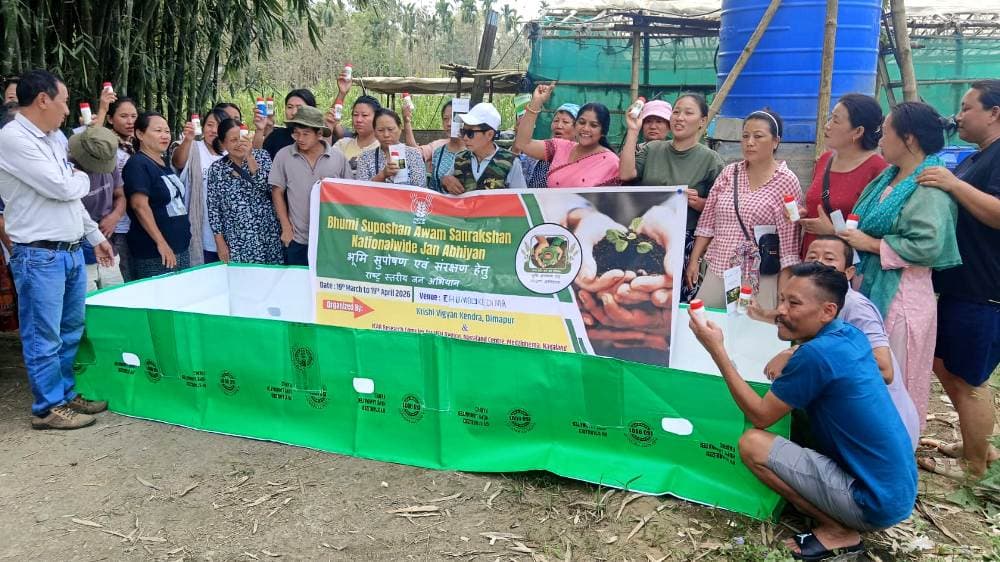
DIMAPUR — The Krishi Vigyan Kendra (KVK), Dimapur, organised a Bhumi Suposhan Programme at Chümoukedima village with an objective of enhancing soil health and promoting sustainable, climate-resilient agricultural practices among farmers.
According to an update, during the programme, farmers were sensitised on the critical role of soil health management in ensuring long-term productivity and sustainability.
Practical demonstrations and scientific advisories were provided to improve soil fertility, optimise nutrient use, and enhance crop yields in an eco-friendly manner.
As a key intervention, vermicomposting technology was promoted, and as part of the initiative, vermicompost pits and bio-fertilisers were distributed among the farmers to encourage eco-friendly and cost-effective farming practices.
A highlight of the programme was the interaction with a progressive farmer, Vilhuca Thou, who has developed a successful and diversified farming model. It was mentioned that along with sugarcane cultivation and processing, he is engaged in the cultivation of dragon fruit, tomato, maize, wheat, and watermelon and has also adopted vermicomposting as an integral component of his farming system.
Read more local news: MSME, NITI Aayog officials review Kiphire Aspirational District works
ANTA Wokha unit inspects Foothills Road, reports illegal taxi operations
On this occasion, Dr. Phool Kumari, Senior Scientist and Head of KVK Dimapur, interacted with the farmers and elaborated on the various technological interventions and outreach activities of KVK.
She visited all the farm units, including sugarcane processing units and crop fields, and appreciated the farmers’ commitment towards adopting innovative and sustainable practices.
She also stated that KVK Dimapur will continue to strengthen its collaboration with line departments and institutions to empower farmers through capacity building, technology dissemination, and the promotion of sustainable agricultural practices for enhanced livelihood security in the region.
The programme saw the participation of 32 farmers and farm women. The initiative began on March 19 in different villages across Dimapur, Chümoukedima, and Niuland districts.