


Konyak Union organises dedication programme for ‘Konyak Naga Traditional Attire Book’ in Mon, aiming for GI tag and cultural preservation.
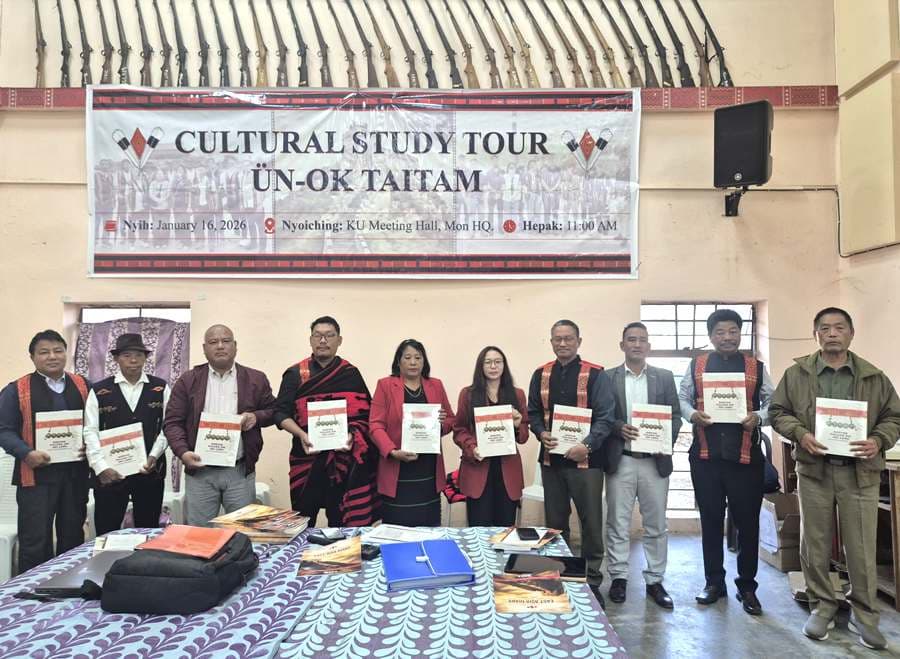
DIMAPUR — The Konyak Union Headquarters, Mon, in collaboration with all Konyak frontal organisations, organised a cultural study tour-cum-dedication programme of ‘Konyak Pulang Ow hei leng Laitep’ (the Konyak Naga Traditional Attire Book) at the Konyak Union Office, Mon town, on January 16.
The book was earlier formally launched by Chief Minister Neiphiu Rio during the Statehood Day celebrations on December 1, 2025, at the Nagaland Secretariat Plaza, Kohima, stated a press release.
Rev. Metjen Konyak officially dedicated the book, stressing the spiritual and cultural responsibility of preserving ancestral knowledge for future generations.
Addressing the gathering, K Yamao Konyak, president of the Konyak Union, elaborated on the significance of the ‘Konyak Pulang Ow hei leng Laitep’ as a comprehensive cultural documentation of Konyak traditional attire.
He highlighted that the book is not merely a publication but a foundational cultural record that will facilitate the process of securing a Geographical Indication (GI) tag from the Government of Nagaland. He explained that the proposed GI registration would recognise co-ownership, with the Konyak Union and the Government of Nagaland sharing primary and secondary ownership, thereby ensuring both community ownership and state-level legal protection.
Read more local news: Model Christian College Kohima organises training on psychological first aid
Yamao also acknowledged the role played by the state government, particularly the Department of Nagaland Handloom and Handicraft Development Limited (NHHDC) and the Nagaland Science and Technology Council (NASTEC), for their guidance, technical support, financial support, and institutional assistance in the documentation process.
He noted that their involvement reflects the state’s commitment to protecting traditional knowledge and promoting indigenous cultural assets through scientific and legal frameworks. He further informed that the Konyak Union will shortly launch a cultural study tour covering major villages across Konyak Naga-inhabited areas. In this regard, he appealed to the Konyak community to safeguard, uphold, and preserve the community’s distinctive cultural heritage.
Special appreciation was extended to the Konyak Documentation Committee led by chairman Wanghen Chohwanglim, all committee members, and the research team, Dr. Eche Wangnyu and Dr. Amo Konyak, whose efforts, research, and fieldwork made the publication possible.
The president also paid tribute to all the informants, elders, artisans, and community members who contributed their knowledge, time, and experiences to ensure the authenticity and completeness of the documentation.