


Kohima district administration and ALIMCO distributed assistive devices worth INR 62.24 lakh to 671 persons with disabilities and senior citizens under ADIP and RVY schemes.
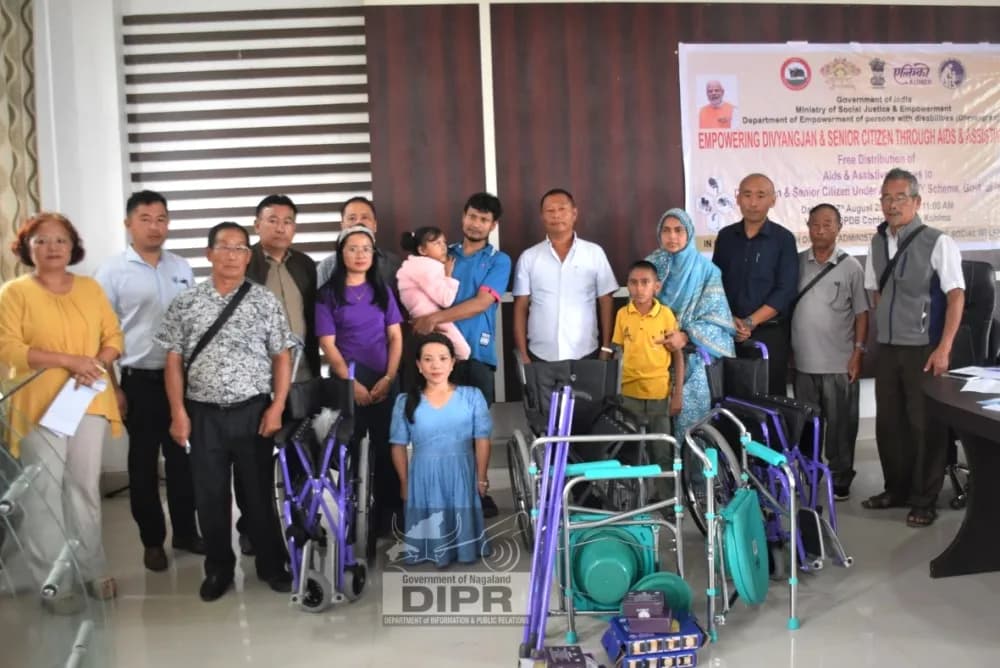
DIMAPUR — The Kohima district administration and District Social Welfare Office, in collaboration with the Artificial Limbs Manufacturing Corporation of India (ALIMCO), distributed assistive devices to 671 persons with disabilities (Divyangjan) and senior citizens under the Assistance to Persons with Disabilities for Purchase/Fitting of Aids and Appliances (ADIP) Scheme and Rashtriya Vayoshri Yojana (RVY) at the DPDB Conference Hall, Kohima, on Monday.
According to a DIPR report, 27 beneficiaries received assistance under the ADIP Scheme, while 644 were covered under RVY.
The total value of the assistive devices distributed was approximately INR. 62.24 lakh, including INR. 2.35 lakh under ADIP and INR. 59.89 lakh under RVY.
The devices included 390 wheelchairs, 500 walking sticks, 14 crutches, two rollators, 120 walkers, 541 LS belts, 13 spinal supports, 646 knee braces, 265 silicon foam cushions, 100 hearing aids, 76 cervical collars, one Sugamya cane, eight TLM kits, two tetrapods/tripods, one ADL kit, one cellphone for a leprosy patient and 457 chairs with commodes, among other assistive appliances.
During the programme, Advisor for School Education Dr. Kekhrielhoulie Yhome handed over selected assistive devices to token beneficiaries on stage.
The systematic distribution of devices is being carried out counter-wise at Chiephobozou, Jakhama and the District Social Welfare Office, Kohima.
Addressing the gathering, Yhome called for greater social inclusion of persons with disabilities and senior citizens, effective utilisation of government funds and stronger convergence among departments to ensure welfare schemes reach people at the grassroots.
He said many persons with disabilities, particularly children, remain confined to their homes due to mobility challenges and other circumstances.
He urged communities to identify such persons, extend support and help them feel accepted as integral members of society.
Read more local news: Baking & confectionery training programme launched in Kohima
Sharing an example from his village, Yhome said youth groups had been encouraged to keep track of vulnerable members of the community and provide care and support.
He said such community participation and social awareness were essential to ensure that no citizen was left behind.
The advisor also urged officers and heads of departments to ensure timely compliance with government requirements and to communicate with concerned authorities whenever necessary.
He cautioned that failure to comply with guidelines could result in the State losing access to available funds.
Yhome highlighted the importance of data generated through ongoing Census operations in identifying beneficiaries and planning effective interventions.
He said even small government interventions could make a significant difference in the lives of vulnerable citizens.
He said Kohima, being relatively well placed in terms of access to information and government institutions, should take the lead in developing a model for delivering government programmes to the doorsteps of people in villages.
The advisor called for collective efforts to design mechanisms for effective grassroots delivery of government services and schemes.
Yhome also highlighted the role of banks in extending financial services to rural areas. He suggested inviting the State Bank of India (SBI) to explain its banking services and rural outreach initiatives, particularly in villages with limited banking facilities.
He further called for stronger convergence among departments and agencies involved in rural development, stating that government programmes would have greater impact when implemented in an integrated manner rather than in isolation.
The ADIP Scheme aims to provide durable and scientifically manufactured assistive devices to persons with disabilities to improve their mobility, independence and overall rehabilitation.
The scheme covers persons with locomotor, visual and hearing disabilities who meet the prescribed eligibility criteria.
The beneficiaries for the Kohima camp were assessed from July 1 to the 6th ahead of the distribution programme.