


Kohima College on Friday hosted the inaugural edition of “Unscripted: Storytelling, Conversations & Creative dialogues,” creative dialogue with Charles Chasie.
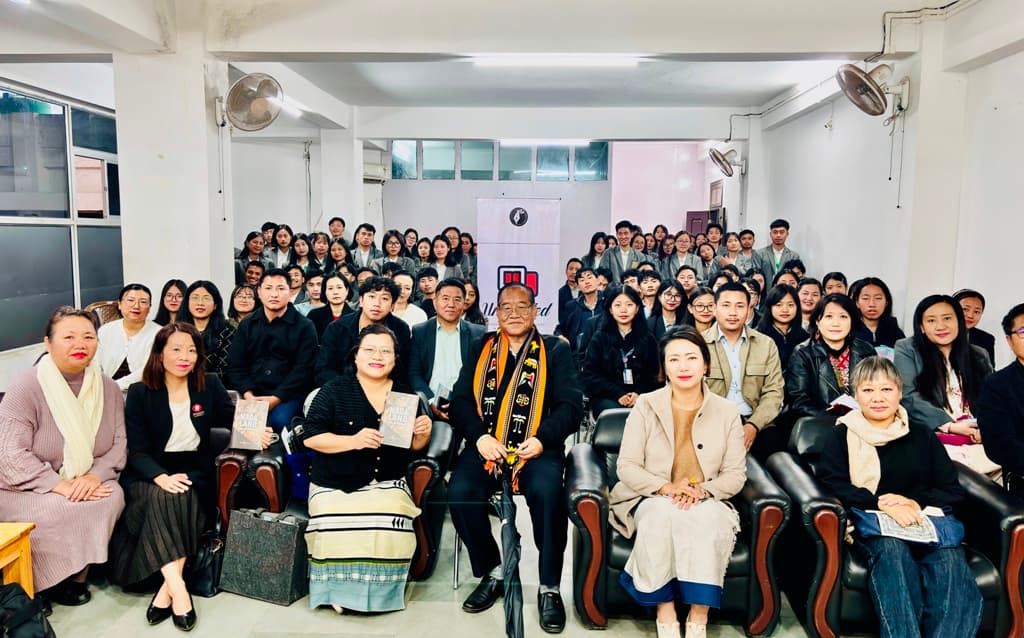
DIMAPUR — Kohima College on Friday hosted the inaugural edition of “Unscripted: Storytelling, Conversations & Creative dialogues,” an initiative of Writers Collective, featuring noted Naga writer and former student of the college, Charles Chasie.
Drawing from his numerous works like “The Road to Kohima: The Naga Experience in the Second World War,” “The State Strikes Back: India and the Naga Insurgency” etc, Chasie emphasised the importance of historical consciousness among younger generations. He observed that many Nagas today remain disconnected from their past, warning that without such awareness, both identity and direction as a society become uncertain.
An update from the college stated that his latest book, “Nagaland: State-in-waiting,” details a comprehensive Naga history to cultivate an understanding of the past in the younger generation.
Also read: 78 Bn CRPF commemorates CRPF Day
He stressed that the past, present and future must be understood as a continuum and that acknowledging the “good, bad and ugly” aspects of history is essential to building an authentic collective identity.
Reflecting on current attitudes, he raised concerns about a growing tendency to look outward for solutions without adequately addressing foundational questions about the Naga movement itself.
Providing historical context, Chasie revisited the origins of the Naga political position, noting that early Naga leaders asserted independence and viewed Indian presence as occupation. He highlighted the contested interpretation of the Nine-Point Agreement, signed shortly before India’s independence, which later became a point of divergence between Naga leaders and the Government of India.
He noted that in 1949, under Jawaharlal Nehru, the agreement was not recognised, contributing to deepening mistrust. Chasie also pointed out that Nagaland was for a time administered under the Ministry of External Affairs, reflecting its unique political trajectory in the early years.
Addressing the peace process, Chasie described it as repeatedly encountering setbacks, cautioning that agreements reached without inclusive consultation risk becoming imposed settlements. On the question of readiness, he stated that Naga society remains too internally divided to effectively implement any accord, identifying fragmentation as a major challenge.
He further remarked that a sustainable resolution requires unity within Naga society, asserting that settlement is a process between parties rather than something to be granted unilaterally.
It stated that concerns about governance, institutional decline and legal frameworks such as the Nagaland Security Regulation Act were also raised during the talk.
During the interactive session, Chasie responded to questions on the Naga movement’s position during India’s conflicts with China or Pakistan—that Nagas were honourable and never distracted the Indian army. It added that questions on the church’s role, independent education system etc., were also brought forth.
In conclusion, Chasie called for introspection and reconciliation within Naga society, emphasising that addressing internal divisions remains essential for any meaningful political progress.
The event witnessed active participation from students and faculty, marking a promising beginning for Writers Collective’s initiative aimed at fostering dialogue, critical thinking and creative engagement.