


Two-day training for Kohima district ministerial staff begins to boost skills, efficiency and administrative capacity building.
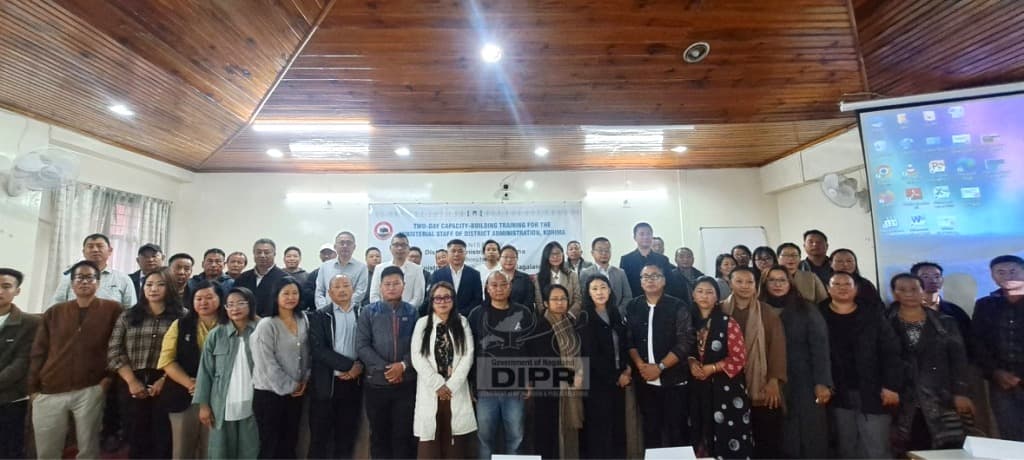
DIMAPUR — A two-day capacity-building training programme for ministerial staff of the Kohima district administration commenced on Friday at the Deputy Commissioner’s conference hall, Kohima.
According to a DIPR report, the programme is being organised by the district administration, Kohima, in collaboration with the Administrative Training Institute (ATI), Nagaland.
In his address, Deputy Commissioner Kohima, B Henok Buchem, expressed enthusiasm over the training initiative and the participation of experienced ministerial staff.
Also read: NH-2 stretch near Kohima to shut for 3 hours on May 3
The DC informed that a team of resource persons comprising some of the most competent officers in the state has been carefully selected for the programme.
Emphasising the foundation of institutional progress, Buchem stated that three key elements are essential for any office establishment—robust infrastructure, upgrade of technology and continuous skill development of manpower.
He stressed that capacity building should not be limited to officers alone, but must include all staff members to ensure overall efficiency.
He further described the training initiative as an “organic local arrangement,” conceptualised and organised by the district administration itself in collaboration with ATI and the Department of P&AR.
Highlighting the objectives, the DC stated that the training aims to equip participants with practical skills, build confidence, and foster a mindset of continuous learning and improvement.
He emphasised the importance of teamwork, noting that administrative functioning is a collective effort where every contribution matters, regardless of rank or role.
Underscoring the importance of file work, Buchem remarked that the way an official draft and processes a file reflects one’s professionalism and responsibility.
He also stressed that accuracy, responsibility, and clarity in official documentation are critical in avoiding complications, including legal scrutiny.
Encouraging active engagement, the DC urged participants to be curious, ask questions, and actively participate in the sessions rather than remain passive. He emphasised that learning should be continuous and that officials must remain updated with evolving rules, procedures, and administrative practices.
Earlier, Lithrila Sangtam, Under Secretary, Department of Personnel & Administrative Reforms (P&AR), delivered a detailed address on the importance of training, highlighting the evolving approach of the government towards capacity building and the relevance of key subjects such as conduct rules, service matters, and record management.
She also presented an overview of the training programme and conducted the first session on the Nagaland Government Servants’ Conduct Rules, 1968.
Vilalie Sogotsu, UDA, shared the importance of training and the expected outcomes. The inaugural session was held under the chairmanship of SDO (Civil) Kohima, Seyiekhrietuo Solo. The inaugural programme concluded with a closing remark given by ADC Chiephobozou, Vekusheyi Rhakho.
Day one sessions included ‘Record management’ by Assistant Record Officer P&AR, Chenonlo Woch and ‘Service matters’ by Under Secretary P&AR, Weku Zhiemi.
On Saturday, the sessions will focus on ‘File noting & drafting and file management’ led by Asalie Lese, Deputy Secretary, ATI.