


Seven-member delegation from Kagawa University, Japan, concludes three-day intensive visit to Kohima.
Share


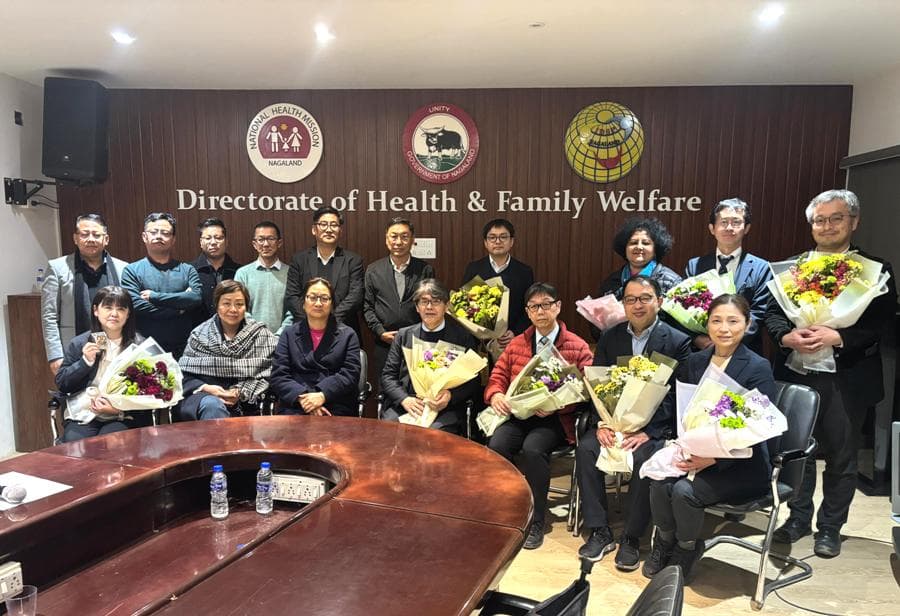
DIMAPUR — A seven-member delegation from Kagawa University, Japan, accompanied by senior officials from the JICA (Japan International Cooperation Agency) India Office, successfully concluded a three-day intensive visit to Kohima from January 29 to the 31st.
The visit marks a significant milestone focusing on transforming the state’s healthcare landscape through advanced research, technology, and human resource exchange, the Directorate of Health & Family Welfare stated in a press release.
During their stay, the delegation led by Professor Wada Kenji engaged in a series of site visits and consultative meetings.
The team visited the Nagaland Institute of Medical Sciences and Research (NIMSR), the Naga Hospital Authority Kohima (NHAK), and the Urban Primary Health Centre (UPHC) Seikhazou, where they interacted with medical faculties and frontline healthcare workers.
Also read: CM Neiphiu Rio launches digitisation of old birth and death certificates in Nagaland
Nagaland-Japan Connect 2026 inaugurated in Dimapur to boost education, employment and cultural ties
A key highlight of the tour was the visit to Science College Kohima, where discussions centred on academic synergy and ‘human-to-human’ knowledge exchange.
Professor Kenji elaborated on Kagawa University’s global leadership in rare sugar research, crisis management & telemedicine research, proposing collaborative innovative research that could benefit Nagaland’s unique topography and biodiversity.
In a detailed interactive meeting at the Directorate of Health and Family Welfare (DHFW), the visiting team shared their impressions of the state’s healthcare challenges, noting similarities between Japan and Nagaland in the rising burden of Non-Communicable Diseases (NCDs) and cancer.
Both parties explored collaboration in cancer treatment and prevention protocols. Professor Kenji presented Kagawa’s success with the K-MIX R (Electronic Health Information System) and iCTG technology, which are used to provide care to remote, inhabited islands in Japan—a model highly applicable to Nagaland’s hilly terrain.
New avenues for collaboration in clinical engineering and hospital management were deliberated to improve the efficiency of secondary and tertiary care facilities.
The visit concluded with a presentation on Kagawa University, highlighting its six faculties spread across four campuses.
“Of particular note was the expansive medical faculty, which encompasses the Schools of Medicine, Nursing, and Clinical Psychology.
“This introduction set the stage for potential faculty and student exchange programs between Kohima and Kagawa’s four main campuses,” the release stated.