


NSLSA trains 26 referral judges in Kohima to promote mediation, fair settlements and effective dispute resolution in Nagaland
Gauhati High Court judge stresses role of referral judges in ensuring fair and voluntary settlements at NSLSA training in Kohima
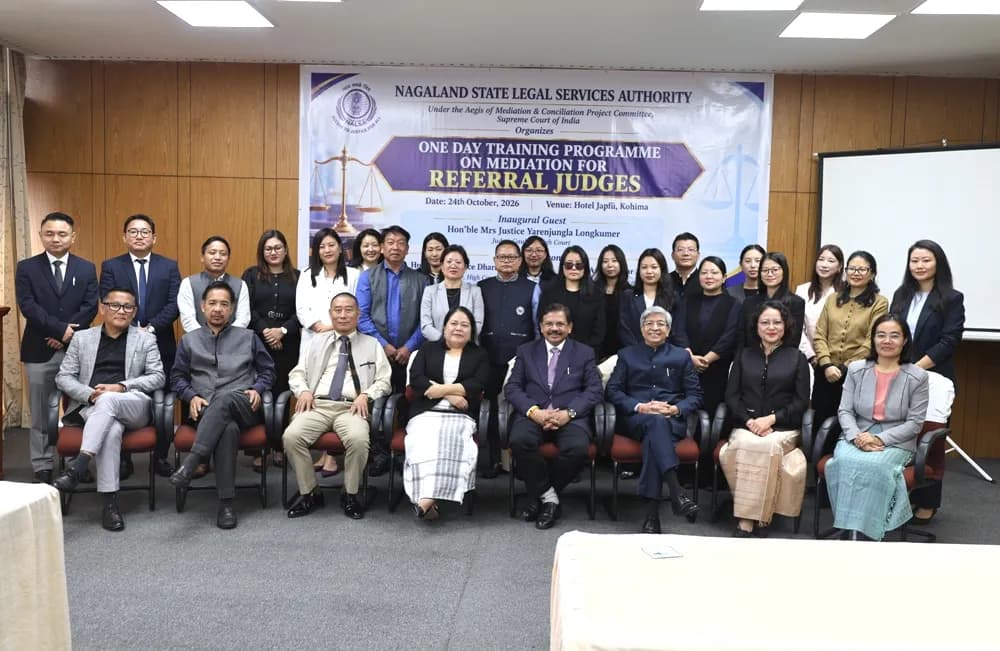
DIMAPUR — Mediation should be viewed not merely as an alternative to litigation but as an essential component of a modern, responsive and humane justice delivery system, said Justice Yarenjungla Longkumer, Judge of the Gauhati High Court.
Emphasising the pivotal role of judges in referring suitable cases for mediation, Longkumer said the success of the process depended not only on the skills of mediators but also on the wisdom, sensitivity and commitment of referral judges.
She was speaking at a one-day training programme on mediation for referral judges organised by the Nagaland State Legal Services Authority (NSLSA), under the aegis of the Mediation and Conciliation Project Committee (MCPC) of the Supreme Court of India, at Hotel Japfü, Kohima, on Saturday.
Longkumer attended the programme as the inaugural guest, an NSLSA press release stated.
She noted that referring a case to mediation was not merely a procedural step to reduce case pendency but a judicial decision that could pave the way for a more constructive resolution of disputes.
Identifying cases that could benefit from mediation, she cited family and matrimonial disputes, neighbourhood disagreements, commercial and contractual disputes, partnership conflicts, landlord-tenant matters and motor accident claims, depending on the circumstances of each case.
However, she cautioned that judges must exercise sound discretion while screening cases for mediation, particularly those involving serious power imbalances, coercion, domestic violence or circumstances that could undermine voluntary consent.
The judge stressed that the objective should not be to secure settlements at any cost but to ensure fair, informed and voluntary participation by all parties.
Highlighting the importance of timely referrals, Longkumer said early intervention could prevent disputes from escalating and becoming more difficult to resolve.
She added that judges should present mediation as a credible avenue for dispute resolution rather than as a lesser form of justice or an additional procedural formality.
On access to justice, she said mediation, where appropriate, could reduce the financial burden, delays and emotional strain associated with prolonged litigation. It could also enable courts to devote more time and resources to complex cases requiring authoritative adjudication.
Justice Longkumer further emphasised that mediation must strengthen access to justice without compromising the rights, dignity or legitimate interests of the parties involved.
While encouraging settlements was important, she said, it should never translate into pressure on parties to reach an agreement.
Any resolution arrived at through mediation must remain consistent with fairness and the law.
She said mediation and adjudication should be viewed as complementary means of achieving justice, adding that judicial wisdom lay not only in delivering reasoned judgments but also in recognising when disputes could be resolved more effectively through peaceful negotiation.
Meanwhile, Member Secretary of NSLSA, Neiko Akami, said the legal services authority had undertaken mediation drives, special Lok Adalats and three National Lok Adalats this year, resulting in the settlement of over 1,000 cases across Nagaland.
The inaugural session was chaired by Principal District and Sessions Judge and chairperson of the District Legal Services Authority, Kohima, Mezivolu T Therieh.
During the training programme, former Delhi High Court judge Justice Dharmesh Sharma and retired judicial officer Arun Kumar Arya served as resource persons.
The MCPC senior trainers covered the relevance of Alternative Dispute Resolution (ADR), the concept and advantages of mediation, and its comparison with judicial proceedings, arbitration and Lok Adalat.
The sessions also addressed the roles of mediators and referral judges, the stages and procedures of referral, consent, identification of suitable cases for mediation, avoiding trial delays, and preparing lawyers and parties for mediation.
A total of 26 referral judges from across Nagaland participated in the training programme.