


Journalists from the Northeast gather in Kohima to discuss media ethics, credibility, and peace journalism at a conclave.
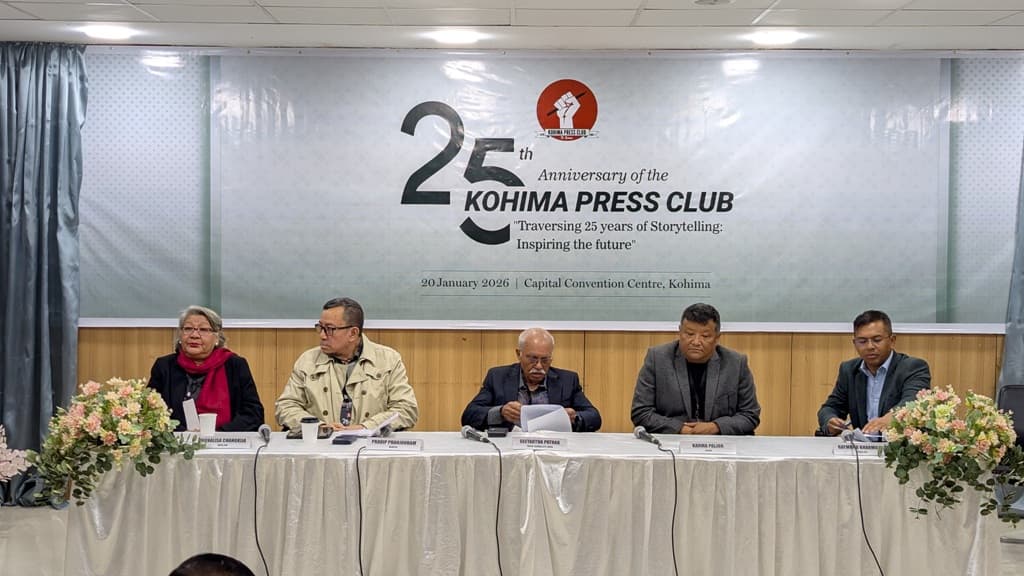
KOHIMA — Journalists from across the eight northeastern states dwelt on the importance of upholding media ethics and the need for a better understanding of the conflict region during a one-day Northeast Media Conclave held in Kohima on January 20.
The conclave titled “Reimagining truth: Northeast journalism for a changing world” coincided with the 25th anniversary of the Kohima Press Club celebrated at the Capital Convention Centre.
Journalists and media researchers from the region spoke on two relevant topics: “Evolving nature of media: Ethics under pressure and strengthening credibility in the age of misinformation” and “Journalism as peace work: Navigating divides, building bridges and a stronger media ecosystem for Northeast”.
Also read: Organisations congratulate Kohima Press Club on silver jubilee
Participating in the first panel discussion, Pradip Phanjoubam, editor of Imphal Review of Arts and Politics, noted that facts and truth have always been disputed. What was considered truth five years ago may not be truth anymore, and journalists cannot impose their minds on the past. The major concern, he said, is the nature of truth and the nature of reality that journalists have to come to terms with, otherwise risking being left behind.
Karma Paljor, an award-winning journalist and co-founder of Atvi Infotainment, stressed the importance of communities supporting in telling their own stories. Till people understand the importance of journalism, the newsrooms will die, and the only way to get information will be from influencers and YouTubers, he added.
Tiamerenla Monalisa Changkija, journalist and poet and former editor of Nagaland Page, said nobody can pressure a journalist as long as they stick to their ethics while adding that it is worth standing up to the ethical standards. If a journalist is going to be pro-power, then they have to ask about their ethical standards, she added.
She also noted the lack of investigative journalism in Nagaland is because newspapers/media houses have not supported it. A lot of content that is carried in the newspapers is “plain lies”, and as journalists, one must be able to discern that.
Raymond Kharmujai, an independent journalist from Meghalaya, pointed out some of the problems that journalists face today. One of the problems is the rise of WhatsApp journalists and influencers, and the biggest challenge now is to fight against fake news. To this, he said journalists must be true to themselves, and their work must be about presenting facts to the people.
President of Indian Journalists Union, Geetartha Pathak, also underscored the need for journalists to adapt to the way of storytelling with the changing nature of journalism.
Medolenuo Ambrocia Loücu, Kohima Press Club member and Nagaland correspondent for EastMojo, moderated the first session.
In the second discussion, Dhiren A Sadokpam, journalist and researcher from Manipur, spoke on the importance of journalists getting a grasp of what violence is about and what is happening in the region.
Utpal Parashar, senior assistant editor with Hindustan Times, believed that journalism for peace is a concept and that the job of a journalist is gathering, preparing and presenting the news. He advised journalists to visit the places and talk to as many people as possible and get views of the neutral experts when reporting. The job is to report what is happening on the ground, maintain due diligence, and follow the basic things.
Ranju Dodum, an independent journalist, editor and media researcher based in Arunachal Pradesh, raised a pertinent question of what the role of a journalist is when it comes to peace work.
Senior copy editor with Indian Express Debraj Deb said that a reporter’s job is to report it. However, he also said that they can't just do the basic reporting anymore, and there is a need for more trained journalists on the ground.
Vanlalrema Vantawl, publisher and editor of Zalen, Mizoram, said the state had been peaceful for a long time but is now faced with a refugee crisis coming from Myanmar.