


Nand Kishore Yadav visits NGISRSC and Drone Centre of Excellence, appreciating the state’s efforts in drone technology, training and future manufacturing.
From training to manufacturing, Nagaland charts drone roadmap
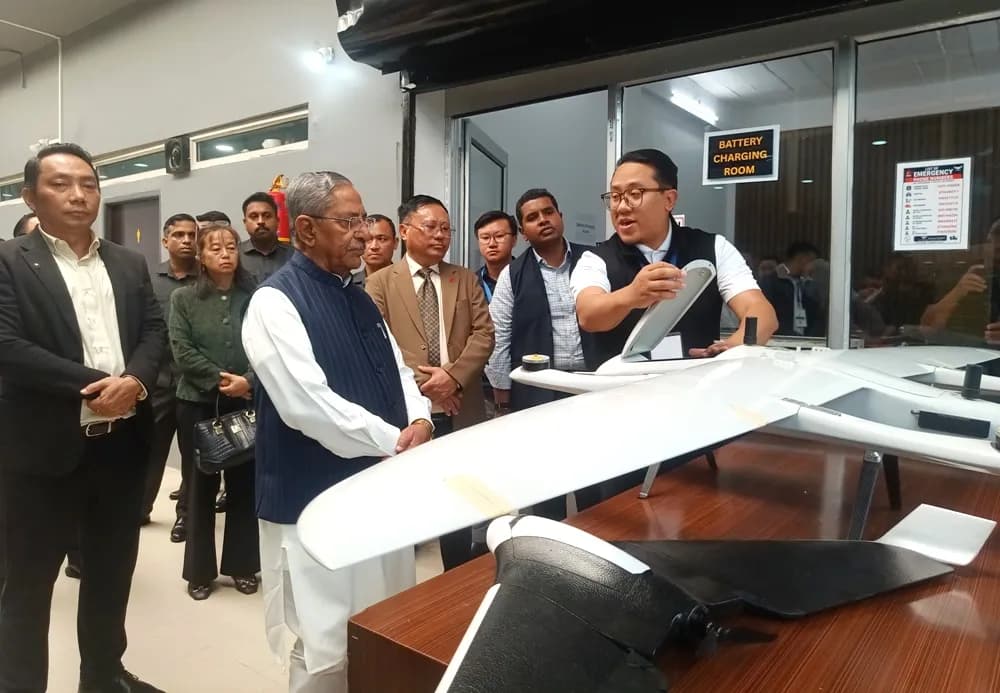
KOHIMA — Nagaland Governor Nand Kishore Yadav on Monday visited the Nagaland GIS and Remote Sensing Centre (NGISRSC) and the Drone Centre of Excellence, Kohima, under the Planning and Transformation Department, where he expressed appreciation for the centre’s work in advancing drone technology and geospatial applications in the state.
During the visit, the governor was briefed on Nagaland’s journey in adopting drone technology, which began with the establishment of a drone unit for mapping, surveying and geospatial data acquisition. The centre has since undertaken research and development programmes and collaborated with government departments and other stakeholders, gradually expanding its capabilities in UAV training and applications.
The Drone Centre of Excellence has evolved from a drone school with the objective of developing skilled manpower and creating career opportunities in employment, entrepreneurship, start-ups and public-sector UAV deployment.
The centre offers specialised programmes, including DGCA-compliant remote pilot certificate courses for small and medium-category drones, as well as training in First Person View (FPV) operations, drone repair and maintenance, GIS-based drone surveying and mapping, drone cinematography and hands-on avionics.
Also read: Rio inaugurates Nagaland’s first Drone School, launches ‘Naga Bazaar’ on Republic Day
Under the Nagaland Skill and Entrepreneurship Development Mission (NSEDM), 70 candidates have been selected for training in various drone-related courses, while 72 trainees have so far completed training under the Drone Centre of Excellence.
The centre’s future plans include the development of a State Geospatial Campus at Tuoliezou, Kohima, along with an Advanced Drone Technology and UAV Innovation Hub.
The proposed facilities are expected to support work involving AI-enabled drones, LiDAR, multispectral and thermal sensors, autonomous systems, fabrication, prototyping, repair and manufacturing.
WATCH MORE:
These technologies are envisaged for applications in areas such as disaster response, agriculture, healthcare, infrastructure, environmental monitoring and geospatial mapping.
Yadav appreciated the efforts to build a skilled workforce in emerging technologies and stressed the need to prepare Nagaland’s youth for future employment opportunities.
He noted that drone technology has wide-ranging applications, including agriculture, infrastructure, disaster management, environmental monitoring, cinematography and geospatial mapping.
The governor also emphasised the importance of leveraging modern technology and innovation for effective governance and development, and assured his support for strengthening the centre’s activities and capabilities.
‘NGISRSC among the best in Northeast’
Principal Secretary and Development Commissioner Y Kikheto Sema described NGISRSC as one of the state’s important projects, which began in 2006, and claimed that the centre is among the best in India and the best in the Northeast.
Sema highlighted the growing demand for drone professionals, stating that around 500 drone pilot positions are expected to become available in the Northeast in the near future.
He said the state was therefore focusing on training and preparing local youth to take advantage of emerging opportunities.
He said the government was committed to promoting drone technology and cited its potential in agricultural spraying, surveys, transportation and logistics, as well as town planning.
He added that the government would hold discussions with agriculture and allied departments on adopting drone technology to benefit farmers.
Sema also said the existing facility is a temporary arrangement and that a dedicated institution for drone technology is planned.
Senior Project Director of NGISRSC Mhathung Kithan said candidates who have passed Class 10 are eligible for the remote pilot training, subject to applicable requirements.
He said the seven-day course covers operational guidelines, rules and security concerns, along with practical flying experience. Applicants who fulfil the prescribed requirements receive the relevant remote pilot certification.
Kithan said the centre had received around 800 applications, necessitating a scrutiny process through the skill development programme.
Aim to manufacture drones in Nagaland
Atho Kesiezie, UAV Engineer and Coordinator of the Drone Centre of Excellence, said the state’s drone design and development capabilities have advanced considerably since 2016.
He said the centre is now able to design drones using computer-aided design software and manufacture structural components through 3D printing and CNC machining of carbon-fibre plates.
While Nagaland currently imports components such as motors, flight controllers, computers and electronic speed controllers, Kesiezie said developing the capacity to manufacture these components locally is the centre’s long-term goal.
He said the ultimate vision is to develop a drone completely made in Nagaland, reducing dependence on imported components while establishing the state as a centre for drone applications, training and manufacturing.
“With the right infrastructure and platform, the Naga people are also very skilled,” he said, adding that the centre hopes to establish Nagaland’s presence on the national map of drone technology.