


Dr. Kekhrielhoulie Yhome urges education reform at PM SHRI Government High School Kohima.
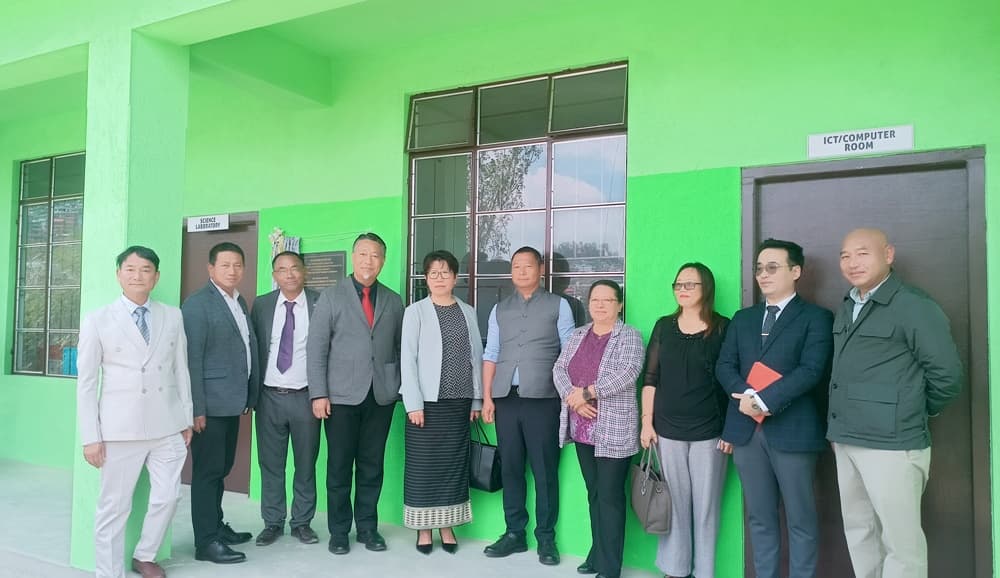
KOHIMA — Advisor for School Education & SCERT, Dr. Kekhrielhoulie Yhome, on Thursday called for a comprehensive rethinking of the school education system while asserting that government schools in Nagaland are on a path of transformation.
The advisor was addressing the inauguration of an Atal Tinkering Lab, Science Lab, ICT/Computer Lab, Library Room, and Vocational Lab at PM SHRI Government High School (GHS) New Market, Kohima, as the chief guest.
Yhome lauded the New Market community for its continued support towards the school, particularly for purchasing land for the institution. He said such community participation is critical, especially in urban areas where land constraints pose a major challenge to expanding government schools.
He reflected on the school’s academic journey and noted that since its upgrade to a high school in 2016, students have consistently appeared for the HSLC examinations.
This year, 26 students will be appearing, while the school has also recorded a steady intake of new students, including 60 fresh admissions in Class Nine. Of these, 19 students have shifted from private schools, indicating a gradual change in public perception.
He cited similar trends in other government schools, including a recently established institution at Phezoucha, which recorded 64 new admissions, with 34 students coming from private schools.
Also read: SCERT Nagaland releases key educational publications
“These are encouraging signs,” he said, adding that urban community schools play a crucial role in catering to working-class families and deserve focused attention.
However, the advisor expressed concern over the prevailing mindset among parents. He pointed out that despite economic hardships, many families continue to send their children to private schools, often at significant financial strain.
“Our people are not economically strong, yet we spend heavily on private education. There is something fundamentally wrong in our system of thinking,” he remarked.
He maintained that government school teachers are qualified and that infrastructure, though not always ideal, is comparable to many private institutions. He added that in some cases, government schools are even better equipped.
To address systemic gaps, Dr. Yhome informed that the state has established the Nagaland School Standards Authority, which will introduce regulatory measures to ensure quality and accountability across both government and private schools.
Outlining the roadmap for reform, he said the government is restructuring the school ecosystem based on three core pillars—improving infrastructure, strengthening governance, and enhancing curriculum and pedagogy.
He also acknowledged internal challenges, including surplus and unfit teachers, stating that the department is actively addressing these legacy issues.
Emphasising the broader role of education, the advisor said, “Our society can only be rebuilt through classrooms.”
He also raised concerns about the unregulated growth of private schools over the years, stating that while private participation is necessary, it must be balanced with state responsibility and proper regulation.
Guest of honour, Dr. Tseilhoutuo Rhutso, MLA, in his address, appreciated the efforts of the School Education department under Dr. Yhome and noted the increasing trend of students moving from private to government schools.
He challenged government teachers to reflect on whether they enrol their own children in the schools where they teach, emphasising the need for greater confidence in the public education system.
Referring to students as the “fields” of parents, he said they must be nurtured carefully to yield a “good harvest.”
Rhutso also suggested the introduction of higher secondary sections in government schools with sufficient land, stating that such upgrades would help improve enrolment in urban areas like Kohima.
Commissioner & Secretary, School Education & SCERT, Kevileno Angami, highlighted the critical role of community involvement in the success of schools.
She expressed appreciation to the School Management and Development Committee (SMDC) and the community for not only supporting the school but also for going beyond their mandate to procure land for its development.
Citing data, she informed that Nagaland currently has 1,881 government schools and 813 private schools, yet only about 40% of students are enrolled in government institutions.
She noted that in many developed countries, the majority of students attend public schools and said a similar shift is possible in Nagaland with the right approach.
She, however, stressed the need for a change in mindset, urging stakeholders to develop a sense of ownership towards public institutions.
Kenny Peseyie, SMDC member, presented a brief history of the institution. He said the school was established around 1933 as an upper primary school and has since evolved through the efforts of community leaders and government support.
Earlier, Kekhriezhazo Dzüvichü, assistant headmaster and chairman of SMDC, delivered the welcome address.