


Nagaland CHOs highlight grassroots healthcare challenges and seek regularisation, more manpower and stronger Health and Wellness Centres.
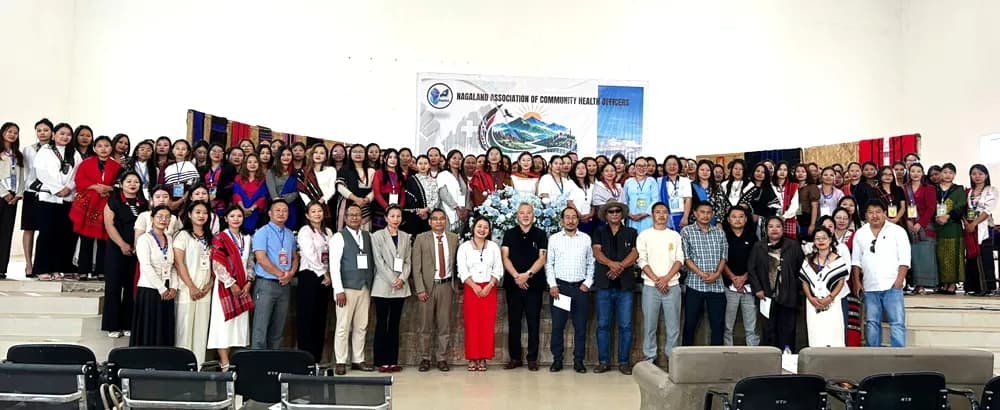
WOKHA — The Nagaland Association of Community Health Officers (NACHO) convened its biennial general meeting on the theme, “United for Health, Committed for Community,” highlighting the critical role of Community Health Officers (CHOs), challenges faced by them, and measures needed to strengthen healthcare delivery at the grassroots level at Tiyi Hall, Wokha town, on Thursday.
Addressing the gathering, Advisor to the Chief Minister, Dr. Chumben Murry, underscored the evolving role of CHOs in bringing healthcare services closer to communities.
Referring to the Alma-Ata Declaration of 1978 and the National Health Policy, he said community-based healthcare was developed to make health services more accessible and responsive to local needs.
Describing CHOs as dedicated mid-level healthcare providers, Dr. Murry said their close engagement with communities enables them to better understand local health concerns and identify appropriate interventions.
Also read: Forest official urges Nagas to use Article 371(A) responsibly
He also highlighted their role in coordinating with frontline healthcare workers, including Accredited Social Health Activists (ASHAs), to ensure effective healthcare delivery.
Emphasising that healthcare responsibilities extend beyond hospitals and clinics, Dr Murry urged CHOs to remain accessible to the people, listen to their concerns, and actively reach out to communities.
He further encouraged healthcare workers not to give up on patients and to continue serving with commitment and compassion.
NACHO president Arensenla Longkhumer, meanwhile, pointed out that common health issues reported at the community level include fever, cough and diarrhoea among children, hypertension among older persons, and anaemia among women and lactating mothers.
Injuries and skin-related ailments were also among the frequently encountered health concerns.
Referring to recent deaths suspected to be linked to spurious liquor consumption, Longkhumer stressed the importance of preventive measures through community awareness.
She informed that standard operating procedures (SOPs) have already been prepared and awareness programmes are being conducted with the support of local communities and church organisations.
NACHO vice president Nevelu Nyekha appealed to the government to regularise the services of CHOs. In the event that regularisation is not feasible, he suggested that their salaries be merged with the Performance-Based Incentive (PBI).
Nyekha also called for additional manpower to ease the workload of CHOs and urged the government to strengthen infrastructure at Health and Wellness Centres across the state.
The meeting also deliberated on the roles and challenges of CHOs and stressed the need for stronger coordination and collaborative efforts to improve healthcare services at the community level.