


District Congress Committee, Mokokchung, slams Modi-led NDA government for repealing the MGNREGA.
Share


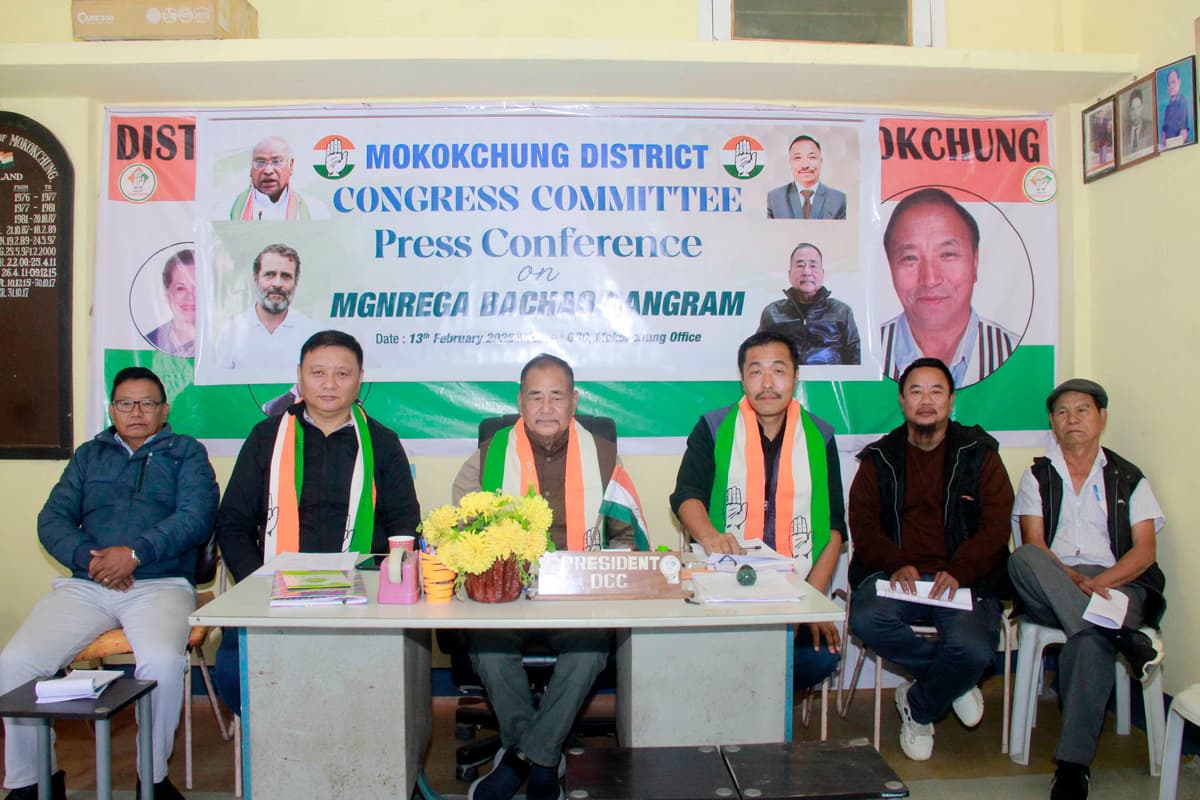
MOKOKCHUNG — The District Congress Committee (DCC) Mokokchung on Friday criticised the Modi-led NDA government for repealing the Mahatma Gandhi National Rural Employment Guarantee Act (MGNREGA) and replacing it with the Viksit Bharat Guarantee for Rozgar and Ajeevika Mission (Gramin) Act, widely referred to as the VB-G RAM G Act.
The DCC described this move as a direct assault on rural communities and called for the immediate restoration of the original MGNREGA, along with the enforcement of fundamental rights to employment and fair wages.
The DCC's key demands include upholding the right to work as a constitutional entitlement, ensuring guaranteed wages, promoting full accountability, reinstating MGNREGA in its original form, restoring the legal right to employment, and implementing a nationwide minimum wage of INR 400 per day.
Also read: Nagaland College Principals Association annual conference focuses on research culture
These demands were voiced during the ‘MGNREGA Bachao Sangram’ press conference held at the party office in Alongmen Ward, attended by DCC leaders, including president Watimongba Aier, vice presidents L Yanger Lemtur, Nukshi I Ozukum, I Temsu Jamir, Aojungshi, and Aotemsu, as well as general secretary (admin.) Temsu Imchen.
Congress leaders alleged that the central government is targeting India’s poor population, particularly in rural areas where the majority of citizens live and depend heavily on MGNREGA for their livelihoods, which supports crores of families.
They warned that the dilution of the Act would inevitably harm rural populations and vowed that as an opposition, DCC Mokokchung will continue its vigorous campaign until the Modi government reverses the VB-G RAM G Act and fully restores the original MGNREGA, which they argue has been diluted and stripped of core guarantees.
They highlighted that under the original MGNREGA, every rural household across India was legally entitled to at least 100 days of work, provided within 15 days upon request at any gram panchayat.
In contrast, they alleged that the new framework under the Modi government transforms employment from an enforceable right into a discretionary provision, subject to central government decisions.
They claimed work would now be selectively offered to specific gram panchayats rather than being demand-driven under MGNREGA.
The Congress further contended that wage protections are being undermined. The MGNREGA scheme ensured jobs at state-notified minimum wages (revised annually), available throughout the year with flexibility for workers to choose when to participate, they alleged.
They argued that the new system allows arbitrary wage setting without guaranteed minimums or yearly revisions.
They added that work would be paused during harvest seasons, reducing workers' bargaining power for better wages in other sectors and compelling them to accept whatever is available, without any minimum wage floor.
The party also criticised the transfer of decision-making authority from gram panchayats to contractors, shifting away from a demand-driven, fully centrally funded model to a "saturation planning" approach in graded panchayats (A/B/C categories).
Previously, they said gram panchayats (village councils) planned and approved local development projects, with contractors prohibited and local mates and rozgar sahayaks assisting workers directly.
They added, under MGNREGA, gram panchayats held the power to engage local workers in diverse village improvement and development initiatives.
The leaders claimed, now the directives originate from Delhi, restricting projects to limited priorities such as water security, infrastructure, livelihoods, and climate resilience, rather than locally identified needs.
They warned that gram panchayats would be reduced to mere implementers of central instructions, with contractors taking control and turning workers into mere labor suppliers, without support from local mates or sahayaks.
Moreover, while MGNREGA provided full central funding for wages with open-ended allocations based on actual demand—relieving states exchequer of heavy burdens—the new Act imposes a schematic entitlement, limited by fixed, normative budget cap and statutory guarantee of 125 workday and shifts to a 60:40 Centre-state funding ratio (90:10 for north-eastern states).
DCC vice president I Temsu Jamir remarked, “The people are being misled by the VB-G RAM G Act's claim of increasing workdays to 125, which is merely a statutory limit rather than the full, unconditional guarantee of 100 days under the original MGNREGA.”
The Congress highlighted that for two decades, MGNREGA had been a lifeline for rural workers. During the COVID-19 crisis, triggered by the government's sudden lockdown that left millions of migrants stranded, the scheme provided employment to 4.6 crore households.
The DCC Mokokchung announced plans to embark on village-level sensitisation campaigns soon to educate people about these changes and mobilize them in support of restoring MGNREGA to its original strength.
The ‘MGNREGA Bachao Sangram’ is a 45-day nationwide campaign launched by the Indian National Congress, running until February 25, 2026. Directed by the party high command, it includes activities such as district-level press conferences, fasts, panchayat chaupals, outreach programs, ward sit-ins, state assembly gheraos, and rallies.