


NIELIT Kohima forensic analyst Atoshe Lohe says defamation cases are among Nagaland’s most common cybercrime complaints and urges citizens to report fraud immediately.
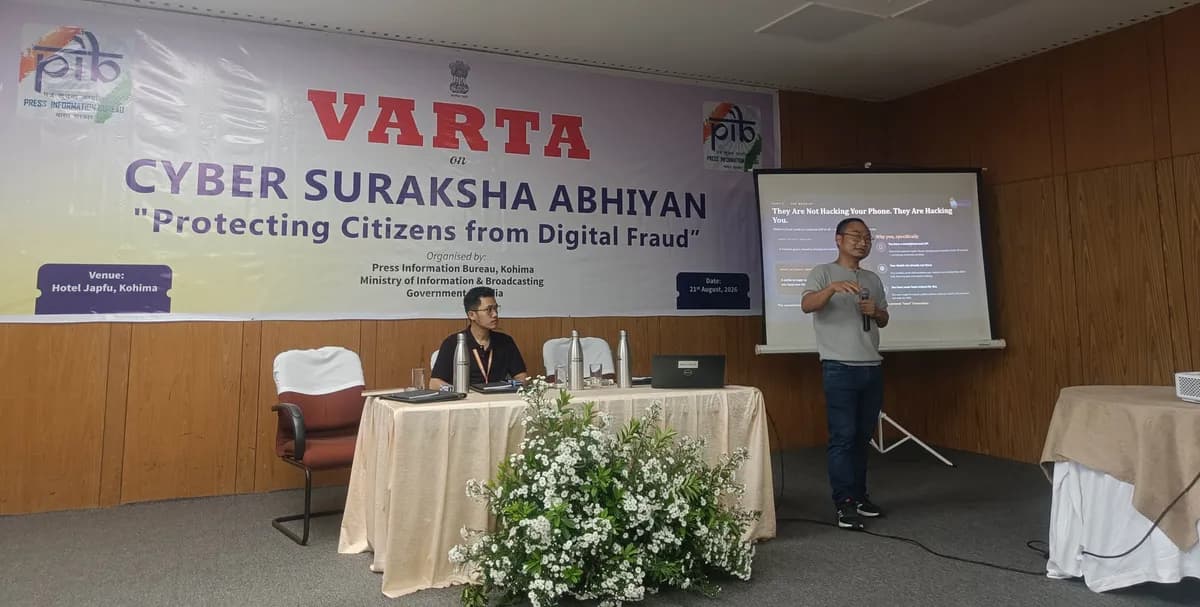
KOHIMA — Principal Forensic Analyst at NIELIT, Kohima, Atoshe Lohe, has said that defamation cases are among the most common cybercrime complaints reported in Nagaland and are frequently encountered during cybercrime investigations.
Lohe was speaking at a one-day media workshop, “Varta on Cyber Suraksha Abhiyan: Protecting Citizens from Digital Fraud", organised by the Press Information Bureau (PIB), Kohima, Ministry of Information and Broadcasting, at Hotel Japfü, Kohima, on Friday.
He said no one is immune to cybercrime and that people can become victims knowingly or unknowingly. He stressed that awareness and responsible use of technology remain the most effective means of protection.
“Technology comes and goes and there is going to be vulnerability in each technology,” Lohe said, pointing out that it is difficult for users and law-enforcement agencies to master rapidly evolving technologies before newer systems emerge.
He said cybercriminals exploit these vulnerabilities, while investigators are also constrained by the technologies being used by offenders.
He emphasised the need for greater public awareness about safe technology use.
Lohe also said the conviction rate in cybercrime cases in Nagaland remains low, partly because criminals are adapting quickly to new technologies and laws.
Law-enforcement agencies, he said, are also trying to keep pace with emerging legal and technological challenges.
He highlighted the importance of following standard operating procedures (SOPs) during cybercrime investigations, noting that failure to follow prescribed procedures could render digital evidence inadmissible in court.
Lohe outlined the Money Restoration and Grievance Redressal modules of the National Cyber Crime Reporting Portal, launched in April 2026 by the Ministry of Home Affairs.
The modules aim to streamline fund recovery for victims of financial fraud and address grievances, including those concerning frozen bank accounts.
He cautioned citizens against fake investment schemes, impersonation of banks and financial institutions, and applications downloaded from unverified sources.
Remote-access applications such as AnyDesk, he said, can be misused by fraudsters to gain control of devices and access sensitive information.
He urged citizens to download applications only from official and trusted sources and to be cautious before granting remote access to their devices.
Emphasising the importance of the “golden hours” following financial cyber fraud, Lohe urged victims to immediately report incidents through the National Cyber Crime Helpline 1930 and the National Cyber Crime Reporting Portal, as early reporting improves the chances of tracing and recovering stolen funds.
He also stressed the need for continued capacity building and training of law-enforcement agencies, particularly as cybercrime investigations are increasingly complicated by multiple digital platforms and encrypted communication channels.
Visezo Dahou, Faculty, Cyber Security, NIELIT, Kohima, in his presentation, cautioned participants about various cybercrimes and frauds, including fake investment and trading apps, digital arrests, sextortion and blackmail, AI voice cloning, fake PM-KISAN registration APKs, non-consensual intimate images, OTP, UPI and banking fraud, fake loan applications and fraudulent online shopping platforms.
Dahou said India recorded losses of INR 22,495 crore to cyber fraud in 2025, with 28.15 lakh complaints reported during the year.
He said 76% of the reported financial losses were attributed to fake investment and trading scams.
He urged citizens to follow the “Pause, Verify, Report” approach before responding to suspicious calls, messages, links or investment offers.
He advised people never to share OTPs, PINs, CVVs or passwords and reminded them that a UPI PIN is required to send money, not receive it.
In cases of sextortion or online blackmail, Dahou advised victims not to pay or engage with perpetrators, but to preserve evidence and report the matter.
He urged victims of financial cyber fraud to call 1930 immediately, contact their bank through its official helpline and report the incident through the National Cyber Crime Reporting Portal.
He said INR 11,158 crore had been saved across more than 32.80 lakh complaints through the Citizen Financial Cyber Fraud Reporting and Management System as of June 30, 2026.
The workshop was attended by representatives of local media houses, members of the Kohima Press Club, Akashvani Kohima, Doordarshan Kendra Kohima, PTI, and students from St Joseph’s College and Nagaland University.