


BIS and NIDC held a sensitisation programme in Dimapur to help Nagaland MSMEs adopt quality certification and expand market access
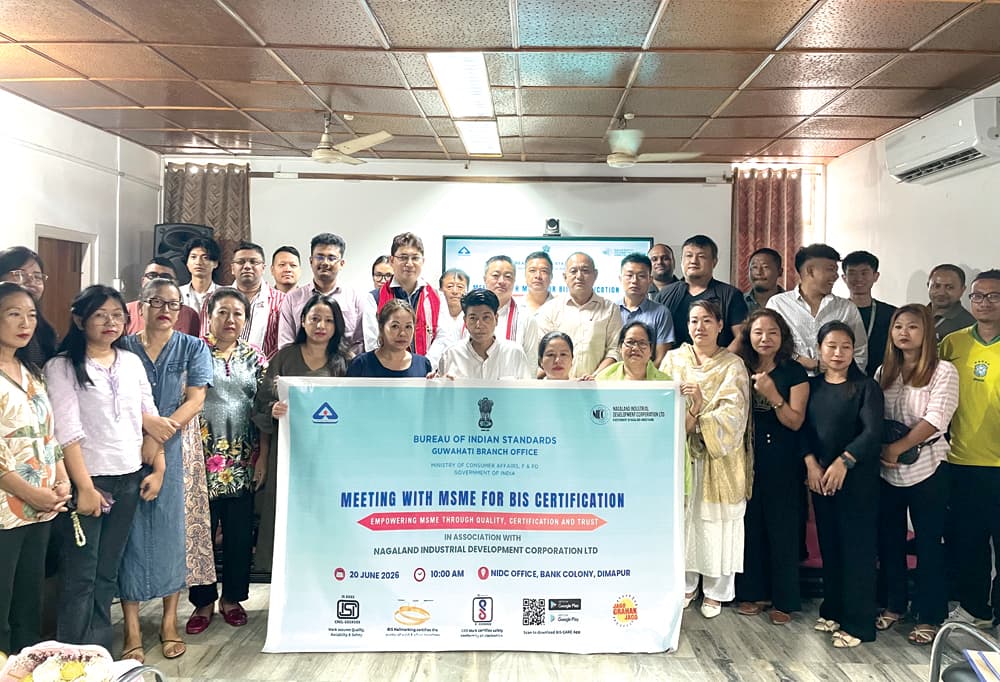
DIMAPUR — A one-day sensitisation programme on quality standards and Bureau of Indian Standards (BIS) certification, aimed at empowering micro, small and medium enterprises (MSMEs) in Nagaland and raising awareness about the importance of quality certification in enhancing market competitiveness, was held at the Nagaland Industrial Development Corporation (NIDC) office in Dimapur on Saturday.
The programme was organised by the BIS Guwahati Branch Office in association with NIDC Ltd.
Addressing the gathering as chief guest, NIDC Chairman Kvulo Lorin said that although the government has created substantial infrastructure in the state, much of it remains underutilised.
He urged entrepreneurs to look beyond Nagaland to expand, survive and compete in a larger market.
"When we look at our economy, we must think beyond Nagaland to stay relevant in today's competitive world... It is not impossible and does not require massive amounts of money. It requires a system and a strategy," he said.
Lorin encouraged participants to act on the knowledge gained during the programme and called for targeted follow-up after the event.
"I would like you to find out the exact industries they come from and connect them with the right people so that they can execute," he said, adding that willingness to participate should translate into proactive action.
In a major announcement, Lorin said the NIDC would serve as a single-window facilitation centre for MSMEs seeking BIS and other certifications.
"We will help you navigate the application process, connect you to financing if certification costs are a barrier, and follow up—not once but until the certificate is in your hands," he assured.
He urged entrepreneurs to leave the programme with a clear plan of action by identifying products or certification schemes relevant to their businesses and engaging with BIS officials during the technical sessions.
Lorin emphasised that quality standards go beyond regulatory compliance and directly benefit consumers while enabling local businesses to access larger markets.
"There is a huge market that almost every industry and business in the world wants to tap into, and that is the Indian market. We are right here," he said.
Pointing to technological shifts, he said artificial intelligence and easy access to knowledge were reducing barriers to growth.
"With the advent of AI and the rapid pace of change, there is actually nothing that can hold you back once you have the knowledge and the necessary regulatory approvals," he added.
Acknowledging the challenges faced by entrepreneurs, Lorin said overcoming difficulties equips local businesses with resilience and adaptability.
He said entrepreneurs in Nagaland possess a natural advantage because they have learned to operate under challenging conditions, placing them in a stronger position than those attempting to establish businesses in the state from elsewhere.
He stressed that the need of the hour was to understand larger markets, explore emerging opportunities and work towards measurable outcomes.
Speaking at the programme, NIDC General Manager Temjenyanger Jamir said that as markets become increasingly interconnected, consumers now demand quality, safety and compliance.
"BIS certification and standardisation play a vital role in enhancing product credibility and boosting consumer confidence," he said.
Jamir observed that the lack of standardisation continues to restrict market access for local producers.
"We manufacture several products in Nagaland, but penetrating organised markets is extremely difficult without standardisation and proper certification," he said.
The GM noted that even high-quality products, including the state's organic produce, face barriers to entering formal markets without recognised certification and organised market systems.
Director and Head of the BIS Guwahati Branch Office, Shouvik Chanda, said BIS serves as India's national standards body and undertakes a wide range of activities beyond formulating Indian standards.
He said BIS administers product certification, including the widely recognised ISI mark certification, management system certifications such as ISO 9001, and hallmarking services.
Chanda added that BIS also promotes standardisation through student and standards clubs in educational institutions and signs memoranda of understanding with premier institutes across the country.