


Dr. Kekhrielhoulie Yhome highlights the heavy salary burden on the School Education department amid protests by Nagaland Government Teachers Association and other teacher groups.
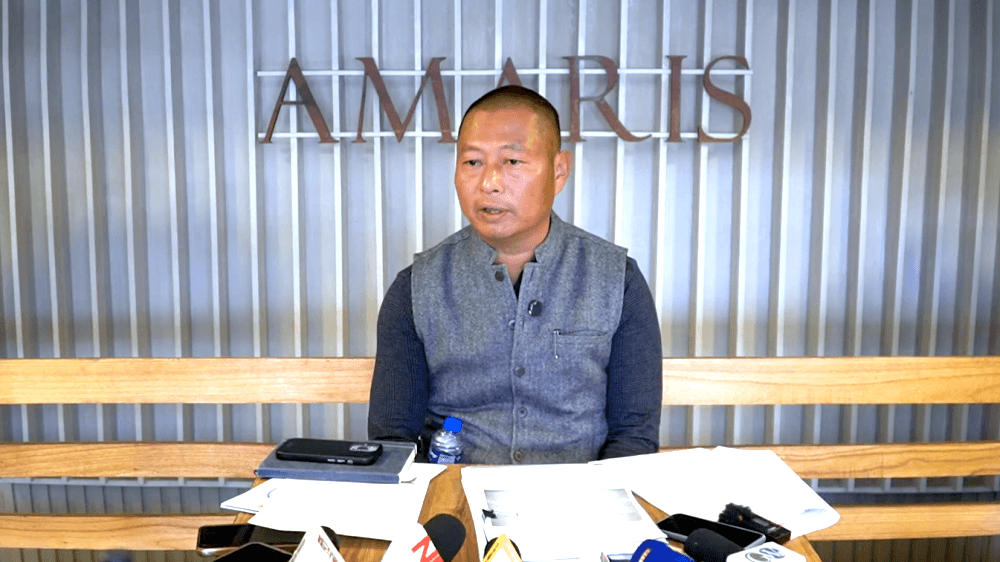
KOHIMA — Advisor for School Education and SCERT Dr. Kekhrielhoulie Yhome on Monday explained the financial implications of service regularisation, backdoor appointments and salary-related liabilities on the state, amid protests (some ongoing, some temporarily paused) by various groups of government teachers.
The protesting groups include the Rashtriya Madhyamik Shiksha Abhiyan (RMSA) teachers’ batch of 2016, the All Nagaland Ad hoc Teachers Group-2015 (ANATG-2015), and the ongoing protest by the Nagaland Government Teachers Association (NGTA) batches of 2010 and 2013, which entered its third day on Monday.
Briefing the media in Kohima, Yhome said that the NGTA’s demand for shifting their salary head from centrally sponsored schemes to the State Plan was “impossible” for the department to implement, as it falls under the prerogative of the state government.
Also read: Nagaland Government Teachers’ Association to intensify protest from March 2
“I cannot understand why they want the state to pay their salaries. That is very unreasonable. Till today, they have been receiving their salaries,” he said, adding that salary emoluments are currently released by the government of India in four instalments.
He suggested that converting salaries to the State Plan would have serious financial repercussions for the budgeting system.
WATCH MORE:
While empathising with the teachers, the advisor said that students were being affected by prolonged classroom absences.
He said that the government may take a political decision that “could go against” the protesting teachers and warned of possible disciplinary action, including suspension and breaks in service, if the agitation continues.
Referring to ad hoc appointments, Yhome said that 2,483 teachers under the School Education department were appointed without open recruitment but were later regularised.
Of these, 1,166 teachers are members of ANATG-2015 who had recently staged agitation in Kohima.
He informed that the total number of “backdoor appointees” regularised by the government stands at 3,364, including 2,483 from School Education and 881 from 41 other departments.
For regularisation, ad hoc teachers are required to undergo multiple verification processes under the Personnel and Administrative Reforms (P&AR) department.
These include verification of appointment orders, regularisation against sanctioned vacancies, release orders, medical fitness, APARs and physical verification of original academic certificates.
“Out of the 1,166 protesting teachers, only 235 have submitted their documents so far, and P&AR has already cleared 100 cases,” he said.
Yhome warned that if any teacher is found to have submitted fake certificates, their services would be terminated and they would be required to reimburse all benefits and emoluments received.
State finances
According to the advisor, School Education department alone receives between 8.3% and 8.5% of the state budget, which he described as “very high,” adding that the bulk of this allocation goes towards salaries.
He said that between 2020 and 2025, the state allocated INR 7,891.36 crore to the department, while central funding amounted to INR 1,535.57 crore.
Combined, the School Education department consumed INR 9,426.93 crore over the five-year period.
Despite this, he said that only 0.48% of the state’s education expenditure was invested in capital infrastructure.
He added that about 14.26% of central grants are being spent on capital works, even as most school infrastructure dates back to the 1960s–80s and is now in poor condition.
On the RMSA 2016 batch, Yhome said that the implication of regularisation is that the state would forgo over INR 80 crore in future central assistance.
He added that the department has calculated that this batch alone would cost the state INR 313 crore until the last teacher retires.
Appealing for patience, the advisor urged teachers to be reasonable and assured that the department would not take any decision without following due process of law.