


Kudecho Khamo urges the Chakhesang community to explore business opportunities and promote entrepreneurship and self-reliance
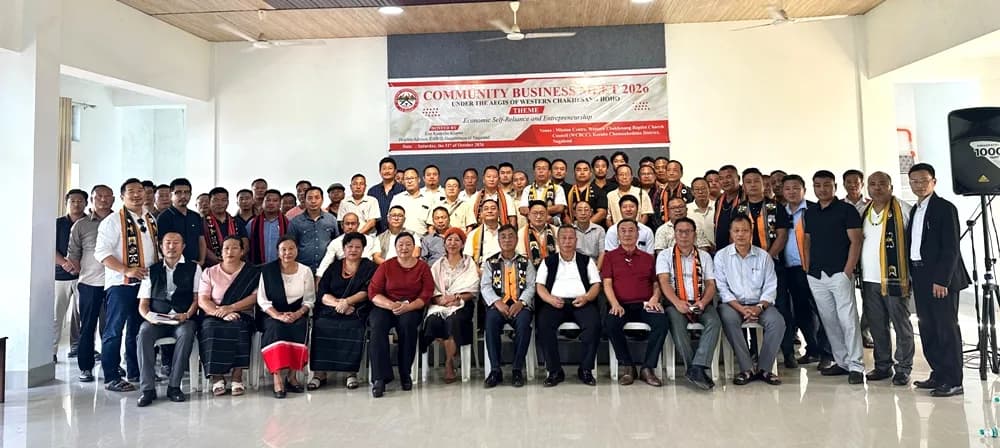
KOHIMA — Advisor for CAWD Kudecho Khamo on Saturday called upon the Chakhesang community to explore business opportunities, promote entrepreneurship and cultivate a culture of self-reliance.
He was addressing the inaugural programme of the Community Business Meet 2026, organised under the aegis of the Western Chakhesang Hoho (WCH) at the Mission Centre of the Western Chakhesang Baptist Church Council (WCBCC), Kozabe, in Chümoukedima district.
Khamo observed that the Chakhesang community was known for its honesty, bravery, hard work and integrity, and urged people to translate these inherent qualities into economic opportunities.
He said the community's human resources and traditional strengths should be harnessed to promote business and entrepreneurship.
Acknowledging the unity and collective participation demonstrated by the community despite linguistic, geographical and social differences, he said such strengths could be channelled towards economic progress.
Pointing to the growing presence of Chakhesang people in vegetable vending and thrift businesses in Kohima, Khamo also highlighted the emergence of young entrepreneurs and encouraged the community to build on these existing ventures while exploring new opportunities.
Also read: Neiphiu Rio calls for all Naga groups to join peace talks
Warning that poverty and backwardness could become serious challenges without social reforms, he called for a shift away from dependence on leaders and expectations that others would provide opportunities.
He urged individuals to take responsibility for their economic well-being rather than blame leaders or those who had progressed through their own efforts.
Emphasising the importance of financial literacy, proper planning and specialisation, Khamo encouraged individuals to identify and develop their talents.
He also called for stronger business partnerships within the community to pool resources, knowledge and capabilities.
Observing that the world had become increasingly competitive, with greater emphasis on capitalism, he urged the community to strengthen its work culture while preserving traditional and cultural values, alongside Christian faith and beliefs.
He stressed the need to remain rooted in one's identity while adapting to changing economic realities.
Khamo said the future of the community should not depend solely on government employment, although those preparing seriously for competitive examinations should continue to be encouraged. He also pointed to limitations in land holdings as one of the challenges in relying primarily on government jobs for livelihood.
Instead, he urged people in the Western Chakhesang area to take the lead in converting available resources, human potential and traditional strengths into viable business ventures.
Maintaining that money alone could not sustain a business, he said the ability to think and the willingness to work constituted the real capital.
He also stressed the importance of sacrifice, discipline and an uncompromising commitment to the fear of God.
Calling for a re-evaluation of the community's approach to economic development, he urged people to become doers rather than commentators and critics.
Identifying the abundance of organic and naturally grown produce in Phek district as a potential business opportunity, Khamo encouraged growers and traders to make better use of improved road connectivity and transportation facilities to access wider markets.
He said such initiatives could benefit both producers and traders.
Earlier, presenting the summit perspective, WCH president Yetshulhi Ngatsi said organising the programme had been a long-standing desire of the hoho.
Ngatsi observed that a significant section of the Chakhesang community continued to lag economically, despite progress made by some members in business.
He said the summit was conceived to provide an impetus to entrepreneurship, strengthen networks and establish business connections within the community.
He stressed the need to strategise and seize available opportunities to empower the community, while creating platforms for people to support one another and develop collective economic initiatives.