


Neiphiu Rio urges NSCN (IM) and NNPGs to join the Naga peace talks under the Forum for Naga Reconciliation platform

KOHIMA — Chief Minister Neiphiu Rio has called on all Naga political groups, including the NSCN (IM) and NNPGs, to come together under the Forum for Naga Reconciliation (FNR) platform and engage in talks with the Government of India, stating that an amicable solution to the Naga political issue would not be possible without the participation of all groups.
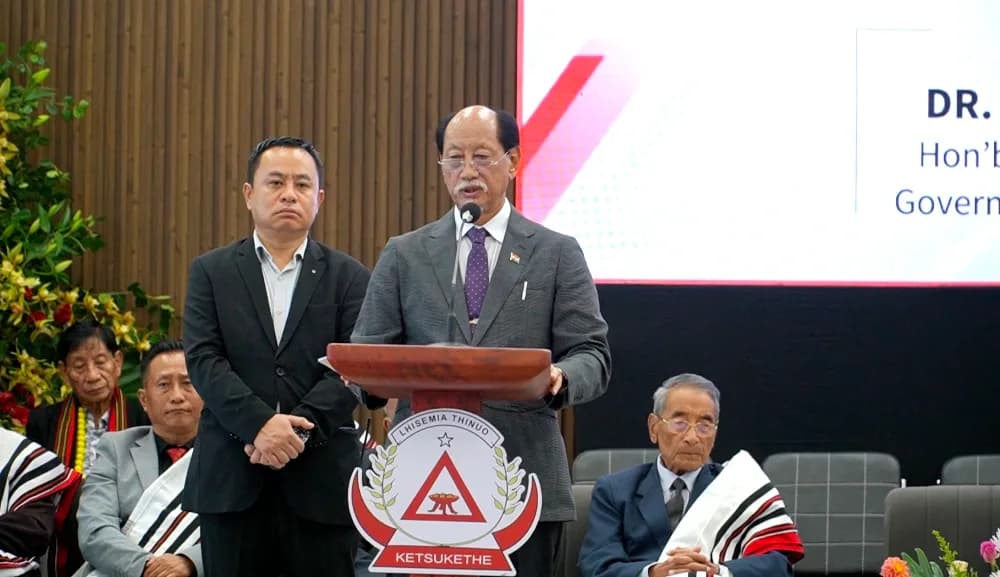
Rio was speaking during the inauguration of the Lhisemia Multipurpose Building at Khrabvübozou, L Khel, Kohima Village, on Saturday. He said the Naga People’s Front (NPF), as a regional party, believed that all Nagas, including underground groups, civilians and organisations, must be included in the political dialogue as “Nagas are a family”.
He reiterated that the Nagas, as one family, could not arrive at a conclusion without sitting together for talks. He said that whenever consultative meetings were convened, all tribal hohos, political parties, civil society organisations and student bodies were invited.
Recalling the consultative meeting held on September 12, 2024, Rio said 60 organisations had participated and there were 220 signatories. He said the meeting had appealed to underground groups not to create more factions, pointing out that while there were only six ceasefire groups, there were more than 30 factions. “More factions means more taxations,” he said.
Also read: Rio highlights women’s empowerment, announces INR 7 cr for ENWO centre
Rio also recalled that the meeting had appealed to the government of India to elevate the ongoing dialogue and peace process to the highest level by appointing a political-level or ministerial-level interlocutor who had the confidence and mandate of the government.
He said the earlier interlocutor, AK Mishra, was a Northeast adviser and not a political interlocutor, and that his talks were limited to underground factions, which did not lead to a solution but resulted in further disarray.
Rio said the government of India had responded on September 11, 2026, stating that it had decided to continue the talks under a minister or group of ministers and had officially appointed Ajit Lal as the interlocutor for the Naga peace talks.
In this regard, he called on the NSCN (IM) and all NNPG groups in agreed positions to come together under the FNR platform and hold talks with the government of India.
On another issue, Rio said Nagaland had four non-Naga tribes — Kuki, Kachari, Garo and Karbi — whom he described as migrants. He also referred to other communities, including Marwaris, Gorkhas, Bengalis and Nepalis, who had migrated to Nagaland over the years.
He said some of these communities had been granted indigenous certificates by government officials in the past, which he described as wrong. Referring to the Kuki, Kachari and Garo communities approaching courts for indigenous status, Rio said the state government would not accept such a ruling, arguing that migrants could not become indigenous.
He said the demand for indigenous status was linked to access to seats and quotas in higher education and scholarships, and cautioned that extending such benefits to more people could affect the share available to indigenous Naga students.
Rio said village councils had the authority to certify indigenous persons and urged them to be careful and vigilant while issuing certificates. He also called for accurate surveys to distinguish indigenous inhabitants from migrants.
The chief minister further encouraged Nagas to strengthen customary laws, stating that the state government was working towards this. He said customary laws, which had been protected since British rule, were recognised by the government of India and could help resolve conflicts between tribal bodies and regions peacefully and quickly.
He said the Central Nagaland Tribes Council, Eastern Nagaland People’s Organisation and Tenyimi Union Nagaland would be called for a meeting in the coming weeks to discuss strengthening customary laws.
On the Inner Line Permit, Rio said people should not oppose migrants who were citizens of India but should take a firm stand against illegal migrants.
Meanwhile, KD Vizo, convenor of the building committee, informed that the land for the multipurpose building was donated by the Lhouvi Tseikha and family. The seven-storey building, constructed at a cost of INR 5.32 crore, houses an entrepreneurship floor, offices for public organisations, a community hall sponsored by the department of Tribal Affairs, a balcony, a mini-conference hall, a library and a rooftop viewpoint.
Former Chief Minister Shürhozelie Liezietsu and Advisor for School Education Kekhrielhoulie Yhome also spoke at the programme. The dedicatory prayer was led by Rev. Keviyiekielie Linyü, Pastor of Ebenezer Baptist Church.
Advisor for Urban Development Zhaleo Rio, MLA Dr. Tseilhoutuo Rhütso and MLA Kevipodi Sophie, among other officials, attended the programme.