


Nagaland officially remains a dry state for 36 years following the passing of NLTP Act, 1989, but alcohol has been unofficially well-stocked.
Thirty-six years of the NLTP Act, 1989: Nagaland remains officially dry, unofficially well-stocked, and spectacularly committed to the paperwork of thirst.
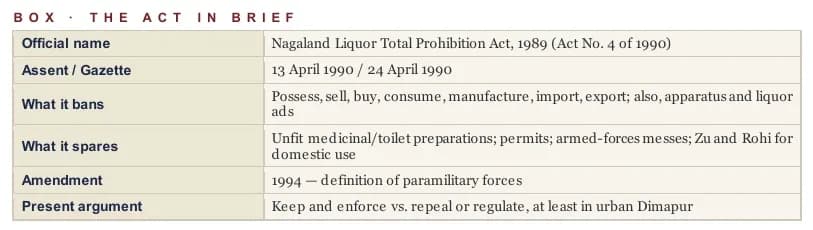
Nagaland is a dry state in the same way that a leaking roof is a water-conservation policy. The Nagaland Liquor Total Prohibition (NLTP) Act, 1989 — passed after church hunger strikes, mothers’ campaigns, and the earnest belief that legislation can out-argue a thirst — declared the hills closed for business. The hills, being hills, did not get the memo.
The Act, which received the Governor’s assent in April 1990, forbids possession, sale, purchase, consumption, manufacture, import and export of liquor. It even frowns on the utensils. Advertisements are banned. Nagaland was to become a moral climate. What it became instead is a logistics problem with a Bible verse attached.
“The government can regulate liquor. It cannot prohibit a man from drinking any more than it can prohibit him from having an opinion about the government.” — a truth the statute has spent three decades trying not to hear.
How a Temperance Crusade Became a Business Model
Give the architects their due. The Nagaland Baptist Church Council (NBCC) and the Naga Mothers’ Association (NMA) did not invent the hangover; they tried to evict it. Article 47 of the Constitution had already whispered that states should endeavour to prohibit intoxicating drinks. Dr S.C. Jamir’s government wrote the whisper into law. The intention was public health, family peace, and a society that did not measure weekends in empty bottles.
Intention, unfortunately, is not a supply chain. Demand stayed. Supply merely changed costume. It stopped wearing a licence and started wearing a lookout. The result is the oldest joke in public policy: ban a popular commodity, and you do not abolish the commodity. You abolish the invoice.
Chief Minister Neiphiu Rio, speaking in the Assembly this month on the health hazards of spurious liquor, said the Act “cannot be called successful.” That is the official dialect for: the patient has been in treatment since 1990 and still keeps a hip flask. He noted the rise of black markets, syndicates and inferior stock, and the inconvenient fact that rural prohibition has a better batting average than the urban one. Dimapur and Chümoukedima, those twin temples of commerce, remain the places where the dry law goes to hydrate.
The Fine Print Nobody Drinks
The Act is not quite as comprehensive as its title suggests. Toilet preparations unfit for use as liquor are spared, which is a mercy for anyone who has ever contemplated aftershave as a last resort. Medicinal and industrial use may proceed under permit. Registered doctors may prescribe. Armed forces and paramilitary messes may pour. Traditional rice beer — Zu and Rohi — survives if it stays domestic, which is the legislative equivalent of saying the party is allowed so long as it pretends to be dinner.
The 1994 amendment updated the definition of paramilitary forces, proving that when the law is revised, it is revised for uniforms, not for reality. Landlords, Gaonburas and government officers are supposed to report offences. Cognizance generally needs a complaint from the Director of Prohibition. In theory, the whole state is a neighbourhood watch. In practice, the neighbourhood has better things to do, and better bottles.
Health, Wealth, and Other Casualties
A ban that cannot stop drinking can still change what is drunk. Unregulated liquor is not a vintage. It is a rumour in a bottle. This month, police reported nine deaths in Tuensang suspected to be from tainted rum and warned seven districts against a batch whose labels did not match the brand — a sentence that should not exist in a place that claims to sell no rum at all.
Assembly members have described mushrooming joints, adulterated stock at festive prices, and young people drifting toward cheaper and deadlier substances because the unofficial whisky costs more than the unofficial conscience can bear. Excise reports still list seizures by the crate: IMFL, country liquor, beer, and the odd cough-syrup consignment that suggests some citizens have developed a very sophisticated cold. Revenue, once a proper excise stream, now lives mostly on compounding fines — the state taxing the evidence of its own unread law.
Manpower is thin. Borders with Assam are not. The personnel-to-population ratio has been compared unfavourably with Mizoram. Every porous road is a pipeline. Every pipeline is an opportunity. Enforcement agencies are asked to police a trade that everyone can see and no one is supposed to admit. That is how institutions acquire a limp and bootleggers acquire a lifestyle.
The drinker pays more for worse liquor. The syndicate keeps the difference. The Treasury keeps the fine. The church keeps the sermon. Everybody is employed except the original purpose of the Act.
A Global Hangover, Locally Bottled
Nagaland is not a pioneer of failure. It is a franchise. American Prohibition (1920–33), that noble experiment in making gangsters vertical, produced poisoned liquor, organised crime, and a homicide rate with opinions. Repeal did not make America sober. It made the product inspectable. The illicit share of the market collapsed because legality is cheaper than a bribe.
Bihar banned liquor in 2016 and found that 130 million people could be declared dry without actually becoming dry. Hooch deaths, overflowing lock-ups of small sellers, and a roaring import business from wet neighbours followed as if on a timetable. Mizoram lifted its ban after ministers conceded that prohibition had mainly improved the market for spurious stock. Gujarat, dry since 1960 and spiritually adjacent to the Mahatma, still drinks through Daman and other geographical courtesies. Kerala and Andhra tried the hairshirt, then quietly asked for their shirts back.
The economic principle is not complicated enough to deserve a conference. Ban a good that people still want and you do not delete the want. You delete the laboratory, the tax stamp, the age check, and the lawsuit when the bottle is paint thinner. You also create a profession whose business plan is “the government will pretend we do not exist.”
The Cry to Continue, and the Case for Growing Up
There is a sincere cry to keep the Act. It comes from churches that remember why the hunger strikers sat down in 1989, from villages where the ban is not a joke, and from citizens who have buried people the bottle took. That cry is not foolish. Alcohol wrecks homes. Domestic violence does not require a footnote. A regulated shop will not baptize anybody.
But a law that cannot be enforced is not a covenant. It is a costume. Continuing the total ban because the original intention was holy is like leaving a burnt-out streetlight in place because darkness used to be the enemy. The light is gone. The pole is still being billed to the municipality.
Repeal, or recast the statute as regulation: licensed outlets, age limits, tested stock, stiff penalties for adulteration, and excise that funds hospitals and de-addiction instead of funding the myth. Start where the farce is loudest — the Dimapur–Chümoukedima belt — if the hills are not ready to speak with one voice. Civil groups in Dimapur have already said the quiet part: lifting the ban is not a toast to alcoholism; it is an attempt to put quality, price and accountability back on a ledger.
The churches may go on preaching abstinence. They should. Sermons are allowed to be absolute. Statutes should not be, when the street has spent thirty-six years filing a dissenting opinion in empty bottles. A dry state that cannot keep rum out of Tuensang is not defending morality. It is subcontracting it to whoever owns the next consignment.
Last Call
The NLTP Act remains in force throughout Nagaland. No district has been legally exempted. That is the law. The rest is commentary, available after dark, at a mark-up, without a receipt.
If prohibition were a crop, we would have stopped planting it after the third failed harvest. We are on harvest thirty-six. The bootlegger has a godown. The drinker has a headache. The enforcement officer has a form. The public has a choice it was never supposed to need: genuine goods at a reasonable price, or the romance of a ban that everyone can taste and nobody can admit.
It is time to choose the unromantic option. Regulate the pour. Tax the bottle. Test the contents. Leave salvation to Sunday. Leave the syndicate unemployed.
Besesayo Kezo, IPS, Retd. DGP
ALSO READ