


The 63rd Indo-Naga Ceasefire Day was observed in Mokokchung with calls for reconciliation, unity, dialogue and a peaceful resolution of the Indo-Naga political issue.
Dr. Villo Naleo urges Naga leaders to overcome internal divisions
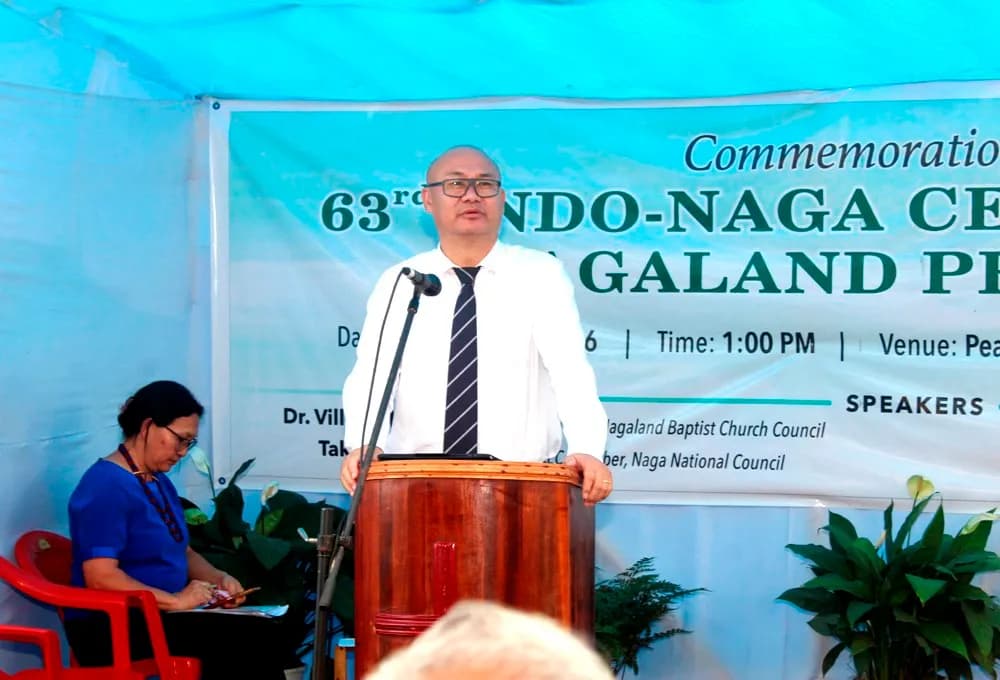
MOKOKCHUNG — The 63rd Indo-Naga Ceasefire Day, also called as Nagaland Peace Day, was observed at the Peace Talk Camp, Khensa, Mokokchung, on Sunday.
The highlight of the observance was the unveiling of a covenant stone, followed by a dedicatory prayer pronounced by Rev. Dr. Akok Amer, pastor of Impur Baptist Church, Mission Centre.
The descendants of the Leubaza clan also made a statement regarding the gifting of land for the site.
Dr. Villo Naleo, Secretary of Social Concern, Nagaland Baptist Church Council (NBCC), spoke on the theme, “Church, History and the Indo-Naga 1964 Ceasefire: Taking the Vision Forward.”
Drawing parallels between the context of the biblical prophet Isaiah and the historical and contemporary challenges faced by the Naga people, Dr. Naleo emphasised the need for dialogue, reconciliation, justice and peace.
He advocated transforming hearts and relationships to achieve lasting peace beyond the mere existence of ceasefires.
He said Naga history, particularly from 1950 to the 1964 ceasefire, had been marked by periods of darkness and conflict similar to Isaiah’s context.
Also read: Naga repatriation: ‘Bringing ancestors home, reclaiming our history’
He also noted the crucial role played by Naga church leaders in advocating for the Naga people, drawing a parallel with Isaiah’s prophetic role.
According to Dr. Naleo, true peacemaking involves a deeper transformation of hearts, relationships and communities, moving beyond violence towards dialogue and reconciliation.
“Peace begins not when all disagreements are resolved, but when the decision is made that disagreements will no longer be settled through violence,” he said.
He further stated that the Naga political issue could not be resolved solely through administration, military strength, economic packages or the passage of time.
Rather, it required political wisdom and will, active listening, courage, statesmanship, and recognition of its deep historical and political dimensions.
Warning that “internal division is the greatest danger, surpassing external opposition,” Dr. Naleo urged Naga leaders to practise reconciliation, forgiveness and peace in their own actions.
“Avoid preaching reconciliation while nurturing hatred, preaching forgiveness while keeping grievances, or preaching peace while being instruments of political hatred.
Naga leaders must sit together, listen to one another, forgive one another, and seek a common path forward,” he said, adding that “Christian peace must begin within each individual.”
Kezha Angami, Kedahge of the Federal Government of Nagaland (FGN), also spoke on “The Naga Vision.”
Read more: 66th Pochury Black Day observed in Meluri
Angami reaffirmed that the FGN had not deviated from its principles and remained committed to its vision. He said the 1964 ceasefire represented a recognition and declaration that military aggression was not the answer to the Indo-Naga issue.
He maintained that a lasting peace settlement would be possible only when violence in its military, structural and cultural forms was addressed through political will, intention, truthfulness and integrity.
Angami further asserted that the Nagas had never consented to being part of the Indian Union and described the Indo-Naga issue as one of occupation and aggression.
“We demand India to simply respect our historical position and leave us alone,” he said.
He said the Naga claim to sovereignty and independence, which he said was mandated by the Naga National Voluntary Plebiscite of May 16, 1951, was rooted in the traditional village republic system that had existed across different regions of the Naga homeland since time immemorial.
“This Naga national character is undeniable and indisputable. This is the people’s voice,” he said.
The FGN leader urged the gathering to pledge to listen to one another, seek common ground for cooperation and work towards healing the wounds caused by division.
“We must work together to build our nation by actively engaging with our soil, land, villages and communities,” he said.
Takuyaba Longkumer, Central Executive Committee Member of the Naga National Council (NNC), also spoke on Naga sovereignty.
He stated that the sovereignty of the Nagas was recognised by natural justice, or God’s laws, from time immemorial, and claimed that Indian Constituent Assembly Resolution No. 2 granted sovereignty to Nagaland.
He further referred to the declaration of Naga independence on August 14, 1947, the Naga Plebiscite of 1951 and the United Nations Declaration, particularly Article 3 of the 2007 declaration, as bases for the Naga claim to sovereignty.
Longkumer criticised what he described as India’s denial of its own Constituent Assembly Resolution No. 2, refusal to recognise the 1951 Naga Plebiscite, imposition of “draconian laws” in Nagaland, withdrawal from the September 6, 1964 ceasefire agreement, and failure to recognise the provisions of the 2007 UN declaration, despite India being a signatory.
The observance concluded with renewed calls for reconciliation, unity and a peaceful resolution of the Indo-Naga political issue.