


Y Kikheto Sema calls for collective efforts to strengthen community biodiversity conservation in Kohima
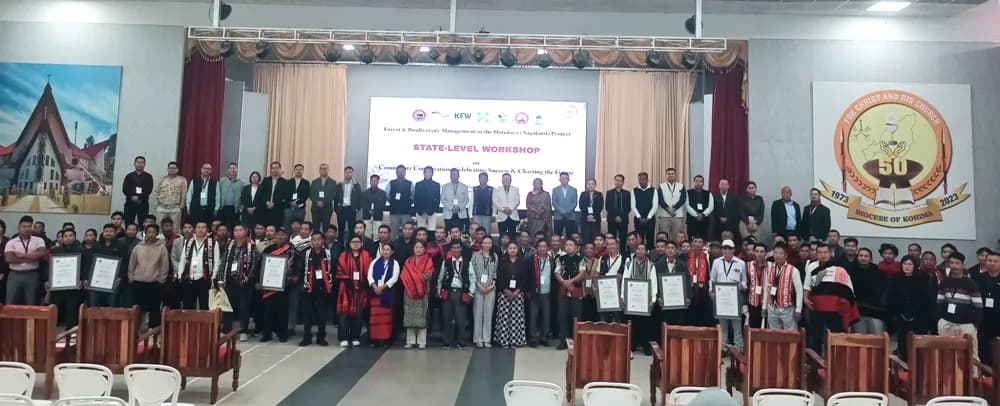
KOHIMA — Principal Secretary of the Department of Environment, Forest and Climate Change and Chairman of the Nagaland State Biodiversity Board (NSBB), Y Kikheto Sema, has called for collective efforts to strengthen community-led biodiversity conservation and protect forests for future generations.
He was addressing the valedictory session of the two-day state-level workshop on "Community Conservation: Celebrating Success and Charting the Future", organised by the Forest and Biodiversity Management in the Himalaya (Nagaland) Project (FBMP) at Golden Jubilee Hall, Cathedral, Kohima, on Wednesday.
Kikheto commended the leaders and members of Community Conserved Areas (CCAs) for their efforts and acknowledged various stakeholders collaborating with the department. He observed that among externally aided projects, the KfW-supported project was fully funded by Germany, unlike other funding patterns.
Referring to the biblical account of creation, Kikheto stated that human beings were created last and entrusted with the responsibility of caring for nature, describing biodiversity conservation as a biblical responsibility to protect resources gifted by God.
Also read: Nagaland’s community conservation needs financial support, say officials
Highlighting the special provisions granted under Article 371(A) of the Constitution, he expressed concern over land ownership issues becoming a challenge to development. He remarked that the number of landowners appeared to be increasing beyond school enrolment and staff strength, adding that land disputes could even become an obstacle to spiritual salvation.
He pointed out that less than four percent of forests in Nagaland are government-owned, with most land belonging to private individuals. Despite this, he said, the Forest department is often blamed for human-wildlife conflicts, including those involving elephants. While acknowledging the importance of Article 371(A), he observed that it should not obstruct development.
Citing forest data, Kikheto stated that Nagaland recorded one of the highest declines in forest cover in India between 2013 and 2023, with a reduction of 795 square kilometres, amounting to around five percent of the state's total geographical area. He further stated that 235 square kilometres of forest cover were lost between 2019 and 2021 due to uncontrolled human activities.
He also acknowledged shortcomings in adequately creating awareness among communities since the enactment of the Wildlife Protection Act in 1972, while degradation of flora and fauna continued.
Calling upon the 64 CCAs represented at the workshop to advance the conservation movement, Sema urged them to become ambassadors of conservation and inspire neighbouring communities. He pointed to alternative livelihoods and carbon trading, noting that Nagaland has considerable potential through its natural resources to provide clean air and energy.
He also recalled the Nagaland Baptist Church Council (NBCC) resolution on biodiversity conservation adopted at its 74th Annual Conference at Rotomi village in 2011.
Earlier, Additional Principal Chief Conservator of Forests (Territorial) Supongnukshi stated that CCAs are conservation initiatives primarily aimed at protecting nature for future generations, the success of which depends on the actions of the people.
The Chief Conservator of Forests (Development and Planning) and Project Director of FBMP Sidramappa Chalkapure presented the workshop summary and way forward.
Community representatives who shared conservation experiences included Purnukshi from Unger village, Mokokchung; S Haku from Keshai village, Tuensang; Keditei from Dungki village, Peren; Mukhe Sotokur, Huke-Yungnyu 3C Chairman; Ekhyimo Lotha from Ronren village; and T Amung from Hak village, Tuensang.