[caption id="attachment_211149" align="aligncenter" width="600"]
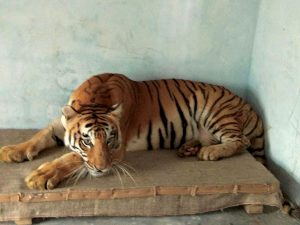 A file picture of the lone female Royal Bengal tiger, named Karthika, inside the Nagaland Zoological Park in Dimapur.
[/caption]
Despite growing awareness, wildlife continue to find way into the Naga kitchen
Our Correspondent
Kohima, Oct. 7 (EMN): As the year’s wildlife week observation comes to a close on Oct. 8 with the department of Environment, Forest and Climate Change organising various activities involving awareness campaigns and wildlife conservation in the past 6 days, the question of whether Nagaland and its people are contributing towards conservation of wildlife in the best of ways remains pertinent.
The theme for the World Wildlife Week 2018 is ‘Big Cats: Predators under Threat’. As far as big cats are concerned, four species are reported to be found in India: the Gir Lion, Bengal tiger, Indian leopard and Snow leopard.
According to current official records, Nagaland has a scanty number of leopards but no tiger recorded in the recent times although sightings were reported from different parts of the state. The Nagaland Zoological Park at Rangapahar in Dimapur has one lone female royal Bengal tiger and two leopards. Department officials attribute the sharp decline in number of the state’s big cats to traditional hunting practices, fragmentation of habitat and forestland due to urbanisation, deforestation for developmental activities such as road construction etc.
Therefore, in general, big cats face many threats: from hunting/poaching, habitat loss, human-animal conflicts, to illegal wildlife trade, which have turned these feline predators into victims today. World Wildlife Week this year hopes to raise global awareness on their plight and increase their chances of survival.
In Nagaland, it has been learnt that a tiger census survey is being carried out for the first time, jointly by the National Tiger Conservation Authority (NTCA) and the state’s Forest department. The department is anticipating positive news from this survey.
Hunting has been one of the earliest forms of occupation and a necessity for survival for the Nagas in the early times, while also intertwining itself with a traditional bend that a man’s skill and prowess were determined by his hunting trophies. Although there has been a visible change in the people’s outlook through conservation efforts, many are yet to be completely detached from their old ways and the meat of (hunted) wild animals continues to find its way to the Naga kitchen.
Communities and villages have stepped forward to conserve their forests and wildlife, but the notion of gifting the meat of wild animals to bureaucrats or VIPs in order to gain favours is still prevalent. Hunting is still rampant mainly due to the fact that there are still takers/buyers, who are ignorant or unaware that they are party to the dwindling wildlife in the state.
An officer of the Forest department speaking to
on Sunday, confirmed to this and lamented that it was ‘very sad’ to notice that many officers and ‘educated people still enjoy accepting such gifts.’
In addition to this, it was learnt that the meat of a stag (venison) was served to the VIPs during the celebration of Yemshe Mini Hornbill Festival in Meluri on October 4 and 5. The event was organised by the state government and the Pochury Hoho. There were reports of selling of wild boar meat and other wild animals including some species of exotic birds as well, however, this could not be confirmed.
Dr. Sapu Changkija of Nagaland University, an ardent environmentalist, in 2016, brought out a book on ‘Biodiversity of Nagaland’ which documents the diversity of resources of plants and animals in the state. A checklist in his book reveals that the state currently is home to only 67 common wild animals and 519 bird species. With forest inhabitants being an indication of a healthy ecosystem and influential in maintaining the delicate balance in the ecosystem, perhaps, time has come to start educating the people who remain ignorant of this vital reality, from the top-to-bottom instead of the bottom-to-up system that is in practice.
Awareness in conservation amongst the citizens, improvement and conservation of existing forests will help to protect these species, according to an official of the department.
On human-animal conflict, he said man-elephant conflicts occur in several villages under Wokha and Mokokchung besides human conflict with other animals. He expressed apprehension that such conflicts are likely to increase as people encroach into their (animals) habitats more and more.
On community conservation efforts, he informed that they were picking up pace and there were many community conserved areas now, both traditionally conserved and recently declared. While the status of many of them were not available, Sendenyu, Old Jalukie, Pangti, Sukhai, Yaongyimchen villages are some few examples. The wildlife wing of the department is said to be facilitating these community reserves by channelling financial assistance from the government.
In regard to the department’s efforts and initiatives to conserve wildlife, the official maintained that there is a separate wildlife wing within the department, headed by a principal chief conservator of forests, and constituted solely to support the conservation of wildlife. The activities of this wildlife wing include: conducting regular wildlife awareness programmes in schools, villages and inter-departmental levels, with the police, the administration and the judiciary; celebration of several important days such as Wildlife Week, World Environment Day etc.; provide compensation for damages to property due to wildlife, eg., human-elephant conflict; conduct periodical highway patrolling and market checks – where there is presence of illegal wildlife trading and cross-border trade in wildlife articles; the Ranghapahar Zoo in Dimapur is an effort to educate the public about wildlife while also providing asylum to injured and rescued wild animals; sensitise and create awareness about wildlife laws among the people.
With 88.03% of forests in the state under the control of individuals and communities and the remaining 11.7% under the control of the state government (as per forest department data), wildlife conservation (for both flora and fauna) efforts in Nagaland cannot succeed without the hands-on involvement of local communities. It is a deep concern for all that even today, timber extraction and coal mining continues to be major sources of income for many villages, which are contributory factors to a rapid degradation of forests and wildlife.


