


World Rabies Day observed across Kohima, Wokha, and Punglwa with vaccination drives and awareness campaigns.
DIMAPUR — World Rabies Day was observed across Kohima, Wokha, and Punglwa on Monday with awareness campaigns, discussions on responsible pet ownership, and free anti-rabies vaccination drives for dogs.
.JPG-1790606142799.webp&w=1200&q=75)
Kohima: In Kohima, the programme was held at the Veterinary Hospital, Kohima, organised by the Chief Veterinary Office in collaboration with the Society for Prevention of Cruelty to Animals (SPCA) Kohima, the National Rabies Control Programme (NRCP), and the Department of Health and Family Welfare.
According to a DIPR report, Deputy Commissioner (DC) and President of SPCA Kohima, B Henok Buchem, stressed the need for responsible pet ownership, noting that complaints had been received regarding pet dogs roaming freely in Kohima, causing safety, hygiene, and health concerns.
He stated that women, senior citizens, and other residents had reported difficulties while walking in the early morning, alongside instances of dog bites and injuries in some colonies.
Urging owners to take full responsibility for their pets with the message "My dog is my responsibility," Buchem called on pet owners to provide proper care, ensure vaccination, and prevent their dogs from roaming in public spaces without leashes. He also advised residents to consider compound size and dog breed suitability before keeping pets.
Buchem informed that the Kohima Municipal Council (KMC) was preparing a regulatory order and that a dog shelter was expected to become operational by mid-October. Once operational, dogs found roaming freely would be taken to the shelter by a designated team with support from the police and local communities, with maintenance expenses recovered from owners.
He also announced that two vaccination camps would be organised annually across all 19 wards of Kohima.
Senior Superintendent of Police Krodi Rhetso described rabies as a fatal but preventable disease and commended the Veterinary and Animal Husbandry and Health and Family Welfare departments for their preventive measures. He noted that rabies prevention requires collective efforts from departments, pet owners, and the community, adding that no official complaints of animal cruelty had been received by SPCA Kohima at the time of the programme.
Free anti-rabies vaccination was administered to dogs following the event.
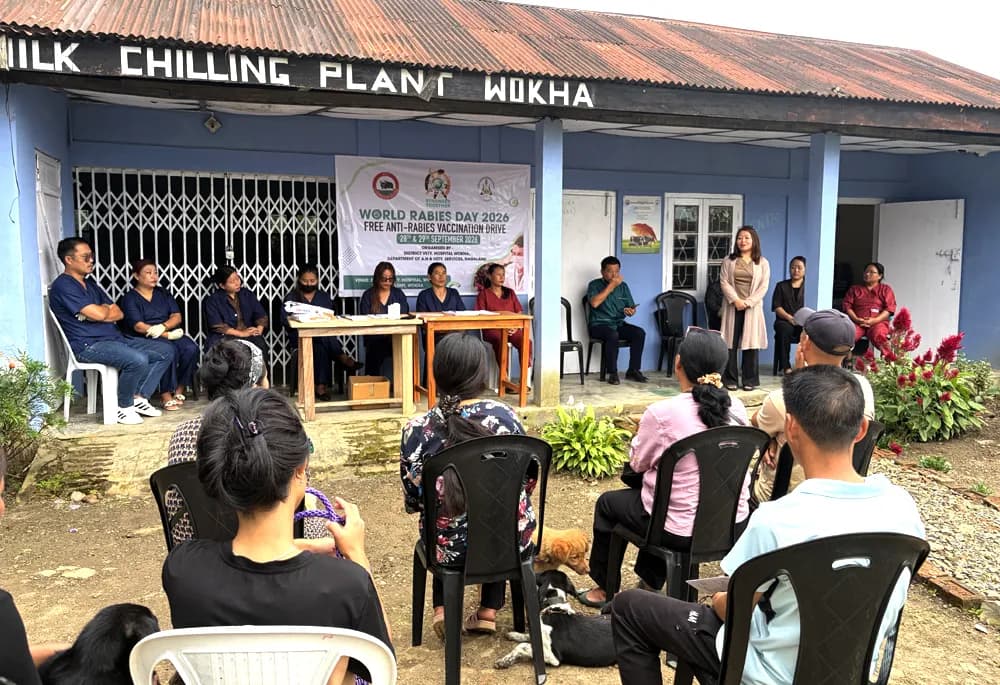
Wokha: At the District Veterinary Hospital in Wokha, World Rabies Day was observed on the theme "Stronger together". The event was organised by the Department of Animal Husbandry and Veterinary Services Wokha in collaboration with the National Rabies Control Programme.
Chaired by Veterinary Surgeon Dr. Gwazenlo Tep, the programme highlighted the need for awareness of zoonotic diseases. Dr. Tep stated that according to a World Health Organisation report, nearly 99 percent of human rabies cases are transmitted through dogs.
Delivering an awareness talk, Integrated Disease Surveillance Programme (IDSP) Wokha Epidemiologist Dr. Khesheli Awomi advised dog owners on the importance of the rabies vaccine. She outlined necessary steps for dog bites, such as washing wounds with running water for fifteen minutes and seeking prompt medical attention.
She stated that anti-rabies vaccines and serum for major bites are available free of cost at government hospitals. The programme was attended by District Surveillance Officer Dr. Kehosenu Sakhrie, VAS Dr. Khuzovinu Richa, departmental staff, and dog owners, after which veterinary staff administered vaccines to dogs.
Punglwa: An awareness programme was also organised at Sainik School Punglwa. The event was jointly organised by the College of Veterinary Sciences and Animal Husbandry, Jalukie, and IDSP, CMO office, Peren district.
Resource persons included Dean of the College of Veterinary Sciences and Animal Husbandry Dr. Sakuntala, Dr. Longkumar Imnuk from IDSP Peren, and assistant professors Dr. Raghubir Singh and Dr. R Mandakini Devi.
The resource persons spoke to cadets about the emergence of rabies, its transmission, prevention, control, and the importance of post-exposure prophylaxis. They also highlighted the government's mission to achieve zero human deaths from dog-mediated rabies by 2030.