[caption id="attachment_187254" align="alignnone" width="550"]
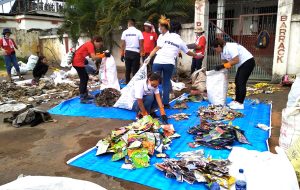 Volunteers segregating plastic waste during the Himalayan Cleanup Campaign at the Dimapur railway station on May 26. (EM File Photo)
[/caption]
Eastern Mirror Desk
Dimapur, June 4 (EMN): As India play host to this year’s World Environment Day (WED), Nagaland is also gearing up to commemorate the day along with the rest of the world to contribute to the global attempt to end plastic use.
The founder and executive secretary of Sustainable Development Forum Nagaland (SDFN), Amba Jamir spoke to
Eastern Mirror and informed that 97% of waste collected was plastic during the recently concluded Himalayan campaign in which 12 mountain states of the country participated.
Jamir pointed out the importance of changing one’s lifestyle to generate less waste, or “zero waste” as he put it.
“The government and organisations should adopt Zero Waste Management,” he implied. He further added that in nature, nothing is waste; it is humans who have created things that do not go back to nature. “Many waste materials like plastic do not go back to nature and it becomes a foreign object to nature,” he remarked.
When asked about what measures Nagaland needs to take to generate less waste, Jamir proposed that apart from changing the lifestyle, he urged consumers to ask questions such as “Do I really need this?” or “what lifestyle should I adopt that will not create waste?”
“At the end of the day it is not about waste, it is about a way of living,” he said while reminding that even sea salt is contaminated with plastic molecules. “We must learn to refuse and reduce before reuse and recycle,” he said.
He also made known that multi-corporates should be aware of the multi-layered harms of plastic being used in their packaging. “A simple biscuit has a box as the outer layer and then inside is the biscuit wrapped in another layer of plastic”
He urged and encouraged citizens to have the responsibility to learn to take care of waste. “We must also reduce the pressure on the municipality, they have a lot to clean up,” he said.
According to Living for Environment (LiFE), the brand audit survey for the Himalayan Campaign in Nagaland on May 26 was conducted after and under the plastic waste category, the disposables dominated with a staggering 3970 pieces from only 23 sacks weighing 210 kilos. Multi-layered plastics and other non-branded plastics with 1820 and 569 pieces respectively were the second and third offenders.
As with any region, non smokable tobacco was the highest with brands like Talab and Dilbagh ranking in the top position in the brand category with 820 pieces. Greenfield Lassi and ORS took the second position with 88 pieces. Third position went to Rum Pum with 87 pieces. Surprisingly according to LiFE NGO, reports also showed that the number of polyethylene terephthalate or popularly known as PET bottles was very less compared to the rest.


