[caption id="attachment_221075" align="alignnone" width="550"]
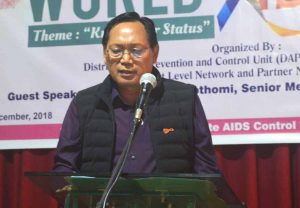 Dr. Tokugha Yepthomi, addressing at the World AIDS Day in Dimapur. (EM Images)
[/caption]
Eastern Mirror Desk/ Our Correspondent
Dimapur, Dec. 1: A lot of barriers to HIV testing remain a challenge and one critical challenge is the social barrier through stigma and discrimination which remains the main obstacle for people from taking an HIV test, said senior medical consultant of CIHSR Dimapur Dr. Tokugha Yepthomi on Saturday.
Addressing the World Aids Day programme held with the theme “Know your status,”at the District Hospital in Dimapur as the guest speaker, Dr. Yeptho said access to confidential HIV testing remains an issue of concern with breaching confidentiality of HIV status and sharing sensitive information without their consent.
The programme was organised by District AIDS Prevention and Control Unit (DAPCU) in collaboration with District Level Network and partner NGOs, Dimapur supported by Nagaland State AIDS Control Society (NSACS) Kohima.
“"The person with HIV is the owner of the information and other must respect their wishes. HIV attacks our body, the stigma and discrimination affects our souls, our mind. With the treatment available today, the wound of the body can be treated. But scars of the soul and spirits can take decades to fade and even last forever. We must continue to shout out and pledge that stigma and discrimination end with me", Yepthomi asserted.
Because of this social barrier, Yepthomi pointed out that many people get tested only after becoming ill and symptomatic and this led to HIV treatment being initiated late and undermines its many benefits for both treatment and prevention. Also, he updated that on April 20 2017 HIV/AIDS prevention control Act Bill passed by the parliament which prohibits discrimination to People Living with HIV (PLHIV).
This year's World AIDS Day theme "Know your status" points to simple action that can bring people closer to the goal and take steps to protect oneself and others; people's ignorance of one's HIV status undoubtedly contributed around 1300 to 1588 new HIV infections in the state in 2017, Yepthomi remarked.
"Trend of HIV infection was reversing in the state and the new infection in 2017 recorded around 1588 with around 60 to 70 new infections every month in Dimapur alone. 91% route of HIV transmission through unsafe sex in Nagaland and this reflects that HIV was rapidly increasing in general population which was a big threat to the generation ".
Yepthomi opined that HIV testing was a critical strategy for both prevention and treatment-for people who test negative there was the occasion to assess their risks and strategy to stay HIV free and for those who test positive, there is an opportunity to start treatment and stay healthy and live long.
Today HIV has become a chronic manageable disease with advent Highly Active Antiretroviral Therapy (Haart) and there are laws to PLHIV. However despite this, the state has around 21000 people diagnosed with HIV so far putting the state in the five highly prevalence state in India.
Also, commemorating day in Kohima, Health & Family Welfare Minister S. Pangyu Phom said the World AIDS day was the first ever global health day which created opportunity for people across the world to unite in the fight against HIV-AIDS, to show support for people living with the disease and to commemorate those who have lost their lives from AIDS-related diseases.
Giving a clarion call to the people to go for blood test, he said an individual can know their HIV status only through blood testing."HIV testing is essential for prevention and also to start treatment because with treatment all people living with HIV can lead a healthy and productive life", he said.
Informing that the state government target to help end the AIDS epidemic as set by UNA1DS have initiated 'Test & Treat Policy' in April 2017, he stated that as per the policy, all people tested as HIV positive are to be treated with ARV medicines immediately.
The minister said the major barriers are stigma and discrimination which deters people from testing for HIV for fear of rejection and discrimination by the family or the community.
"Still there are many people who get tested for HIV only after becoming ill and symptomatic. We must break all these barriers and encourage people to come forward for HIV testing, as it is the only gateway to care, support & treatment",he said.
Phom disclosed that at present there are 70 ICTC facilities across the state where free HIV testing was provided.
He also informed that as per data, since 1999 to September 2018, 10,76,631 blood samples have been tested for HIV out of which 24,218 samples were found HIV positive in Nagaland.
He was optimistic in implementation of the HIV and AIDS (Prevention and Control) Act, 2017, which came into force on September 10 this year.
Dr. Melissa Nyendalk, branch chief of Prevention, Care Treatment CDC India said knowing ones status is an essential entry point to HIV care, support, treatment and prevention services. She enlightened that one out of four people in the world living with HIV are unaware they have HIV.
People who test positive in India can now be immediately linked to antiretroviral treatment to keep them well, she informed.


