


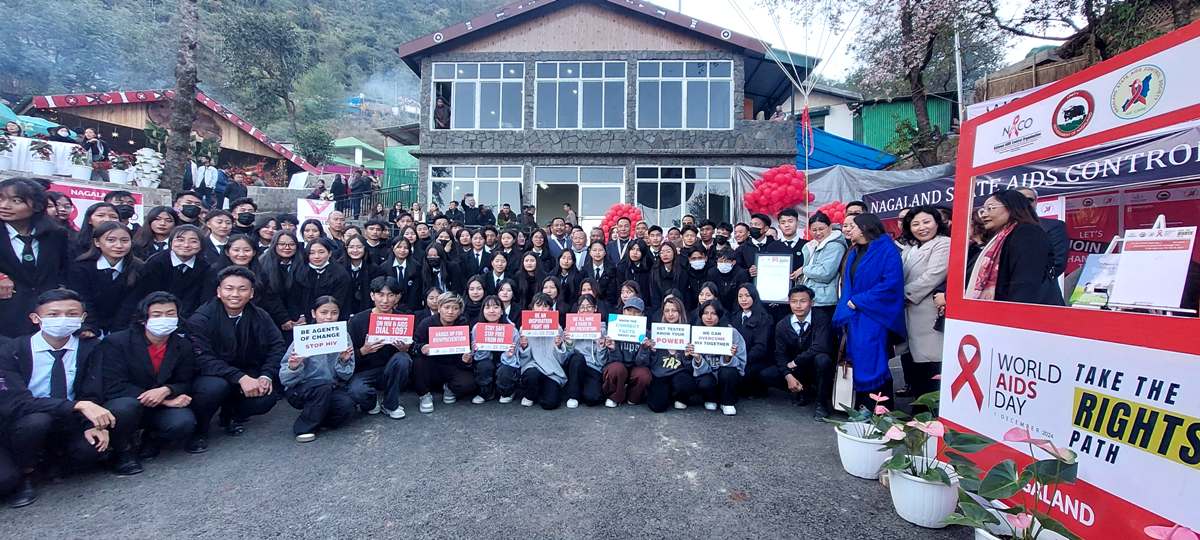
 Minister Paiwang urges elimination of discrimination
Dimapur/Kohima/Wokha — Minister for Health and Family Welfare, P Paiwang Konyak, emphasised the need for greater outreach to people in rural areas and called for efforts to support and stand in solidarity with those affected by HIV and AIDS, urging society to eliminate discrimination and avoid stigmatising individuals.
He was speaking as a special guest during the observance of World AIDS Day at the Nagaland State AIDS Control Society (NSACS) stall at Naga Heritage Village, Kisama, on Sunday.
The minister also administered a pledge to the gathering, encouraging them to create awareness and spread the message that prevention is the only cure for AIDS.
Earlier, the welcome address was delivered by Anoop Khinchi, commissioner and secretary for Health and Family Welfare and chairman of NSACS.
To mark the occasion, balloons were released and a flash mob was performed. The programme was led by Dr. Ahu Sekhose.
The NSACS also honoured Jailu Gonmei as the "Longest alive and on ART in Nagaland." She began her ART treatment on July 1, 2004 at the ART Centre in NHAK, Kohima.
An "Award for Achieving UNAIDS' First 95-95-95 Goals" was presented to Dimapur district. Additionally, an award was given to Nohoru Rhetso, a Red Ribbon Club member from Japfü Christian College, Kigwema, for being the first person to voluntarily undergo HIV testing on World AIDS Day 2024.
Chümoukedima: In Chümoukedima, a programme was held on the theme ‘Take the right path: My health, my right!’ at CPO Hall.
The event was organised by the District Integrated Strategy for HIV/AIDS (DISHA), in collaboration with Dimapur District Legal Service Authority (DDLSA), District Level Network, partner NGOs, HLFPPT, CHRI, NNP+ and development partners.
In his address, senior medical officer of ART Plus Centre at District Hospital Dimapur (DHD), Dr. Hotoka Hesso, said that this year's theme advocates for the removal of legal and social barriers that infringe on people's rights, such as discriminatory laws and criminalisation that hinder access to healthcare and social support for people living with HIV (PLHIV).
The theme also encourages leaders in different fields and communities to promote inclusive policies and create legal frameworks that support HIV prevention, treatment, and care without stigma, he said.
Dr. Hesso said that to end AIDS, it requires reaching out and engaging everyone who is living with, at risk of, or affected by HIV, especially people who have been most excluded and marginalised.
Also, the doctor maintained that empowering individuals with access to HIV prevention tools, education, and services protects not only their health but also their rights.
Stating that stigma and discrimination undermine the fight against AIDS, Dr. Hesso emphasised that human rights are essential to achieving universal HIV care and breaking down barriers to access.
He reminded that with early diagnosis and consistent antiretroviral therapy, PLHIVs can lead long and healthy normal lives and that collectively, the UNAIDS 95-95-95 targets can be achieved.
The UNAIDS Global AIDS Strategy aims for 95% of PLHIVs to know their HIV status, 95% of people who know that they are living with HIV to be on lifesaving antiretroviral treatment, and 95% of people who are on treatment to be virally suppressed.
Dr. Hesso informed that the ART Plus Centre, DHD, has achieved the first and third targets, while the second target of 95% of people who know their status and are receiving HIV treatment has reached only 86%.
Wokha: To commemorate the day, Wokha district held a programme at Witter Theological College (WTC), Vankhosung.
The event was organised by DAPCU, WNP+, NUN, ZWS, BYWC TI NGO, and sponsored by the Nagaland State AIDS Control Society under the theme "Take the Right Path."
The event was attended by Renbomo Ezung, the additional deputy commissioner of Wokha.
In his speech, Ezung urged the audience to take responsibility, emphasising that neglect could worsen the situation.
He acknowledged the significance of World AIDS Day in raising awareness and highlighted the availability of ART treatment to support healthier lives. He stressed that discrimination and stigmatisation worsen the disease, urging educated individuals to actively engage in supporting and consoling those affected.
Dr. Aseno Rhetso, District Programme Officer (DPO) for Non-Communicable Diseases (NCD), spoke on the significance of the day.
She emphasised that protecting everyone's rights is crucial to achieving the goal of ending HIV and AIDS by 2030. She called for an end to discrimination, which hinders treatment and prevention efforts, and encouraged the community to support ART therapy and combat discrimination.
She reported that, as of September 2024, 342 individuals in Wokha are undergoing ART treatment.
Zunheboto: In Zunheboto, a programme was held at the Town Hall themed "Take the right path, my health my right".
The guest of honour for the occasion was Rahul Bhanudas Mali, Deputy Commissioner of Zunheboto, while the guest speaker was Vitoli Rochill, president of the Sumi Totimi Hoho Oking, Zunheboto.
Speaking on the occasion, Mali discussed the differences between HIV and AIDS and urged the community to support people living with HIV. He noted that while there is no cure for HIV, several treatments and prevention methods are available.
He encouraged regular HIV testing and proper healthcare, including nutrition, for people living with the virus. Mali also called for the allocation of more funds for those living with HIV and AIDS, urging the Health and Family Welfare department to take proactive steps in supporting the affected community.
Dr. Anatoly Suu, Deputy Chief Medical Officer of Zunheboto, emphasised the importance of World AIDS Day as a global observance to remember and support people living with HIV and AIDS.
She highlighted alarming statistics, stating that over 2.5 million people are living with HIV globally, with Nagaland having one of the highest HIV prevalence rates in the country.
She stressed that while there is no cure or vaccine for HIV and AIDS yet, prevention and awareness remain crucial. Dr. Suu also spoke about the role of mothers in preventing the transmission of HIV to their babies during pregnancy.
Vitokali Zhimo, president of the Women Organisation NDPP Zunheboto Region, delivered a speech on the impact of HIV and AIDS, particularly on young people. She emphasised the importance of sex education in schools, advocating for early counselling to educate students on the risks of HIV and AIDS.
Kalito, president of the Network of Zunheboto People Living with HIV/AIDS (NZP+), shared the challenges faced by individuals living with HIV, particularly the lack of proper facilities and resources.
She urged the public to support and uplift people living with HIV rather than discriminating against them and stressed the need for greater awareness and cooperation to improve the quality of life for these individuals.
The event was organised by 35 AC NDPP in collaboration with the Nagaland State AIDS Control Society (NSACS) and sponsored by K Tokugha Sukhalu, Advisor for Food and Civil Supply and Legal Metrology.