


Nagaland marked World AIDS Day with NBCC urging data-driven HIV prevention and experts highlighting rising infections and needed reforms.
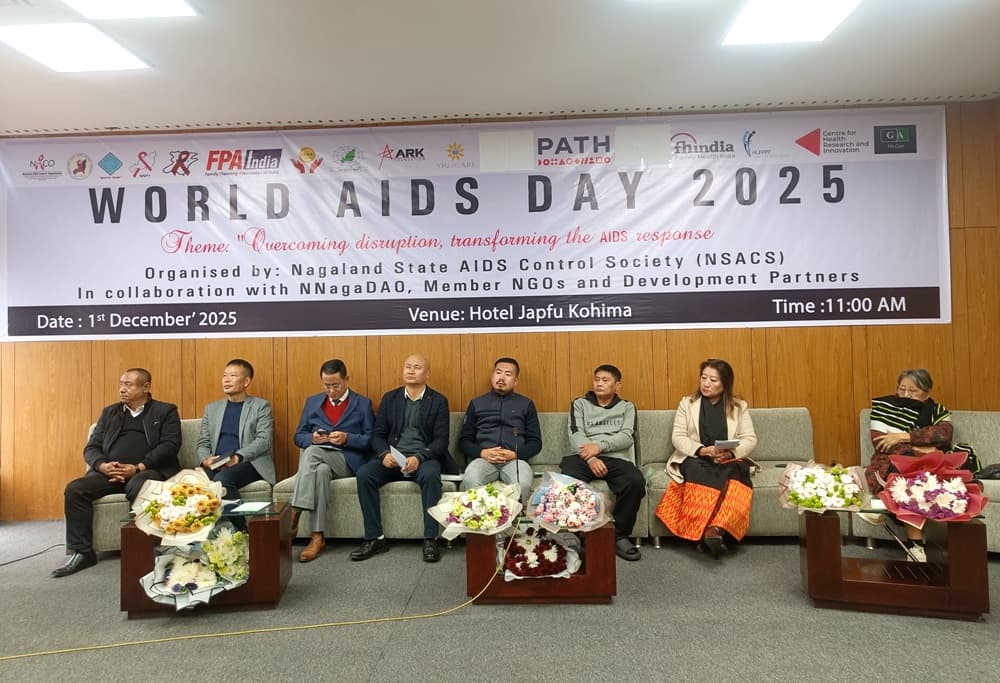
DIMAPUR/KOHIMA — Nagaland observed World AIDS Day on Monday across the state on the theme “Overcoming disruption, transforming the AIDS response” with discussions on the high prevalence of HIV&AIDS in the state and the ethical debate surrounding prevention methods.
At Hotel Japfu, Kohima, a debate on whether the use of protection (condoms) should be encouraged or if it is against Christian ethics was highlighted.
With reports that 90% of HIV&AIDS cases in Nagaland are transmitted through the heterosexual group, speakers questioned whether encouraging the use of condoms to prevent transmission can lead to an increase in extra-marital affairs and pre-marital sex.
Vilo Naleo, secretary of social concerns, NBCC, expressed that in the Nagaland context, where people are mostly Christian but have the second-highest prevalence of HIV&AIDS in the country, “honestly I don’t know how to address this issue.”
He opined that if such a percentage of HIV&AIDS is transmitted through heterosexuals, then the church needs to be sensitised on this and expressed that he is open for further discussion based on the data researches.
“If the government is convinced that using condoms can prevent the spread of AIDS in Nagaland 100% by providing a database, the church should listen, and we will help,” he commented.
Also read: Nagaland climbs to 8th in national HIV response ranking as experts call for unified, urgent action
He opined that if encouraging the use of protection (condoms) in the Naga context is against Christian ethics, he questions other ways they can creatively highlight the issue.
He stated that while social stigma and lack of healthcare systems are some primary reasons, he believes there are some ways to deal with the high rates of HIV&AIDS. He suggested that they should find the cause, look for crucial moments, evaluate the past strategies and assess how it failed, and also study some states that have produced better results.
He assured that the church will collaborate and partner with organisations that are in the field doing the work, “but sadly many times we have to first fight the lack of political will instead of the virus. We face indifference in churches; instead of encouragement, we have to overcome stereotypes.”
Vimeyiekho Vitso, vice president of NSF, opined that the usage of protection will undoubtedly decrease the transmission of the disease, but “it has also apparently increased the rate of pre-marital sex and extra-marital affairs, which is a great concern for us all, and collectively we should address this matter.”
He also suggested some points to fight against HIV&AIDS in the state, which include the need for regular family testing because with this practice, he believes that it will normalise the thought process of every individual and invite the idea that they should not indulge in things that invite the disease.
No funds from state government
KP Ezung, assistant director of Kripa Foundation, Nagaland, said that they are currently running the National AIDS Control Phase (NACP) 5, which is expected to end by March 2026. He cited that the programme is solely supported by the government of India, and not a single penny comes from the state government.
He said that the state government is supporting them largely only through the infrastructure, but besides that, no funds, thus expressing concerns that if there is no NACP 6, then there is no one to support them.
He also highlighted that the average IDU (injecting drug user) in Nagaland has decreased, with the national average at 9.03% and Nagaland at 2.54%, but the HIV&AIDS adult-prevalence rate in Nagaland is 6.3% times higher than the national average of 0.22%, thus citing that the HIV epidemic has moved from the IDU to the general population.
Ezung stated that HIV is prevalent across the state and questioned what the state government is really doing to contribute in terms of bringing down the HIV epidemic. He informed that approximately 214 people diagnosed with HIV die each year, and the new infection rate every year is about 2,000 cases, which is a big concern.
Infections shifting from traditional high-risk
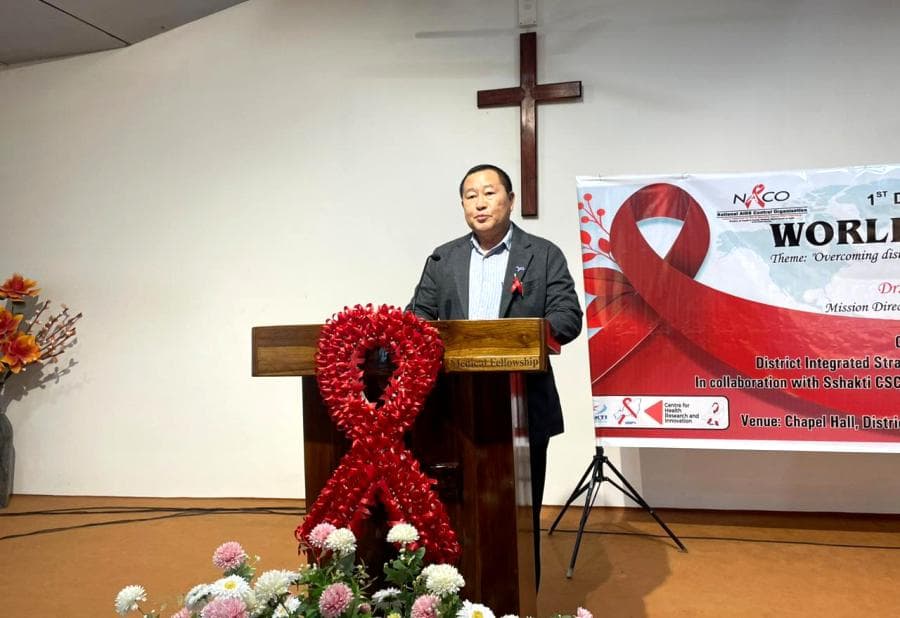
The District Integrated Strategy for HIV&AIDS (DISHA) Dimapur, in partnership with Shakti CSC 2.0, the District Level Network (DLN), targeted-intervention NGOs and development partners, commemorated the day at the Chapel Hall of District Hospital, Dimapur.
In his keynote address, Dr. Keveduyi Theyo, Mission Director of Health and Family Welfare, underscored the relevance of this year’s theme against a backdrop of persistent obstacles, budget reductions, overburdened health systems, and growing stigma that have hindered worldwide HIV-fighting efforts. He stressed the need for a resilient, inclusive response that safeguards vulnerable populations and bolsters public-health infrastructure to meet the 2030 goal of ending AIDS.
Dr. Theyo highlighted that Nagaland still records the second-highest adult HIV prevalence in India at 1.37%, well above the national average of 0.21% (India HIV Estimates 2023). He added that infections are shifting from traditional high-risk groups to people in the general population who engage in risky behaviours and called for greater vigilance and intensified community-led initiatives.
He highlighted compassion, universal access to services and solidarity, urging stakeholders to move beyond stigma, guarantee widespread testing and treatment and unite in protecting the rights and dignity of people living with HIV.
In her address, Dr. Sussana Kikon, medical officer at the ART Centre in Chümoukedima, tackled the myths and misconceptions that still cloud public understanding of HIV treatment.
She warned that misinformation poses a serious risk, reiterating that HIV remains incurable and that antiretroviral therapy (ART) merely suppresses the virus, enabling long, healthy lives. “It’s dangerous and false to stop ART because you think you’re cured,” she cautioned.
Observances across state
Elsewhere, DISHA and the respective district administrations facilitated observances at the DPDB Hall in Kiphire and the GB Hall in Peren, which also saw events at the district jail, Children’s Home, and Lydia Centre. Similar programmes were held at the Dr. Wethselo T Mero Memorial Hall in Phek and the VDB Conference Hall in Longleng under the District Health Society.
In Wokha, the District AIDS Prevention and Control Unit (DAPCU) partnered with the Wokha Network of Positive People, the Nagaland Users' Network (NUN) Link Worker Scheme, NUN Targeted Intervention, and NUN CiTY BARN at the CMO office.
Meanwhile, Wangkhao Government College (WGC) in Mon collaborated with the Red Ribbon Club, Shansham Organisation, Evergreen Welfare Society, and Mon Users’ Network, while four Targeted Intervention projects—JACAOA Tobu, NNP+ Aboi, Shansham Organisation Mon Town, and Turning Point Tizit—jointly observed the day at Tobu town. Chavara Home in Dimapur also marked the occasion.