


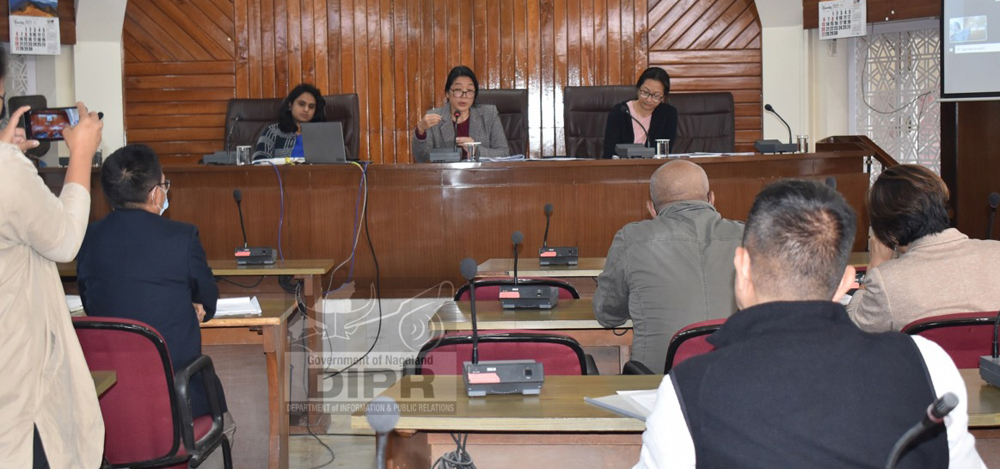
Dimapur, Nov. 10 (EMN): A state-level workshop on non-communicable diseases-nutrition, lifestyle, and management, which was co-led by secretary of Health and Family Welfare, Asangla Imti, was held on November 9 at the Secretariat conference hall, Kohima.
In her address, Asangla stated that the workshop was organised to discuss on prevention and control measures based on the hazard risk factors, multi-sectoral approach, priority areas that are lacking and focusing on potential areas, stated a DIPR report.
The principal secretary and development commissioner, Amardeep S Bhatia, in his virtual speech, asked the officers to look into the challenges being faced in their respective areas. He asked them to draft the non-communicable diseases prevalent in Nagaland and see what the potential solutions to the problems are.
He further stated that it was an opportunity for the departments to specifically see what the state requires and to be innovated to tackle the problem.
In her powerpoint presentation on the topic ‘National programme for prevention and control of cancer, diabetes, cardio vascular diseases and stroke’ (NPCDCS), the joint director and SPO, NHM, Dr. Mereninla Senlen, pointed out that Nagaland has one state NCD cell, 11 district NCD clinics and 25 CHC NCD clinics at present.
She said the activities include population based screening (PBS), opportunistic screening management of common NCD, counseling, physiotherapy, health promotion including use of IEC for behavioral change communication. She also shared the achievement and targets of the department under NPCDCS.
Dr. C Teheo, who dwelled on the topic ‘Tobacco scenario in Nagaland,’ highlighted that Nagaland is the 7th most tobacco-prevalent state among the North eastern states. He pointed out that 13% of the population indulges in smoking tobacco and 30% in smokeless tobacco usage and 8.9 % use both smoking and smokeless tobacco.
He also stated that Nagaland has the highest use of pan masala with tobacco in India with a prevalence of 21% and the tobacco use amongst the youth between 13-15 years is 42% (Global youth tobacco survey GYST-4 2019).
He further highlighted on the ongoing activities undertaken by the STCC to spread awareness through different means.
Dr. John Kemp, who highlighted on the Pradhan Matri National Dialysis Programme (PMNDP), said Nagaland started the haemodialysis in 2019 and many patients have availed the facility provided under PMNDP. He said the four districts where PMNDP through Fairfax India Charitable Foundation Limited has provided the haemodialysis machines are Kohima, Mokokchung, Dimapur, and Tuensang. He also gave suggestions for better outcomes of these units, the report stated.
Dr. Bendangtula, in her presentation, said Ayush facilities exist in three intergraded Ayush hospitals, 49 Ayush health and wellness centres with 49 Ayush doctors.
She also said the services given are Ayush ODP, hypertension and diabetes screening, yoga sessions, herbal garden, and participation in VHND where screening and awareness talks are given.
The departments present in the workshop included Health and Family Welfare, Social Welfare, School Education, Urban Development, Higher Education, IPR, Youth Resources, and Food and Civil Supplies.
Dr. Atsung Aier from CIHSR, Dimapur, and Dr. Along from Eden Hospital, Dimapur, also took part in the discussion.