 Our Correspondent
Moreh, March 11 (EMN):
Our Correspondent
Moreh, March 11 (EMN): Drying up of streams in Manipur is a serious concern considering its importance in maintaining the water security for the state’s population, according to experts.
“So time has come to look into such issues in order to address the grievances of the people,” says Deputy Director Dr T Brajakumar of state Environment department. “While we are discussing about the global water issues, we have already started to witness water scarcity problems in and around some locations.”
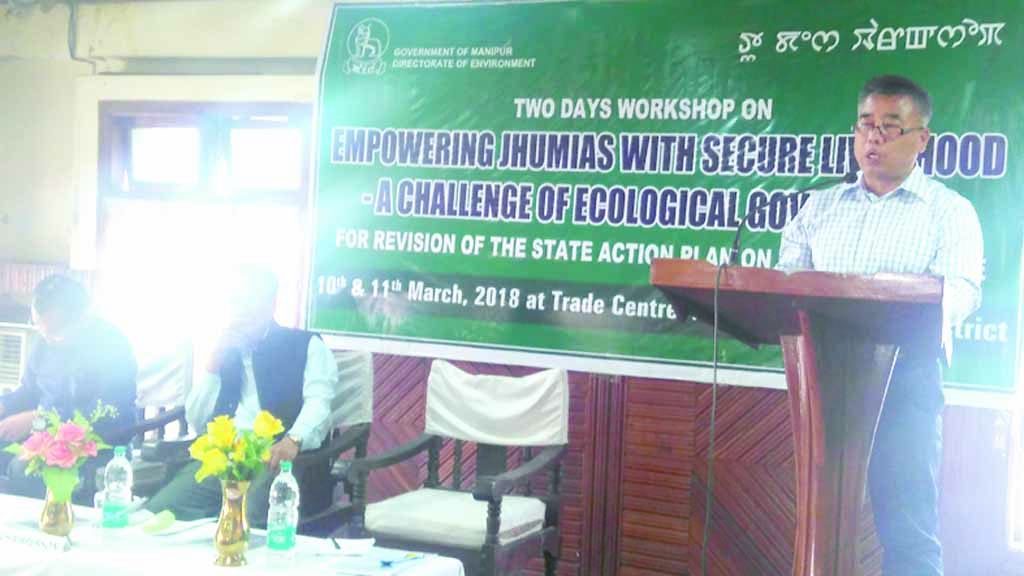
Dr Brajakumar was speaking during the two-day workshop on “Empowering Jhumias with secure livelihood: A challenge of Ecological Governance” at the trade centre hall at Moreh, the border town of Manipur located about 110 km south of Imphal. The workshop concluded on Sun. March 11.
The officer also informed that 64 streams(heads)out of 95 streams and Singda dam water reservoir which feeds a large population of Imphal town have already dried up in the last 42 years (till 2016) while only about 31 streams survives.
Former member NE region vision, DoNER, Government of India Prof N Mohendro Singh, In his speech, Prof Mohendro said that livelihood of the villagers involved in shifting (jhum) cultivation has been affected tremendously (because of the changing development and urbanisation process across the state).
But those involved in jhum cultivation cannot become a trader overnight. It will take time so we need to develop foundation of economy.
Thus competition is very tough with the proposed arrival of government’s Act East policy in the region particularly in Manipur’s border town Moreh.
“You cannot take up development activities in isolation as development needs connectivity,” he opined.
In his speech, Deputy Commissioner Raghumani of Tengnoupal district expressed the need to have better convergence (among line departments) for a better livelihood.
On the other hand, Deputy Director Dr T Brajakumar of state environment department highlighted the activities taken up by the state Environment department in association with 22 concerned line departments, 25 nongovernmental organisations experts and others since 2011 to frame 154 action plans to deal with various kinds livelihood and other climate change issues under eight different sectors.
To revise the action plan, he sought comment, opinion, experience and suggestions from the concerned stakeholders including the general population.


