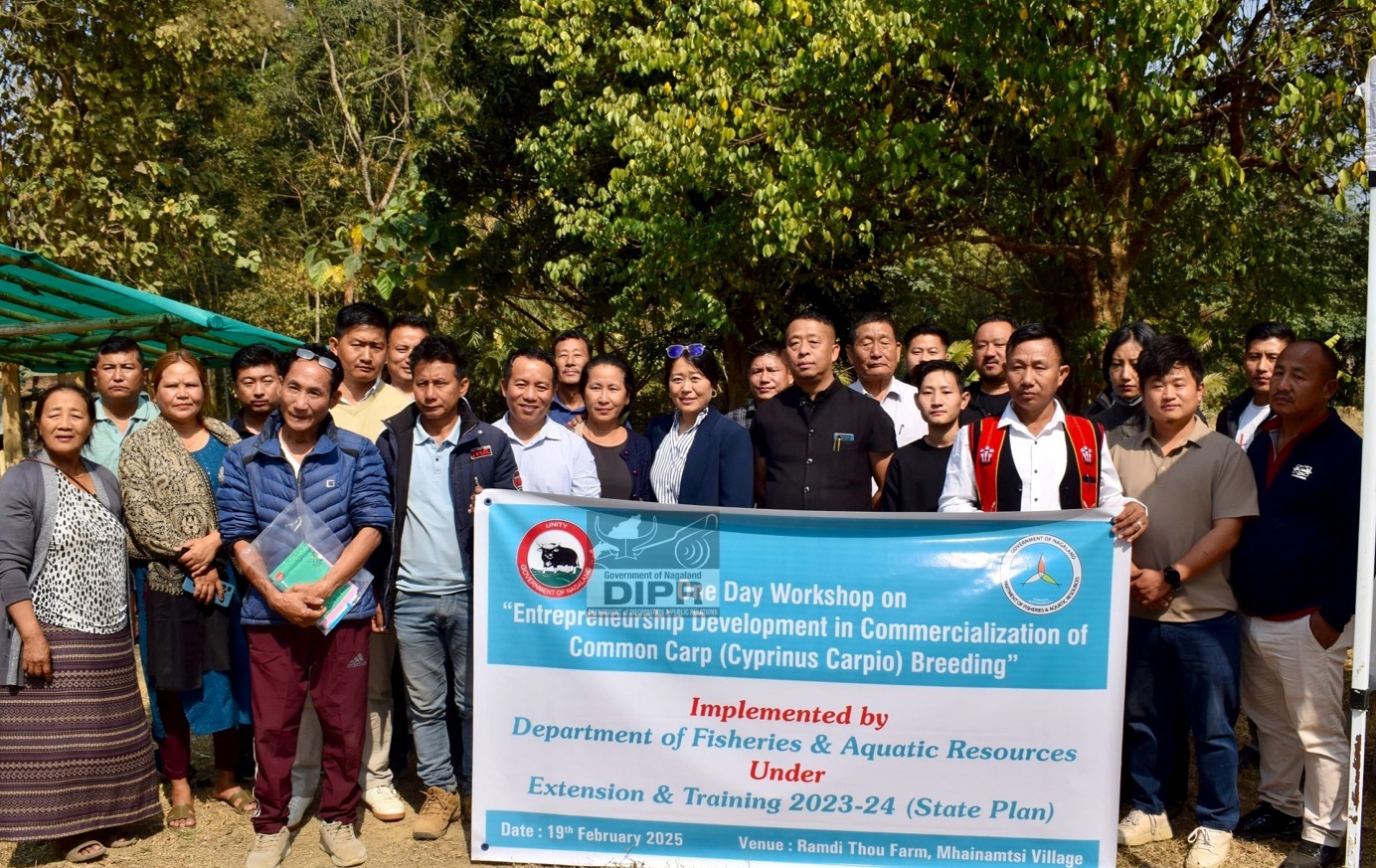
Officials of Fisheries and Aquatic Resources department along
with the participants during a workshop on "Entrepreneurship development
in commercialisation of common carp (Cyprinus carpio) breeding" in
Mhainamtsi village on Wednesday.
- DIMAPUR — The
Department of Fisheries and Aquatic Resources, Peren, organised a one-day
workshop on "Entrepreneurship development in commercialisation of common
carp (Cyprinus carpio) breeding" under extension and training 2023-2024
(State plan) at Ramdi Thou Farm in Mhainamtsi village, Jalukie, on Wednesday.
- Briefing on overview of the entrepreneurship development
workshop, the district fishery officer (DFO), Peren, C Dory Yanthan, informed
that it was organised with the objective to sensitise fish farmers by providing
them knowledge and skills on how to successfully breed common carp.
- The special guest of the programme and ADC of Jalukie, TL
Kiusumong Tikhir, lauded the department for organising the training for the
most potential and energetic fish farmers in the valley. He expressed hope that
such training would immensely benefit as well as create great impact for the
fish farmers.
- He further encouraged the farmers to open up their minds,
clear their doubts and take back something out of the training session.
- A DIPR report stated that common carp is a highly
sought-after fish species; prized for its adaptability, fast growth rate and
high demand. Recognising its potential, the department of Fisheries and Aquatic
Resources aims to empower entrepreneurs to take up common carp breeding by
unlocking the full potential of the industry.
- It mentioned that commercial common carp breeding could
create employment opportunities for rural youth, women and marginalised
communities. By providing a stable market, entrepreneurs could increase
farmers' and rural communities' income. This, in turn, would enhance food
security and nutrition by increasing the availability of protein-rich fish.
- It further stated that the department is committed to
supporting entrepreneurs, aiming to create jobs, increase income, improve food
security and promote sustainable aquaculture practices.


