Paves way for implementation of 33% reservation for women in municipalities
[caption id="attachment_85297" align="alignnone" width="501"]
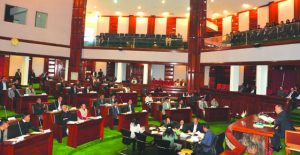 Speaker Chotisuh Sazo presiding the 14th session of the 12th Nagaland Legislative Assembly on Thursday.
[/caption]
KOHIMA, NOVEMBER 24 : The saga surrounding the issue of reservation of seats for women to urban local bodies in Nagaland has taken a new turn with the Nagaland Legislative Assembly adopting a resolution to revoke its earlier resolution of 2012, paving way to implement 33% women reservation in municipalities.
The government’s new resolution was passed on the last day of the winter session of the State Assembly on Thursday, notwithstanding protests from various tribal bodies including the Naga Hoho to consider the ramifications of such a move.
Clarifying to queries raised by some MLAs before the new resolution was adopted, Chief Minister TR Zeliang, as the leader of the House, reminded the need to understand the situation at the national and global levels on empowerment of women.
“The whole world has accepted that women should participate in any electoral platform….. Today, in our country’s context, every state has accepted women reservation and some states have gone up to even giving 50% seats to women, not 33%,” he pointed out. He also mentioned that the Kerala government had, on their own, came out to reserve 55% seats for women.
Towards this, Zeliang maintained that if the Naga people were to stick to Article 371A “even in their kitchen”, they cannot move forward.
He said the situation today is that the Municipal Act was passed in 1992 in the Parliament and if the Naga people really did not want women reservation, “our MPs” should have raised the issue within one year’s time then that it was not acceptable in Nagaland but they did not.
In the context of Nagaland, he said even before 1992, this Act had come into being as we had been following the “tribal area Assam regulation 1950 notification” and the Nagaland government had been practicing elections to adhoc town committees. He pointed out that when the Act was passed in 1992 with 33% women reservation, other states started implementing the same, but Nagaland passed its Municipal Act only in 2001, that too without the provision of Part IXA.
Consequently, he recalled that in 2005, the Naga Mothers’ Association (NMA) went to High Court against non-provision for women reservation and the latter had directed the State Government to include the Part IXA by inserting ‘section 23A and 23B’. He said the State Government complied and amended the Act in 2006 which ensued in various tribal organisations reacting against it and thereafter, elections to municipal and town committees stopped till today.
While touching upon the background of the subsequent challenge filed by the women’s group, Zeliang said the ground reality in Nagaland is that Article 371A empowers Nagaland Assembly the constitutional authority to overwrite by a resolution but the 2012 NLA resolution did not touch the Act which was already passed in 2006. “It was only a resolution. We intended to take a u-turn from the 2006 amendment Act but the NMA challenged our resolution and the matter is still pending in the Supreme Court,” he stated. He said the reason for the decision to go ahead with the Municipal Act which was passed in 2006 is that “we cannot keep on waiting for the Supreme Court verdict, which may take 10 years, 15 years or even 20 years”. Since nobody can say that the Supreme Court will deliver a decision within a specified period, Zeliang maintained that Nagas were travelling to “unknown destination” with the dispute between men and women.
Thus, he said, the NLA, with the constitutional provision given in Article 371A, was revoking its earlier resolution with the intention that it should move ahead and the people should derive the benefit from the civic bodies. “When we have created so many townships, if we were to go on without elections to civic bodies for 10-15 years, the people would be the loser,” he further reasoned, adding, whatever funds are available for these town councils and municipalities, the people should derive the facilities and developmental activities should be undertaken.
Terming the entire issue as “our own creation”, he felt the House should not deviate from its stand. In order to go with the civic polls, he said the “cloud” was needed to be cleared and the resolution of 2012 be revoked.
“Our intentions are very clear and to make it clear to the people, we had a consultation meet on November 16 and we have explained very clearly about the stand of the government,” the Chief Minister said. He mentioned that it was made known then that if this Act or in any of its part needed amendment, they could suggest, and whatever was suggested were being incorporated in the amendment Bill.
“In regard to reservation, this Act was passed in 2001, amended in 2006 and we have accepted the 33 percent reservation in this House, that is why today, instead of creating controversies among us and among the Naga society, we have decided to go ahead with the election. I hope and believe that people will cooperate, and those who do not understand the reality will also understand the ground reality,” he concluded vaguely before appealing to the members to pass the resolution.
Meanwhile, responding to queries put up by some of the MLAs on whether the absence of women candidates to reserved seats could allow male candidates to fill the vacancy, the Chief Minister clarified that in such cases, the seats will remain reserved and men cannot fill up those seats. He added that in such an event of absence of women candidates, the government will take a decision and issue fresh notifications till such particular seat is filled by a woman representative. “Outside the total number of seats in every municipal and town council, there will be a government nominee as prescribed by us,” Zeliang said.
Meanwhile, parliamentary secretary for Municipal Affairs R Tohanba, who moved for passing of the resolution, said when the NLA amended the Nagaland Municipal Act 2001 in 2006, providing women reservations under the High Court order, it has “willingly and consciously downloaded Article 243T into the state Act”. Therefore, he pointed out, the state Act was no longer an independent Act, independent of the Constitution of India, and the two were now intertwined and interdependent.
“We made a u-turn on this when we passed the Resolution on 22/9/2012. Now we are not doing any u-turn, but aligning ourselves with the Constitution and the state Act as we have decided to conduct polls in accordance with the provisions in the Court ordered State Act and thereby in accordance with Article 243Tof the Constitution of India,” the legislator reasoned.
Tohanba further maintained that if the government did not pass the revocation resolution, it would have several consequences, including giving an impression that it is against the Constitution when it incorporated all Constitutional provisions in the State Act in 2006; difficulty in convincing the Courts regarding the validity of the September 12,2012 resolution; deny themselves the advantage of getting out of the protracted court case by making the case before the Supreme Court in fructuous by extinguishing the resolution by themselves by revocation; technical hurdles to conduct polls to the municipal and town councils with women reservation when the resolution that denies reservation is operative; and also face the denial of “precious resources” from the Centre for local urban development if polls are not conducted within the framework of Part IXA of the Constitution of India read with the state Act.
The new resolution was finally passed by voice vote. The House also passed the Nagaland Municipal (Third Amendment) Bill 2016, following which Speaker Chotisuh Sazo adjourned the House sine-die.


