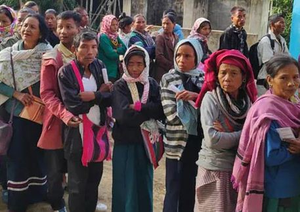
IMPHAL/AIZAWL — Women
voters outnumbered the male voters in the electoral rolls of four northeastern
states - Manipur, Mizoram, Meghalaya and Arunachal Pradesh - where overall
gender ratio was much higher than the national average, officials said on
Tuesday.
The final electoral rolls of the four northeastern states,
released by the Election Commission of India on Monday as part of a Special
Summary Revision 2025, showed women outnumbering men.
Against the national gender ratio of 948, the gender ratio
in the electoral rolls of Manipur is 1,070, followed by 1,066 in Mizoram, 1037
in Arunachal Pradesh and 1028 in Meghalaya.
According to election officials, women voters during the
past many years surpassed male electors in the electoral rolls of Manipur,
Mizoram, Meghalaya and Arunachal Pradesh.
The national gender ratio on the electoral rolls increased
from 940 in 2023 to 948 in 2024, the officials said.
In Manipur, Chief Electoral Officer Pradeep Kumar Jha said
that like all previous electoral rolls, 10,61,979 women voters outnumbered the
male electorate of 9,92,140 in the final electoral rolls.
He said that as per the final electoral rolls, the gender
ratio stands at 1,070 as compared to 1,069 in the draft electoral rolls,
published on October 29, 2024.
The CEO said that the elector population ratio is recorded
at 55.37 per cent as compared to 54.84 per cent in the previous draft rolls.
The total number of voters in Manipur as per final electoral
rolls is 20,54,387 showing a net increase of 19,727 with 10,61,979 women
voters, 9,92,140 male voters and 268 third gender.
In Arunachal Pradesh, out of the total number of 8,91,518
electors in the state, 4,37,609 are male voters, 4,53,905 women, and four third
genders.
State's Joint Chief Electoral Officer Liken Koyu said, as
per the final electoral rolls of 2025, there has been an overall increase of
0.99 per cent in the number of electors compared to last year's total voters.
In Meghalaya, where a matrilineal society exists, out of the
total number of 22,69,512 voters, 11,50,599 are female voters, 11,18,907 male
electors and six third-gender voters.
In Mizoram, 4,48,925 women electors outnumbered the 4,20,888
men electors by 28,037 voters. Election officials in Aizawl said that in the
final electoral rolls, the voter count increased by 1.5 per cent for 2025,
showing 8,69,813 voters.
Out of Mizoram's 11 districts, Mamit district is the lone
district where male voters exceed women - by 576. In the last Assembly election
in Mizoram, held in November 2023, the state scripted history as for the first
time, three women candidates were elected to the 40-member Assembly in one go.
Poll winner Zoram People's Movement (ZMP) candidate
Lalrinpuii won from Lunglei East constituency and her party colleague and
television presenter Baryl Vanneihsangi was elected from Aizawl South-3 seat.
Pravo Chakma of the Mizo National Front (MNF) won from the West Tuipui seat.
In the November 7, 2023 Assembly elections, 174 candidates,
including 16 women, fought the polls while in the last Assembly elections in
2018, a total of 209 candidates, including 18 women, contested.
In the 2013 Assembly polls, 136 candidates, including six
women aspirants contested the polls. None of the women candidates had won in
the 2013 or the 2018 polls.
In Mizoram, the first woman elected to the legislature
(Mizoram was elevated to Union Territory status in 1972 with a 30-member
legislature) was L. Thanmawii of People's Conference (PC), led by former Chief
Minister Brig. T. Sailo (retd), from Serchhip constituency in 1978.
K.Thansiami of the same party was the second woman elected
to the Assembly in 1984, followed by Lalhlimpuii of the MNF who was inducted as
the first woman minister in 1987 in the government headed by the then Chief
Minister Laldenga, a militant leader-turned-politician.
Lalhlimpuii was a minister for 19 months before the
government was toppled in the latter part of 1988.
In the 2023 Assembly polls in Nagaland, Meghalaya and
Tripura, women's electoral performances were slightly better than in the
previous elections.
In most of the societal and domestic aspects, women in most
of the northeastern states are in a leading position but when it comes to the
political and governance domination, the women are sidelined.
(Sujit Chakraborty can be contacted at
sujitchakrabortyne@gmail.com)