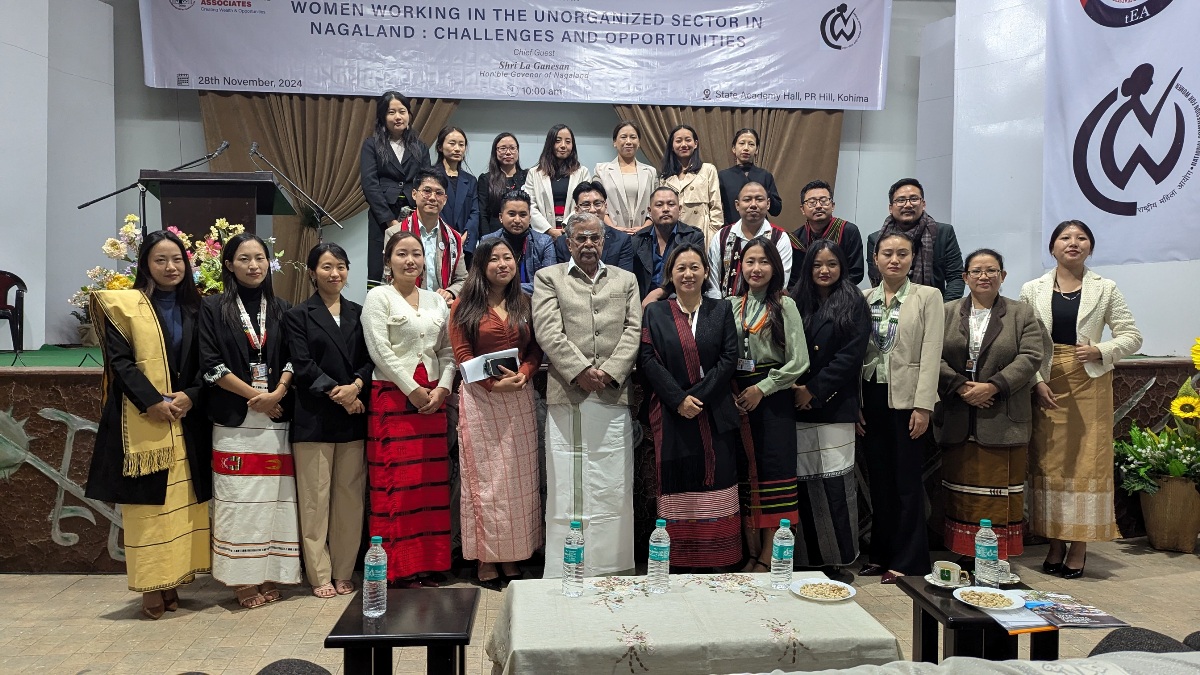
KOHIMA — Nagaland Governor La. Ganesan on Thursday emphasised the
significant yet often overlooked contributions of women in the state’s
unorganised sector.
Addressing
a seminar organised by The Entrepreneur Associates (tEA) in Kohima, he noted
that women constitute a substantial portion of this workforce and play vital
roles in the socio-economic development of the country but are usually the
“unsung heroines.”
“Women in
the unorganised sector often work tirelessly behind the scenes. In Nagaland,
they comprise a significant portion of this sector, making invaluable
contributions that are both diverse and essential,” he said.
He cited a
2021 e-Shram portal report, which indicated that approximately 8% of Nagaland’s
population works in the informal sector, with women making up more than half of
this workforce.
“Women are
not just contributors, but many are the primary breadwinners of their families.
The resilience and dedication of these women have consistently influenced and
moulded the socio-economic landscape of the state and the country,” Ganesan
said.
Addressing
the challenges faced by women in the informal sector, including irregular
income, inadequate infrastructure, and limited access to financial services,
the governor stressed the need for greater awareness and education about
government welfare schemes. He said that recognising the unyielding spirit of
these women is crucial for national progress and expressed hope that the
seminar would facilitate solutions, knowledge sharing, and empowerment through
awareness of various welfare schemes and opportunities.
He further
urged for continued support to ensure all women, particularly those in the
unorganised sector, receive the necessary opportunities and assistance.
During the
seminar, titled “Women Working in the Unorganised Sector in Nagaland:
Challenges and Opportunities,” Neikule Doulo, Executive Director of tEA,
highlighted the organisation’s work in providing financial services, training,
and capacity building to women in both urban and rural areas.
Today, 70%
of tEA’s beneficiaries for financial services are women, she said.
Discussing
the challenges faced by women small-scale traders, including the disruptive
impact of online shopping on their businesses, she said that women will continue
to dominate the unorganised sector for years to come with variations, despite
the challenges.
The
governor released a report titled “Lived Realities of Women in the Unorganised
Sector in Nagaland,” based on a study of 1212 women who are beneficiaries of tEA’s
programmes.
Prepared by
tEA’s Research and Development (R&D) team, the report revealed that 231 of
the 1212 women surveyed faced infrastructural limitations and safety concerns,
with some reporting assault by intoxicated men. Other challenges included a
lack of toilet and sanitation facilities, complex loan procurement systems, and
limited digital and financial literacy.
The report
also highlighted the low educational attainment among women in this sector: 8%
are graduates or above, 34% have secondary education, 35.4% have primary
education, and 22.6% have no formal education.
The seminar
included technical sessions on social security health schemes, accessing
financial services, and legal protections for women in the unorganised sector,
presented by experts from UNICEF, SBI Kohima, and the Kohima Family Court,
respectively. tEA representatives also shared their experiences working with
women in the unorganised sector.