


Chief Secretary Sentiyanger Imchen says empowering women entrepreneurs is essential for building Nagaland's climate-smart, resilient rural economy amid climate change.
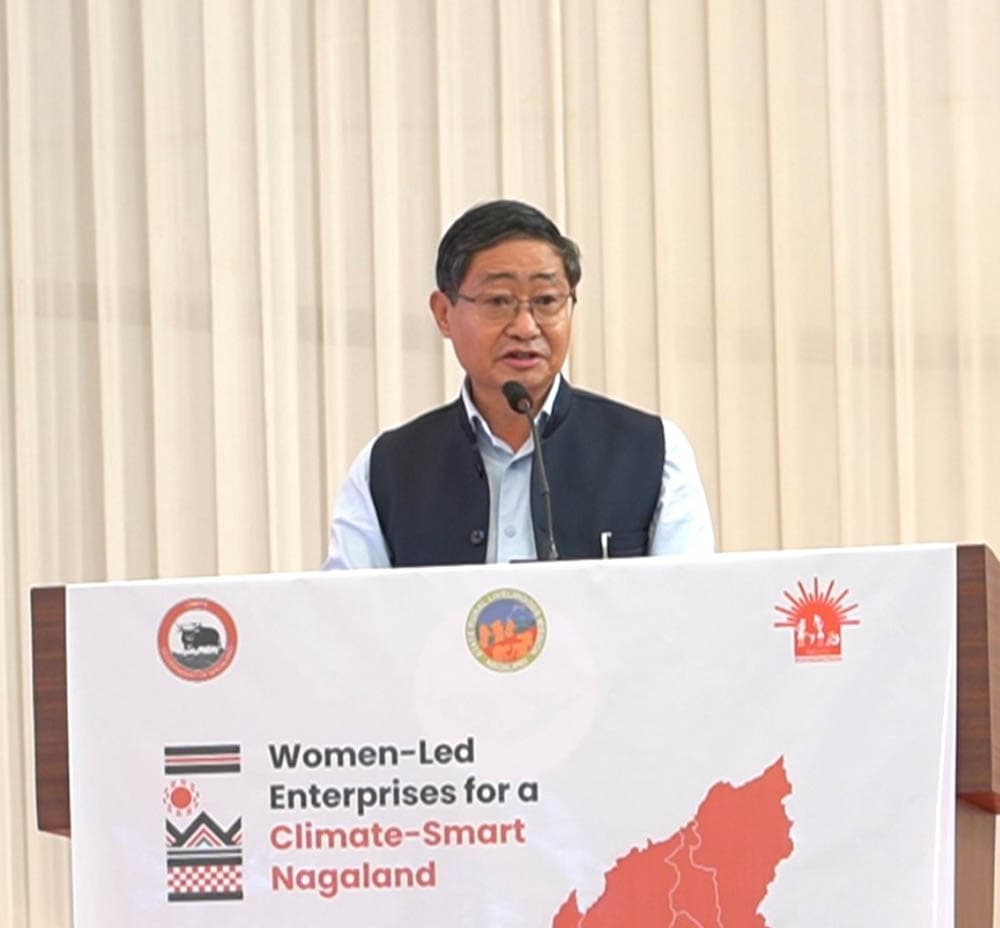
KOHIMA — Chief Secretary Sentiyanger Imchen on Friday said that empowering rural women with clean energy technologies, financial inclusion and market access will be critical to building a climate-smart and resilient rural economy in Nagaland.
Addressing the inaugural session of Trade Facilitation Fair organised by Nagaland State Rural Livelihoods Mission (NSRLM) in collaboration with SELCO Foundation at the NBCC Convention Centre in Kohima, Imchen maintained that women-led enterprises would be central to Nagaland's transition towards sustainable and low-carbon development.
He said that Nagaland's traditional strengths in agriculture, weaving, food processing, livestock rearing and other livelihood activities must now be complemented by innovation and climate-smart technologies to remain viable in the face of changing climatic conditions.
"The future of our rural economy lies in enterprises that are innovative, resilient and sustainable. Rural women have always been at the heart of Nagaland's economy, and empowering them with technology, finance and market access will enable them to become leaders of sustainable development," he said.
Drawing attention to the impact of climate change, Imchen pointed out that changing rainfall patterns and erratic monsoons have begun affecting agricultural cycles across the state.
"Many farmers have seen their crops germinate and then wither because the expected rains did not come. Sowing, which earlier began in April, is now often delayed until June," he said, adding that global warming has increased the frequency of extreme weather events.
Highlighting the progress of Self-Help Group (SHG) movement under NSRLM, the chief secretary said that more than 1.17 lakh rural households have been mobilised into 15,445 SHGs across 1,231 villages covering all 17 districts of the state. These groups have further been federated into Village Level Organisations and Cluster Level Federations, creating a strong foundation for community-led development.
However, he said that many rural entrepreneurs continue to face barriers in accessing modern technology, finance, markets and business support. "It is our collective responsibility to create an enabling ecosystem that helps them transform their skills and available resources into sustainable and successful enterprises," he added.
Referring to the partnership between NSRLM, SELCO Foundation and financial institutions, Imchen described the initiative as timely, saying clean energy technologies such as solar-powered dryers, grinders, cold storage units and decentralised renewable energy systems could reduce post-harvest losses, improve product quality, lower production costs and create employment opportunities in rural areas.
He also called on banks and financial institutions to strengthen credit support for women entrepreneurs, saying access to finance is as important as access to technology.
"I would be failing in my duty if I fail to mention the State Bank of India, Nagaland Rural Bank and Nagaland Cooperative Bank, who are present here today, and urge them to provide the necessary credit that is crucial for establishing new enterprises and expanding existing ones," he said.
Speaking at the event, SELCO Foundation Director Huda Jaffer said that development interventions must be designed with future challenges in mind rather than relying on conventional approaches.
She stressed the need for need-based interventions and customised solutions for rural communities instead of adopting a one-size-fits-all approach.
"A million farmers need a million different solutions. Development cannot be one-size-fits-all. We look forward to working together to design solutions based on the needs of communities and ensure that today's discussions translate into meaningful action on the ground," she said.
The event also featured a panel discussion moderated by Rachitra Misra, Associate Director of SELCO Foundation, with Minha Khan, Project Lead, PRIME-Rural Meghalaya, and women entrepreneurs sharing experiences on strengthening climate-smart rural enterprises.