Wildfires spread, fanned by strong winds, in South Korea's s
Wildfires spread, fanned by strong winds, in South Korea's southeastern region as death toll climbs to 24
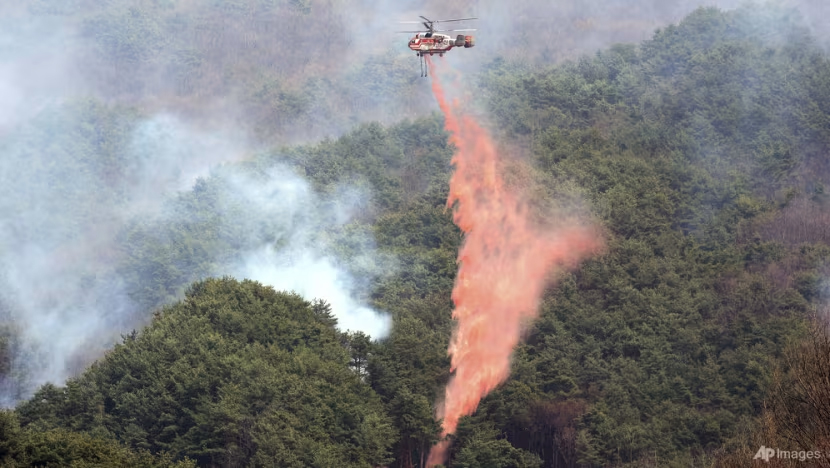
Scores of firefighting helicopters, about 5,000 personnel and some 560 pieces of equipment were mobilised to contain a wave of wildfires that tore through South Korea's southeastern region
Firefighters extinguish a fire at a factory building that
was engulfed in a wildfire in Uiseong, South Korea, Mar 22, 2025. (Photo:
AP/Yonhap/Yoon Gwan-shick)
SEOUL — Firefighters were scrambling on Wednesday to contain a wave of
wildfires that tore through South Korea's southeastern region and killed at
least 24, but strong winds and dry weather have continued to hamper efforts to
limit the spread of the flames.
Scores of firefighting helicopters, about 5,000 personnel
and some 560 pieces of equipment were mobilised, but the wildfires that began
in Sancheong County in South Gyeongsang Province last Friday have spread across
the region's northeast.
For five days, the fires have spread to nearby Uiseong
and were advancing to neighboring Andong, Cheongsong, Yeongyang, and Yeongdeok.
Of the 24 victims from the wildfires, 20 were found in
Uiseong and four were from Sancheong as of 4 p.m., according to data from the
Central Disaster and Safety Countermeasures Headquarters.
Police and fire authorities earlier tallied 21 deaths in
the northern part of North Gyeongsang Province: two in Andong, three in
Cheongsong, six in Yeongyang, and seven in Yeongdeok.
The wildfires are at risk of spreading further to eastern
coastal regions due to the strong winds, raising concerns the flames could
reach the coastal county of Uljin, home to a major nuclear power plant.
A forestry official urged caution against unpredictable
factors, such as sudden shifts in the wind direction, noting that while the
Uiseong wildfires initially spread eastward, southerly and southwesterly winds
were observed on Tuesday and Wednesday.
In Yeongyang, four of the five victims were found burned
to death on a road at around 11 p.m. on Tuesday.
On Wednesday, acting President Han Duck-soo called for
all-out efforts to help prevent the further spread of the deadly wildfires,
describing them as "the worst ever wildfires."
So far, the wildfires have destroyed 17,000 hectares of
forest and 209 houses and factories, Han said.
The engulfing flames destroyed Goun Temple in Uiseong, an
ancient temple built in 681 during the Silla Dynasty (57 B.C.-A.D. 935).
National treasures stored in the temple had been relocated to other locations
earlier.
Earlier in the day, a firefighting helicopter crashed in
Uiseong while battling a large wildfire in the country, killing the pilot.
The North and South Gyeongsang regions are home to
numerous historical and cultural assets, including national treasures.
With the blazes showing signs of drawing closer, tensions
were again rising around Hahoe Folk Village in Andong, Yonhap news agency
reported.
Authorities said the wildfire has advanced to within just
5 kilometers of Hahoe Village and plan to deploy two firefighting helicopters
as a preemptive measure.
Hahoe, about 190 km southeast of Seoul, is one of the
most famous and popular folk villages in South Korea and was listed by UNESCO
as a World Heritage site in 2010. It preserves houses and traditions from the
Joseon Dynasty (1392-1910).