[caption id="attachment_261470" align="aligncenter" width="500"]
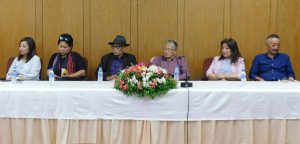 Members of FNR during the informal interaction with people from different walks of life, in Kohima on July 20.
[/caption]
“Our social and cultural behaviour points out the fact that Naga men and women are not liberated...We are victims of the past.”
Our Correspondent
Kohima, July 20 (EMN): With an aim to empower people’s participation in the Nagas’ journey of common hope, Forum of Naga Reconciliation (FNR) conducted an informal interaction programme at Hotel Japfü, in Kohima on July 20. It was a part of ‘Walking the Naga Day’ process since FNR celebrated Naga Day on January 10, 2018.
People from different walks of life came together and deliberated on issues concerning Naga peace process and loopholes along the way. People expressed their perspective and suggested possible ways to achieve the common goal.
Author Visier Sanyü observed that the division between various factions and the Nagas of Nagaland and those other states and country has become “very deep.” He felt that Nagas of Nagaland do not understand the Naga issue.
On the Framework Agreement (2015), Sanyü said that “a solution will not come but some form of agreement will come.” Stating that many agreements had been signed in the past, he pointed out that Framework Agreement is going to be exactly the same.
“It is going to be an agreement which we hope or I hope that it will give us a space to think for the next generation,” Sanyü observed.
He felt that the Naga society is “too divided” and unless we come up with “refreshing and new ideas” to tackle the issue, it cannot be solved. “Unless we change, our nation will not change,” he added.
Peace activist Niketu Iralu observed that the peace process of the Nagas have been “damaged” along the way because of greed. “Our agenda has become so conflicting that the ship is in danger of sinking,” he said.
“If we want nothing for ourselves but want what is right and best for the people, for neighbour, and for the world; that is the right battle, as it becomes God’s battle not our battle. If we do that we will have a chance to make ourselves survivable people and nation,” he observed.
He said that every person see the struggle from different perspectives and “we are blaming one another for what we have not yet achieved.” He urged the people to understand what has been achieved already and appreciate one another’s contribution. Most of all, it is important to continue the journey, Iralu added.
Convenor of FNR Dr. Wati Aier said that the reason behind the Naga Day is to continue the process of walking the Naga Day. The goal of reconciliation, he said, was to achieve “liberation” from everything other than the psychological aspect. He felt that Nagas need to be liberated.
“Our social and cultural behaviour points out the fact that Naga men and women are not liberated. We are victims of the past” and of many things, he said. Therefore, reconciliation must take place in every layer among the Nagas, he added.
He called upon different organisations, hohos, societies, groups, and individuals to go beyond their walls and respond to the greater calling, that is, the Naga issue. “Naga interest is the interest of all,” he added.
Saying that peace process is not limited to FNR, he said that one should support and applaud any organisation or hoho that is able to initiate the process.
Author and Proprietor of The Morung Express, Dr. Aküm Longchari in his concluding remark spoke about the importance of considering others’ perspective towards the Naga reconciliation process. He was of the view that Nagas have lost sense of direction and seemed anchorless.
“Can the church be the place for truth-telling” for without telling the truth, forgiveness is not possible, Longchari said while responding to a query raised by a church leader. He said that it is very difficult for forgiveness to come out alive because “we are comfortable in our own cocoons.”
It’s time Nagas start talking about issues, he said, adding that Nagas are faced with the crisis of foundation and the crisis of credibility.
The three Rs -- reconciliation, reconstruction, and rebuilding -- are the three pebbles that will hold the society together. Walking the Naga Day is a new phase of FNR and the approach of reconciliation is from the point of social transformation, he said. The process of walking the Naga Day is a reflective process for the FNR as well, so as to avoid the same mistake in the future, he added.


