


Vipin Arya explains agripreneurship, career pathways, AI, startups and opportunities for students in agriculture and the Northeast.

DIMAPUR — Drawn to understanding why agriculture graduates often preferred government jobs over business, entrepreneurship or startups despite the availability of lucrative government schemes such as the AC&ABC Scheme and the RAFTAR programme, Vipin Arya found his calling during his graduation.
Curious to understand the reasons behind this trend, he chose to experience the entire educational and professional journey himself, pursuing an MBA in Agribusiness after completing his B.Sc. (Hons.) Agriculture. While he did not initially have a clear career goal or envision becoming an academic, it was the journey itself, including the struggle to secure a job after his MBA, that shaped his path.
Currently serving as an assistant professor in the Department of Vocational Studies and Skill Development, School of Agricultural Sciences, Nagaland University, Medziphema, Arya teaches entrepreneurship, agribusiness management and skill development under the M.Voc. Entrepreneurship programme.
He completed his Class 10 from Satluj Public School, Ellenabad, and Class 12 from TDBS Secondary Model School, Hisar; earned his B.Sc. (Hons.) Agriculture and MBA in Agribusiness Management from Chaudhary Charan Singh Haryana Agricultural University, Hisar; cleared the UGC-NET in 2020 on his first attempt; and is about to complete his Ph.D. in Agribusiness Management from North-Eastern Hill University, Tura Campus, Meghalaya, where his research focuses on the value chain analysis of Kinnow Mandarin in Haryana.
Before joining Nagaland University, Arya worked with organisations including the National Cooperative Development Corporation, Symbiosis International University, North-Eastern Hill University, Ninjacart, Sonipat Mushroom Farmers Producer Company, WAPRO (Partners in Prosperity), Vasudev Hi-tech Dairy Farm, ICAR-NDRI and the Haryana State Seed Certification Agency, gaining experience in agribusiness marketing, Farmer Producer Organisations, value chain development, agricultural extension, research, project management and corporate engagement. His research interests span agripreneurship, agricultural value chains, agricultural marketing, digital agriculture, artificial intelligence in agriculture, technology adoption and rural entrepreneurship.
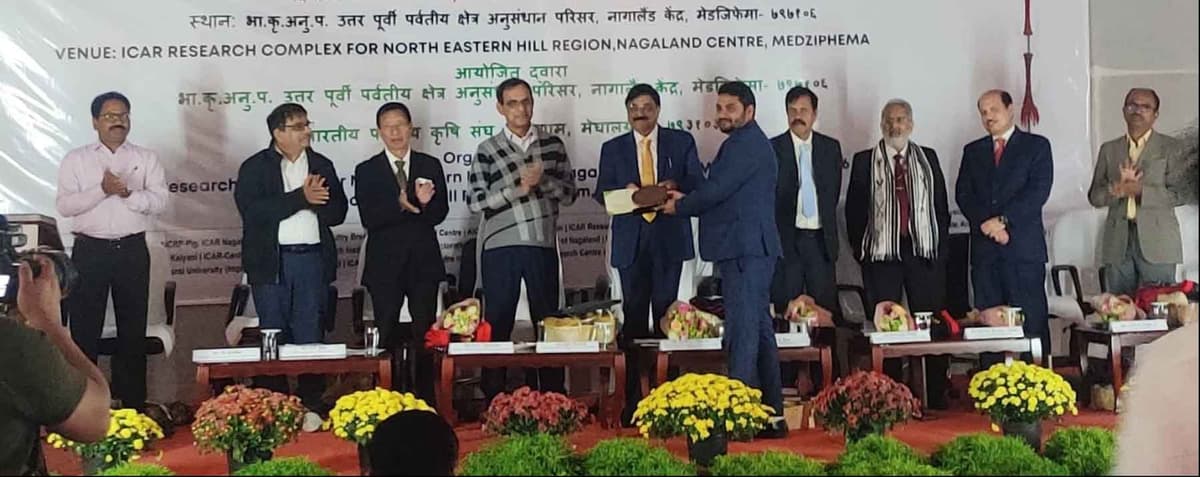
He has published research papers, authored book chapters and articles, presented at national and international conferences, and received the Best Poster Presentation Award at a national conference organised by IAHF and ICAR Research Complex for NEH Region, Nagaland, in 2024. Alongside academics and research, he regularly conducts training programmes, workshops and mentoring sessions for students, farmers, startups and aspiring agripreneurs, believing that agriculture has immense potential to create employment and sustainable livelihoods through innovation, entrepreneurship and emerging technologies.
In this interview with Eastern Mirror, Arya speaks about opportunities that entrepreneurship offers in agriculture.
For students who are unfamiliar with the term, what is agripreneurship?
In layman's terms, doing entrepreneurship in agriculture is agripreneurship. More precisely, solving agricultural sector issues through innovative ideas is agripreneurship. The best example is adoption of precision farming, which helps in saving agricultural input and decreasing the cost of production.
What are the different areas within agripreneurship that students can explore?
Value chain management and development, supply chain management, warehouse management, agricultural input management, precision farming, hydroponics practice, e-commerce of agri-commodities, export of indigenous agri-commodities, off-farm local signature products, etc.
Is it necessary to have agricultural land or come from a farming family to succeed in agripreneurship?
No, startups like Ninjacart, Bigbasket, Dehaat, Fyllo, Fasal, etc. are solving farmers' problems with their unique solutions for which they are charging money. But to get started with agripreneurship, it is necessary to understand the problem. The problem can be small or big, but the economic viability of the agripreneurship depends on the volume of the problem.
What technical and business skills are equally important for a successful agripreneur?
To be a successful agripreneur, an individual must have innovative ideas, risk-taking capability, leadership, a learning attitude, networking skills, effective communication, team management, be updated with new tech and trends in the market, and have acceptance for criticism and conflict management. Talking about technical skills an agripreneur must have computer skills especially MS Office to prepare data sheets, make dashboards, prepare DPRs and presentations, use AI, and have knowledge of rules and regulations related to business, organisation mandates and formalities, HR management, etc.
Which colleges, programmes, or vocational courses would you recommend for students interested in this field?
If you are aiming for high-profile roles in this sector, I would recommend pursuing an MBA in Agribusiness from institutions such as IIM Ahmedabad; IIM Lucknow; MANAGE, Hyderabad; CCS National Institute of Agricultural Marketing (CCS NIAM), Jaipur;
Symbiosis, Pune; or ISAB, Noida.
If you are planning to start your own venture, you can consider programmes such as the PGDM in Entrepreneurship at EDII Ahmedabad, the M.Voc. in Entrepreneurship at Nagaland University, or the M.Voc. in Entrepreneurship and Trade at Manipur University.
How can digital platforms and e-commerce help young agripreneurs reach larger markets?
Digital platforms such as E-NAM, Agmarknet, DeHaat, Ninjacart, BigBasket, and Reliance Fresh provide young agripreneurs with access to wider markets. These platforms also offer valuable information on market trends, prices, reports, and research, helping entrepreneurs better understand the market and make informed business decisions.
What role do communication, marketing, and financial management play in running an agricultural enterprise?
These three are imperative pillars of any agricultural enterprise. The agriculture market largely depends on strong networks, access to information, and an organisation's reputation and portfolio.
Which agribusinesses can young entrepreneurs start with relatively low investment?
A plant nursery is a low-investment agribusiness with a high potential for returns, provided it is managed consistently and with discipline. Vermicompost and farmyard manure production are also low-cost ventures, as most of the raw materials are sourced from farm waste. In addition, there are agribusiness opportunities that require little to no investment, such as agribusiness consultancy, placement agencies, and career counselling.
How can students identify real problems in agriculture and turn them into successful business ideas?
Students should travel and spend time at agricultural hubs such as farms, APMC mandis, local mandis, weekly markets, production units, and processing plants. A classic example is Mr. Thirukumaran Nagarajan, CEO and Co-founder of Ninjacart. He spent a long time at Azadpur Mandi in Delhi, the largest fruit and vegetable market in India. He even slept inside the mandi on many nights to understand the gaps in the market.
Later, he identified a significant problem and developed a solution, which became Ninjacart. The company provides a B2B supply chain service that connects farmers directly with kirana stores and restaurants. By using purpose-built technology to streamline logistics, warehouse operations, and quality checks, Ninjacart has reduced farm-to-store delivery times to under 12 hours.
Which technologies do you think every aspiring agripreneur should learn about?
AI in agriculture, precision farming, blockchain, IoT, drones and remote sensing, farm management software, climate-smart technologies, etc.
How is artificial intelligence (AI) transforming agriculture and creating new opportunities for young agripreneurs?
Every year, nearly 50% of agricultural produce in our country is lost due to post-harvest losses. This itself shows the huge potential of the market. AI is capable of analysing large volumes of data and providing valuable insights, making it easier to take timely and informed decisions. However, we need innovative minds to harness and utilise the full potential of AI.

Which government schemes, incubation centres, and funding opportunities should aspiring agripreneurs know about?
Aspiring agripreneurs should be aware of several government schemes, incubation centres, and funding opportunities that can help them start and grow their ventures. The Agri-Clinics and Agri-Business Centres (ACABC) scheme by MANAGE provides training along with credit-linked subsidies for eligible entrepreneurs. The RKVY-RAFTAAR Agri-Business Incubation (R-ABI) programme offers incubation support, mentoring, and startup funding. Startup India and Stand-Up India provide startup recognition, tax benefits, mentoring, and easier access to finance.
NABARD also offers various schemes that support farmer producer organisations (FPOs), rural entrepreneurship, and agri-enterprises. The PM Formalisation of Micro Food Processing Enterprises (PMFME) scheme promotes food processing and value addition, while the Agriculture Infrastructure Fund (AIF) provides financing for warehouses, cold storage facilities, and other farm infrastructure. In addition, MSME support programmes assist entrepreneurs engaged in manufacturing, food processing, and business development.
For business incubation, India has several agri-incubation centres that support startups through mentoring, networking, and access to resources. Besides these, the Department of Science and Technology (DST) and the Department of Biotechnology (DBT) have established their own business incubation centres. The Atal Incubation Centres also play a significant role in promoting entrepreneurship and nurturing innovative startups across the country.
What are the biggest mistakes first-time agripreneurs make, and how can they avoid them?
The most common mistake is starting with a product or service instead of identifying a market need. Many new agripreneurs focus on production without securing buyers first.
Other common mistakes include a lack of proper business planning and budgeting, ignoring market research and customer preferences, depending on a single crop or income source, poor financial record-keeping, underestimating climate and production risks, and failing to adopt appropriate technologies.
These mistakes can be avoided by conducting market surveys, preparing a business plan, starting on a manageable scale, maintaining accurate financial records, diversifying income streams, and continuously learning through training and mentorship.
What unique agripreneurship opportunities do you see in Nagaland and the Northeast?
Nagaland and the Northeast possess exceptional natural resources, rich biodiversity, and indigenous knowledge that offer tremendous potential for agribusiness. The region has strong opportunities in organic farming and certified organic products, as well as the cultivation of high-value spices such as Naga King Chilli, turmeric, and ginger. There is also significant scope for medicinal and aromatic plants; beekeeping and speciality honey production; mushroom cultivation; bamboo-based enterprises; fruit processing and value addition; piggery; poultry; fisheries; floriculture; and ornamental plants.
The region can also benefit from eco-tourism integrated with agriculture and the digital marketing and export of its unique regional products. Instead of competing in commodity markets, the Northeast should focus on premium, niche, and value-added products that capitalise on its distinct identity, rich biodiversity, and traditional knowledge.
If a Class 10 or Class 12 student wants to become an agripreneur, what roadmap would you suggest over the next five years?
If a Class 10 or Class 12 student wants to become an agripreneur, I would suggest a five-year roadmap that combines learning with practical experience.
In the first year, the focus should be on building a strong foundation in agriculture, biology, business, and digital skills. Students should visit farms, attend workshops, and begin learning about entrepreneurship to understand how the sector works.
In the second year, they should gain practical experience through internships, school projects, or volunteering with farmers and agri-enterprises. This is also the right time to learn the basics of financial management and digital marketing.
In the third year, students should pursue higher education or vocational training in agriculture, horticulture, food technology, agribusiness, or related fields. They should also familiarise themselves with emerging technologies such as AI, IoT, drones, and precision agriculture.
In the fourth year, they should participate in startup competitions, hackathons, and incubation programmes. This will help them develop a business idea, prepare a business plan, and validate it with potential customers.
In the fifth year, they should launch a small pilot enterprise, apply for government support and funding schemes, seek mentorship, and gradually scale the business based on market feedback.
Throughout this journey, students should focus on continuous learning, networking, and developing problem-solving and leadership skills.
What is the one message you would like every student to remember about building a career in agripreneurship?
Agripreneurship is no longer just about farming—it is about solving real-world problems through innovation, technology, and sustainable business. Agriculture today offers opportunities in food processing, digital agriculture, biotechnology, logistics, exports, and climate-smart solutions.
The future belongs to those who can combine scientific knowledge, entrepreneurial thinking, and a commitment to sustainability. Instead of asking, "Can agriculture provide me with a career?" ask, "What problem in agriculture can I solve?" The entrepreneurs who create value for farmers, consumers, and the environment will build the most successful and impactful businesses.
RAPID INSIGHTS
One startup from the agriculture sector you admire?
Fyllo: It is a precision farming startup. They provide a set of IoT devices to make timely decisions for every operation of the agricultural farm from land preparation to harvesting, which saves a lot of money, energy and time of the farmers.
If you weren't a professor, what would you be?
Business consultant and standup comedian.
If you could solve one challenge facing Indian farmers overnight, what would it be?
Wise utilisation of each and every tangible and intangible resource used by farmers.