Alice Yhoshü
Kohima, March 8: Two cubs belonging to the Asian black bear (Ursus thibetanus) family, also known as the moon bear, Asiatic black bear and white-chested bear, were recently rescued in the jungles of Sendenyu village under Kohima district. The Asiatic black bear is classified as vulnerable by the International Union for Conservation of Nature (IUCN), mostly because of deforestation and hunting for its body parts.
[caption id="attachment_101937" align="alignleft" width="169"]
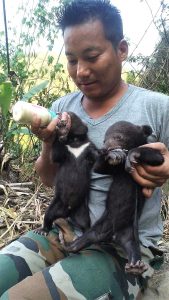 A youth volunteer of the community conservation of Sendenyu village feeding goat-milk to the recently rescued Asian black bears from the village forests.
[/caption]
The rescued cubs, weighing around 3-4 kg, were said to have been found by woodcutters during the first week of March. Upon hearing the news, youth volunteers of the Sendenyu Community Biodiversity & Wildlife Conservation Committee reportedly took over custody of the cubs.
“For two nights we left them where they were found in the jungle but the mother bear did not return, so we are taking care of them for now. The cubs are being fed with goat milk as they are very young. Once they grow bigger, we plan to let them go in the reserve forest,” a volunteer said. Stating that the nearby jungles have been a habitat for the Asian black bears for a long time, the volunteer expressed concern that deforestation is chasing the species away.
The Sendenyu village, under Kohima district, conserves about 22 sq km of the forest around the village, and is gaining popularity with environmentalists with the village’s community conservation efforts.
In 2015, the Sendenyu Community Biodiversity & Wildlife Conservation Committee called a public meeting with its three associate villages wherein it was decided that an indefinite ban on hunting in the village land would be imposed. The village’s avid efforts in conservation which spans for the last 15 years or so, reportedly saw a visible migration and increase in wildlife population in the neighbouring village areas where, until the recent past, were almost thought to have gone extinct.
The Asian black bear species is morphologically considered very similar to some prehistoric bears, and is thought by some scientists to be the ancestor of other extant bear species (aside from pandas and spectacled bears). Adult Asiatic males weigh 60–200 kg (130–440 lb) with an average weight of about 135 kg (298 lb). Adult females weigh 40–125 kg (88–276 lb), and large ones up to 140 kg (310 lb).
Although the black bear is protected in India, after being listed as vulnerable in the Red Data Book in Appendix I of CITES in India and in Schedule I of the Indian Wildlife (Protection) Act and its 1991 amendment, it has been difficult to prosecute those accused of poaching black bears due to lack of witnesses and lack of Wildlife Forensic Labs to detect the originality of confiscated animal parts or products.
Moreover, due to India's wide stretching boundaries with other nations such as Pakistan, Tibet, China, Nepal, Bhutan, Bangladesh and Myanmar, it is reportedly difficult to police such borders, which are often in mountainous terrains.


