[caption id="attachment_147291" align="alignnone" width="500"]
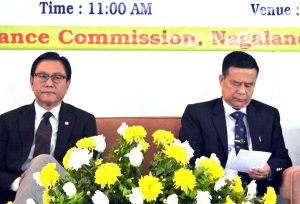 (L-R) Vigilance Commissioner KT Sukhalu and DIGP for Vigilance I Meyionen. (EM Images)
[/caption]
Health, School Education, PWD tops list
Our Correspondent
Kohima, Oct. 30 (EMN): The State Vigilance Commission (SVC) of Nagaland has recovered funds amounting to Rs.1,79,85,661 during investigations and has ‘disposed’ 35 cases during the past one year, from November 2016 till October 2017.
This was revealed by DIGP for Vigilance and Anti-Corruption Police, I Meyionen, during a Vigilance Awareness Week programme on Monday at the SVC’s office in Kohima town. Highlighting the achievement of the commission during the past one year, the official said 83 cases were currently under investigation while 18 were under trial in the court.
According to the official, the department of Health and Family Welfare had the highest number of cases under investigation (15 cases out of 83) while School Education and PWD had 10 each; Rural Development nine, the police dept. five, the Transport dept. four; PHE, Taxes, Power and Irrigation and Flood Control with three each; and Municipal Affairs had two cases.
Meyionen disclosed that during said period, three cases under the PWD (Roads and Bridges) department and Irrigation and Flood Control, and concerned with incomplete work / abandoned projects, were completed after investigation. He informed that one person has been terminated from service while 14 persons have been served with an ‘administrative warning’ so far.
On the issue of fraudulent drawing of pension, he said eight claims were proved genuine while four cases were found to be bogus. Reports of investigation were submitted to the AG office for necessary action, it was informed.
The SVC has listed recommendations to 13 departments; seven have accepted while the others are pending, it was learnt.
Govt. and public equally responsible for corruption
Delivering the keynote address during the occasion, Vigilance Commissioner KT Sukhalu candidly asserted that corruption was not a new phenomenon in the Naga society. He blamed both the public and the government of being ‘equally responsible’ for the ‘mass corruption of Nagaland’.
The official said there used to be a time when the state was unable to utilize all the funds allotted to it. But today, he said, the state’s debt has risen to a level where insufficient funds chronically debilitate the state’s policy implementation. “The underlying cause is the fact that the Naga conscience is no longer able to withstand Naga dishonesty,” Sukhalu pointed.
“Corruption is an all pervasive issue; we have all come face to face with corruption... At the most basic, we have either offered a bribe or have been offered a bribe at some point of our social life,” the official stated. He lamented that people have started seeking ‘shortcuts’ even to the extent of circumventing the system: bribing just not to take a chance in competitive exams or not to take a chance on an open tender bid etc. “Bribery has become such an accepted norm that we now officially call it ‘commission’ and commissions are openly demanded by bureaucrats, politicians, various organizations, even RTI applicants are misusing it for individual gains,” he said.
The official lauded social organisations including the churches for creating awareness on the importance and the long-term impact of clean elections. The general perception of the public believes that the root of corruption lies in elections, Sukhalu said. However, he maintained, the fight against corruption should be taken beyond the electoral process, and into ‘the daily habits of the citizens.’
The official was of the view that if the society had pursued a ‘higher degree of morality’ then that value would automatically ‘transfer it into the government.’
He noted that people suggest more stringent rules and laws to fight corruption. But, he said, legislations and laws can not correct the social menace unless citizens are willing to correct themselves first. He pointed out that corruption was not confined to backdoor appointments and multi-crore scams. It includes bribery, cheating, submission of false completion certificates by VDBs and village councils for development projects etc., and so on at the community and citizens’ level
He added that a corruption-free Nagaland cannot be brought about by legislation but by bold and determined efforts of the public.
On the improvement of the prevailing system, he suggested that judiciary should be given more independence and be proactive on issues related to corruption; special courts be set up to tackle corruption issues and speedy trials be held; allow law and order machinery to work without political interference.


