


The Dimapur District Congress Committee questioned the VB-G RAM G Bill’s 125-day job promise, saying Nagaland struggles to provide even 10 days under MGNREGA.
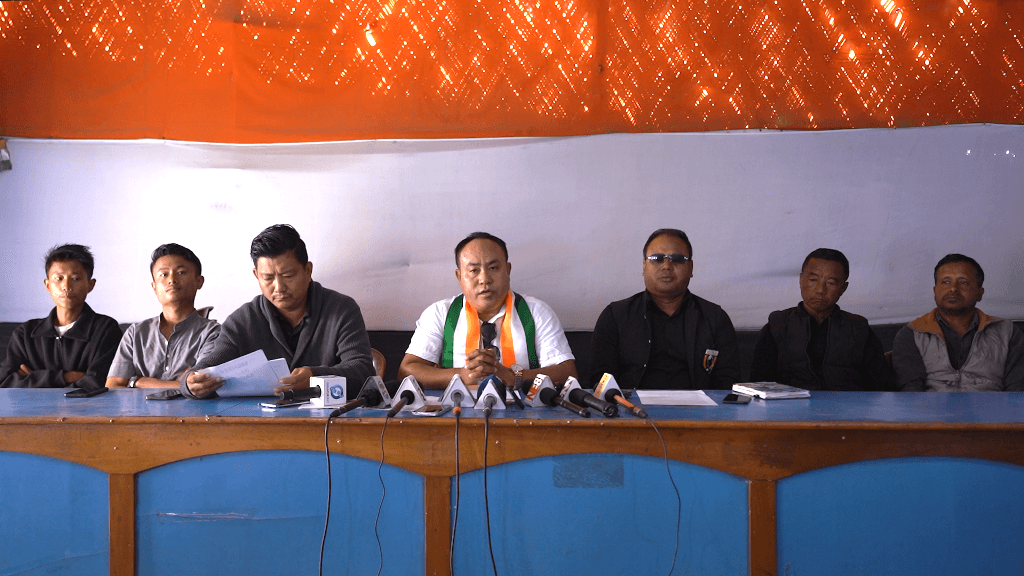
DIMAPUR — Questioning the feasibility of the Centre’s promise of 125 days of employment under the Viksit Bharat–Guarantee for Rozgar and Ajeevika Mission (Gramin) (VB-G RAM G) Bill, the Dimapur District Congress Committee (DCC) on Saturday said Nagaland has been unable to provide even 10 days of work under the existing MGNREGA.
Addressing a press conference at Congress Bhavan here, district party general secretary Kumjimong said the 125-day guarantee under the new Bill “looks good on paper” but was disconnected from the ground reality in Nagaland, where even the existing 100-day guarantee has not been fulfilled.
He said the VB-G RAM G Bill undermines the legal right to work, which was a crucial aspect of MGNREGA aimed at uplifting rural communities. He alleged that the new legislation centralises implementation and increases the financial burden on states, as they would now have to share costs that were earlier borne by the central government.
Kumjimong expressed concern that the proposed 90:10 funding pattern would strain the state government’s finances, as Nagaland would now need to contribute 10% towards wages. Previously, the central government covered 100% of the wage component. Given Nagaland’s experience with similar funding models, he said the party was sceptical about the state’s ability to meet these obligations, which could directly impact workers.
He further alleged that the VB-G RAM G Bill prioritises asset creation over providing jobs to the vulnerable, with projects and locations to be decided by the Centre rather than based on people’s needs. Under the present system, he said, village councils identify and upload work requests, but this decentralised mechanism would be weakened under the new Bill.
Also read: Two NSCN-K (Ang Mai) cadres killed in alleged mortar attack in Myanmar
“Earlier, every village had work but that’s changing. Now the Centre will decide where work happens and who gets it,” he said, questioning whether opposition areas could be sidelined.
Kumjimong also questioned the Centre’s ability to implement the scheme, stating that while the Bill speaks of 125 days of employment, the state has been unable to ensure even 100 days of wages. He alleged that the central government owes over INR 100 crore towards material costs and that wage payments are also pending.
The press conference was held as part of the Congress party’s ongoing 45-day protest against the renaming and restructuring of MGNREGA, which began on January 8.
DCC president Kutoho Chishi said MGNREGA has been a lifeline for rural India, guaranteeing 100 days of wage employment and empowering workers. He alleged that the VB-G RAM G Bill could water down the scheme by limiting job guarantees, reducing funding commitments and altering implementation mechanisms, thereby raising serious concerns about rural employment.
Chishi said the party was highlighting how the new Bill could harm rural jobs, income and stability in Nagaland and across the country. He said the Congress was raising awareness about preserving worker protections under MGNREGA, which he said were rooted in constitutional values, and was pushing for withdrawal of the Bill and restoration of MGNREGA in its original form.
He urged the central government to reconsider the legislation and engage with stakeholders to protect the interests of rural workers. Chishi also invited residents of Dimapur and other parts of Nagaland, civil society organisations and concerned citizens to participate in protest programmes scheduled from January 31 to February 6, including panchayat-, ward- and district-level dharnas.
Chishi further alleged that workers’ dues were being siphoned off in the state, with officials demanding cuts from beneficiaries’ wages, and said standing up for MGNREGA was essential to protect the dignity and livelihood security of rural workers.
DCC general secretary (media) Andrew Humtsoe outlined what he described as four major ways in which the new Bill threatens the right to work. He said the guaranteed 100 days of employment under MGNREGA was being scrapped, making employment discretionary rather than a legal entitlement.
He said the Bill would also limit work availability to select areas chosen by the government, unlike the earlier system where work was available in every village. This, he said, could exclude many rural households from employment opportunities.
Humtsoe raised concerns over wages, stating that workers who earlier could demand work throughout the year might now be denied employment during critical periods such as the harvest season. He also alleged that the Bill allows the government to arbitrarily fix wages, doing away with the existing minimum wage guarantee.
On Panchayati Raj institutions, he said village councils would lose control over work projects, with the government deciding where and when work would take place. He alleged that this could favour select contractors, and added that support systems such as MGNREGA Mates and Rozgar Sahayaks would also be scrapped.
On state finances, Humtsoe said the new funding pattern would place additional pressure on states. Earlier, he said, the Centre covered 100% of MGNREGA wages, but under the new Bill states would be required to contribute 40%, and 10% in the case of hill areas. To cut costs, he warned, states might limit or deny work.